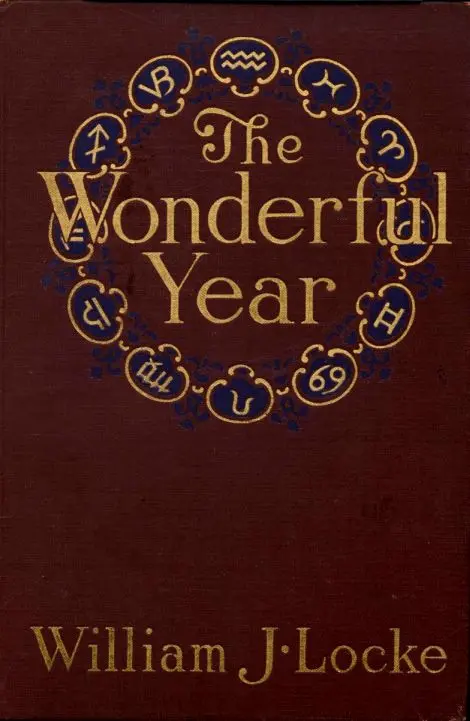
The Wonderful Year
William John Locke
THE CLASSIC COLLECTION · 1897
"Derelicts" by William John Locke is a novel written in the late 19th century. The book explores themes of isolation, redemption, and the search for connection through its lead character, Stephen Joyce, a man grappling with the shame of his past as a former convict. Since his release, he navigates the harsh realities of life as he attempts to reclaim his place in society while yearning for friendship and understanding. The opening of the novel introduces Stephen Joyce as he sits despondently on the steps of a grand but deserted house in Holland Park, a poignant symbol of his lost past. We learn about his former life, filled with promise and affection, which has been shattered by his time in prison. Despite his self-loathing, a glimmer of hope emerges when he unexpectedly encounters Yvonne Latour, a former friend who recognizes him and offers her friendship. Their interaction showcases Joyce's internal struggle, juxtaposed against Yvonne's warmth and kindness, setting the stage for a complex exploration of guilt, desire for redemption, and the power of human connection as the story unfolds.
Introduction adapted from the source catalogue; source summaries may be automatically generated.
Free to read · English · 78,249 words · No account needed
MAKE TIME FOR A GOOD BOOK
On by default. Untick to stop anonymous reading totals. Each page counts after 10 seconds in view. How this works.
Anonymous counting is on unless you have switched it off.
“I mustn’t keep the Bishop waiting,” he said.
“Nor I, Mrs. Winstanley.”
They joined the group, where Yvonne received her congratulations and compliments with childish pleasure. In a few moments they separated, and the Canon drove off, regarding the Bishop by his side with uncanonical feelings.
Late that evening Vandeleur was smoking a cigarette in Miss Vicary’s hotel sitting-room. As Yvonne’s friends, they had been dining with Mrs. Winstanley. Vandeleur was charmed with her urbanity, and sang her praises with Celtic hyperbole.
“I should n’t trust her further than I could see her,” said Geraldine. “She hangs up her smile every night on her dressing-table.”
“Just hear a woman, now,” said the Irishman.
“Yes, just hear a woman,” retorted Geraldine, sarcastically. “I suppose you think she loves Yvonne, don’t you?”
“Of course I do. I’m sure she’s thinking how sweet she is this very
minute.”
“She would like to be poisoning Yvonne this very minute.”
“Well, I’m blest!” exclaimed Vandeleur, letting the match die out with which he was preparing to light a fresh cigarette. “It takes a woman to imagine gratuitous devilry!”
“And it takes a man to absorb himself in his dinner to the besotting of his intelligence! But I have eyes. And a logical mind--don’t tell me I have n’t. Now, hitherto, Mrs. Winstanley seems to have been the central figure in this wretched little provincial society. Who is, at the present moment?”
“Sure, it’s yourself, Geraldine--the great soprano from London.”
She did not condescend to notice the flattery.
“It’s Yvonne. I bet you she’s the most-talked-of person in Fulminster this evening. And Mrs. Winstanley the sickest. Oh, how dull men are! What is all this Festival, really, but the apotheosis of Yvonne?”
“It’s the canonisation of Yvonne, I should say,” remarked Vandeleur,
drily.
Miss Vicary’s expression relaxed, and she leaned back in her chair.
“You’re not such a fool, after all, Van.”
“So I ’ve been told before,” he replied, with a chuckle. “Anyhow, it will be a splendid thing for the dear child.”
“Oh, how can it be? I have no patience with you!”
“That’s obvious,” said Vandeleur.
“Yvonne would give any man her head, if he whimpered or clamoured for it,” Geraldine, rising to her feet, “and then tell you in her pathetic way, ‘but he wanted it so, dear.’ And there isn’t a man living who could be good enough to Yvonne!”
“There I agree with you,” said Vandeleur.
Your reading position is saved on this browser. Take it to another device with a library code. Reading pages adapt to text, rather than matching a printed edition.
William John Locke
William John Locke
William John Locke
William John Locke
BEHIND THE BOOK
This eBook is for the use of anyone anywhere in the United States and most other parts of the world at no cost and with almost no restrictions whatsoever. You may copy it, give it away or re-use it under the terms of the Project Gutenberg License included with this eBook or online at www.gutenberg.org. If you are not located in the United States, you will have to check the laws of the country where you are located before using this eBook. Read the source licence.
The original source file, including credits and licence, is retained by this library. Request an original-format copy at no charge. Please include the book title and Project Gutenberg identifier #55927.
KEEP YOUR CURIOSITY GOING
Coulson Kernahan

Maurice Baring
Frances Wright
Cécile Tormay

Frederic Jesup Stimson

W. H. P. (William Henry Pope) Jarvis