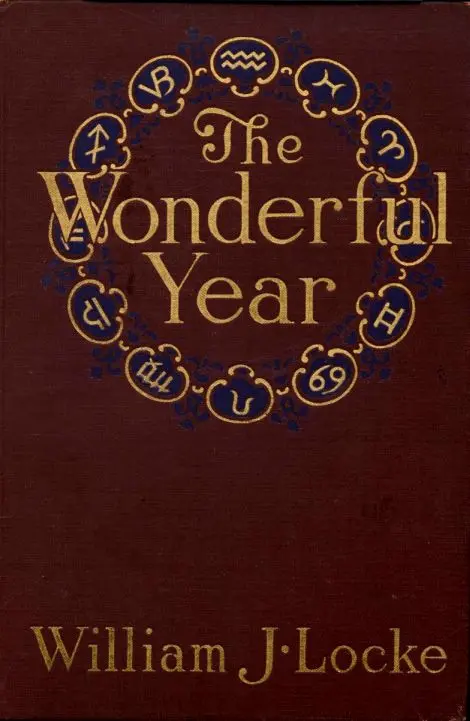
The Wonderful Year
William John Locke
THE CLASSIC COLLECTION · 1897
"Derelicts" by William John Locke is a novel written in the late 19th century. The book explores themes of isolation, redemption, and the search for connection through its lead character, Stephen Joyce, a man grappling with the shame of his past as a former convict. Since his release, he navigates the harsh realities of life as he attempts to reclaim his place in society while yearning for friendship and understanding. The opening of the novel introduces Stephen Joyce as he sits despondently on the steps of a grand but deserted house in Holland Park, a poignant symbol of his lost past. We learn about his former life, filled with promise and affection, which has been shattered by his time in prison. Despite his self-loathing, a glimmer of hope emerges when he unexpectedly encounters Yvonne Latour, a former friend who recognizes him and offers her friendship. Their interaction showcases Joyce's internal struggle, juxtaposed against Yvonne's warmth and kindness, setting the stage for a complex exploration of guilt, desire for redemption, and the power of human connection as the story unfolds.
Introduction adapted from the source catalogue; source summaries may be automatically generated.
Free to read · English · 78,249 words · No account needed
MAKE TIME FOR A GOOD BOOK
On by default. Untick to stop anonymous reading totals. Each page counts after 10 seconds in view. How this works.
Anonymous counting is on unless you have switched it off.
“Do you mean to tell me,” he insisted, “that you married a second time, having no further proofs of your first husband’s death than a mere newspaper report?”
“It never occurred to me to doubt it,” she replied, opening piteous,
innocent eyes.
The childlike irresponsibility was above his comprehension. Her apparent insensibility to the most vital concerns of life was another shock to him. It seemed criminal.
“God forgive you,” he said, “for the wrong you have done me.”
“But I did it unknowingly, Everard,” cried poor Yvonne. “If one has to get greater proofs, why did you not ask for them, yourself?”
The Canon turned away and paced the room slowly, without replying. At last he stood still before her.
“Among ordinary honourable people one takes such things for granted,” he
said.
“Forgive me,” she said again, humbly.
But he could find no pity for her in his heart. She had wronged him past
redemption.
“How much truth was there in the newspaper story?” he asked coldly.
She told him rapidly what Amédée Bazouge had said concerning his attack in the hospital and his subsequent stroke.
“So the man is wilfully killing himself with absinthe?” he said.
“It appears so,” replied Yvonne with a shudder.
“Could you tell me what passed between you otherwise--in general terms?” he asked, after a short silence. “You explained your position? Or did you leave him in ignorance, as you were going to leave me?”
“I told him--of course. It was necessary. And he laughed--I thought to
spare you, Everard.”
“Spare me, Yvonne?”
“Yes,” she said, simply, “I could have borne all the pain and fright of it alone--why should I have made you unhappy? And he said he would never interfere with me, and I can trust his word. Why should I have told you, Everard?”
“Do you actually ask me such a question, honestly?”
“God knows I do,” she replied pitifully.
“And you would have gone on living with me--I not being your husband?”
“But you are my husband,” cried Yvonne, “nothing could ever alter that.”
“But good God! it does alter it,” cried the Canon in a voice of anguish, breaking the iron bonds he had placed on his passion. “Neither in the eyes of God nor of man are you my wife. You have no right to bear my name. After this hour I have no right to enter this room. Every caress I gave you would be sin. Don’t you understand it, child? Don’t you understand that this has brought ruin into our lives, the horror of loneliness and separation?”
“Separation?” said Yvonne.
Your reading position is saved on this browser. Take it to another device with a library code. Reading pages adapt to text, rather than matching a printed edition.
William John Locke
William John Locke
William John Locke
William John Locke
BEHIND THE BOOK
This eBook is for the use of anyone anywhere in the United States and most other parts of the world at no cost and with almost no restrictions whatsoever. You may copy it, give it away or re-use it under the terms of the Project Gutenberg License included with this eBook or online at www.gutenberg.org. If you are not located in the United States, you will have to check the laws of the country where you are located before using this eBook. Read the source licence.
The original source file, including credits and licence, is retained by this library. Request an original-format copy at no charge. Please include the book title and Project Gutenberg identifier #55927.
KEEP YOUR CURIOSITY GOING
Coulson Kernahan

Maurice Baring
Frances Wright
Cécile Tormay

Frederic Jesup Stimson

W. H. P. (William Henry Pope) Jarvis