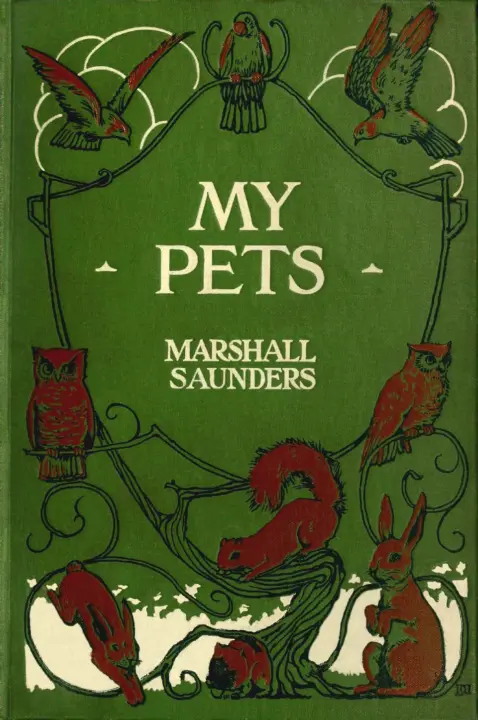
My pets
Marshall Saunders
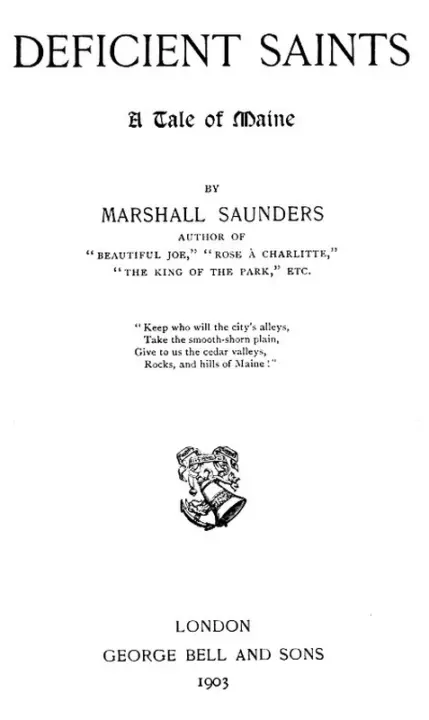
THE CLASSIC COLLECTION · 1899
"Deficient Saints: A Tale of Maine" by Marshall Saunders is a novel written in the early 20th century. Set in the quaint town of Rossignol, Maine, the story revolves around Mrs. Hippolyta Prymmer, a somewhat eccentric widow obsessively maintaining a 'death-book' that catalogs deceased acquaintances. As she navigates her life among other townsfolk, including her newly-returned son Justin and his unexpected wife Derrice, the narrative explores themes of family, societal expectations, and the peculiarities of life in a close-knit community. The beginning of the story introduces Mrs. Prymmer engrossed in her death-book as she muses about her past marriages. We learn about her son, Justin, who surprises her by returning home with his new wife, Derrice, causing considerable upheaval in her life. Their interactions highlight the generational and ideological clash between Mrs. Prymmer and her modern daughter-in-law, who represents a break from traditional expectations. The opener sets a comedic yet poignant tone, drawing readers into the dynamics of family relationships while hinting at the complexities and challenges ahead.
Introduction adapted from the source catalogue; source summaries may be automatically generated.
Free to read · English · 88,409 words · No account needed
MAKE TIME FOR A GOOD BOOK
On by default. Untick to stop anonymous reading totals. Each page counts after 10 seconds in view. How this works.
Anonymous counting is on unless you have switched it off.
"Yes, I will, aunt."
"Thank you," said Mr. Huntington, rising. "I do not think you will
regret it."
"I think we should be grateful to you," said the young lady. "There are few desirable people in Rossignol, and you would not call our attention to any one who would be undesirable."
She spoke sweetly and smoothly, yet her tones flowed into her relative's ear with a hidden meaning. "Now what do you mean by that, Chelda?" she asked.
Chelda glanced at their caller. He understood her, and he at once lost the contented, almost exalted expression that he had brought away from the Mercer mansion, and took on instead his usual one of slight moodiness.
"She means," he said, hastily, "that my duties call me among a class of people with whom it would not be your good pleasure to associate."
"And I am called the most radical woman in Rossignol!" said Miss Gastonguay. "Thank you, young ecclesiastic."
"I referred to your niece, rather than to you," he said, with a bow.
"Oh, Chelda,--yes, she is an aristocrat," said Miss Gastonguay. "It is born in her, she can't help it. You ought to understand her, in view of your former life. Come, now, do you love all those dirty mill hands and slovenly women you work among?"
"I do not think we need discuss that point. There is duty to be
considered as well as pleasure."
"But if one can combine both," said Chelda; "it is possible."
"The question is to know your duty," he replied.
"It is our duty to be happy," said the young lady, blandly, yet with a
certain boldness.
The clergyman looked straight into her eyes. They were wide open. Their usual filmy appearance was gone. What he saw seemed to fascinate and yet repel him, for with his hands he made a gesture as if he would be gone, yet his feet still lingered.
Miss Gastonguay's abrupt voice disenchanted him. "Come back to lunch, Mr. Huntington. I daresay you are taking your Monday walk in this direction."
He started slightly. "I am, yet I thought of returning to my study."
He had retreated toward the door, but the young lady moved a step toward him. "How devoted you are to that desk of yours. How you must miss your former life of freedom."
The cloud on his brow grew more heavy, and seeing it, Miss Gastonguay exclaimed, hospitably, "Let the musty old Negus books alone, and go take your constitutional on the river road. Then after lunch Chelda will drive you in town and make her call on your friend, the bride. You will, won't you, Chelda?"
Your reading position is saved on this browser. Take it to another device with a library code. Reading pages adapt to text, rather than matching a printed edition.
Marshall Saunders
Marshall Saunders
Marshall Saunders
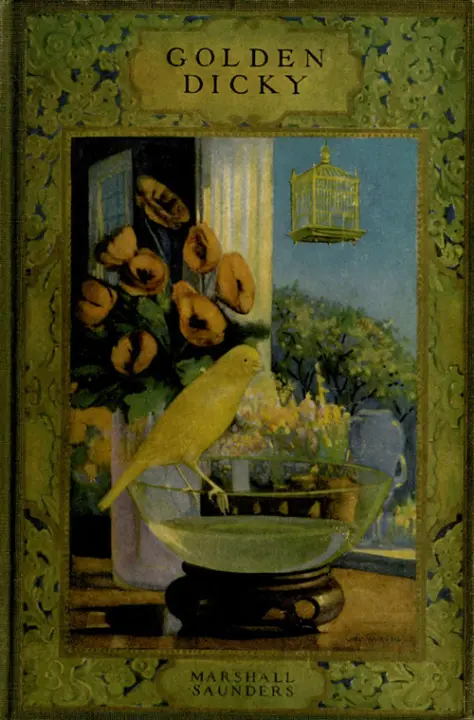
Marshall Saunders
BEHIND THE BOOK
This eBook is for the use of anyone anywhere in the United States and most other parts of the world at no cost and with almost no restrictions whatsoever. You may copy it, give it away or re-use it under the terms of the Project Gutenberg License included with this eBook or online at www.gutenberg.org. If you are not located in the United States, you will have to check the laws of the country where you are located before using this eBook. Read the source licence.
The original source file, including credits and licence, is retained by this library. Request an original-format copy at no charge. Please include the book title and Project Gutenberg identifier #52783.
KEEP YOUR CURIOSITY GOING
Coulson Kernahan

Maurice Baring
Frances Wright
Cécile Tormay

Frederic Jesup Stimson

W. H. P. (William Henry Pope) Jarvis