
Letters of Marque
Rudyard Kipling
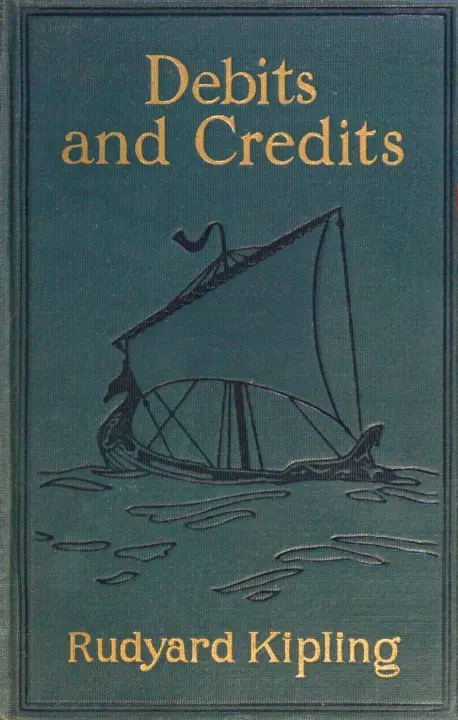
THE CLASSIC COLLECTION · 1919
"Debits and Credits" by Rudyard Kipling is a collection published in 1926. This volume gathers fourteen stories, nineteen poems, and two play scenes that range from retellings of ancient tales to accounts of World War I's impact. The stories explore diverse settings—from Sussex villages to medieval abbeys, from school pranks to wartime trenches. Kipling examines themes of love, loss, duty, and human resilience, while some poems playfully imitate the Roman poet Horace. The collection showcases Kipling's versatility across genres and subjects.
Introduction adapted from the source catalogue; source summaries may be automatically generated.
Free to read · English · 88,304 words · No account needed
MAKE TIME FOR A GOOD BOOK
On by default. Untick to stop anonymous reading totals. Each page counts after 10 seconds in view. How this works.
Anonymous counting is on unless you have switched it off.
Monsieur Voiron replenished our glasses with the great wine that went
better at each descent.
“They kept him for some time in the yards to practise upon. Naturally he became a little brutal; so Christophe turned him out to learn manners among his equals in the grazing lands, where the Camargue joins the Crau. How old was he then? About eight or nine months, I think. We met again a few months later--he and I. I was riding one of our little half-wild horses, along a road of the Crau, when I found myself almost unseated. It was he! He had hidden himself behind a wind-break till we passed, and had then charged my horse from behind. Yes, he had deceived even my little horse! But I recognised him. I gave him the whip across the nose, and I said: ‘Apis, for this thou goest to Arles! It was unworthy of thee, between us two.’ But that creature had no shame. He went away laughing, like an Apache. If he had dismounted me, I do not think it is I who would have laughed--yearling as he was.”
“Why did you want to send him to Arles?” I asked.
“For the bull-ring. When your charming tourists leave us, we institute our little amusements there. Not a real bull-fight, you understand, but young bulls with padded horns, and our boys from hereabouts and in the city, go to play with them. Naturally, before we send them we try them in our yards at home. So we brought up Apis from his pastures. He knew at once that he was among the friends of his youth--he almost shook hands with them--and he submitted like an angel to padding his horns. He investigated the carts and tractors in the yards, to choose his lines of defence and attack. And then--he attacked with an élan, and he defended with a tenacity and forethought that delighted us. In truth, we were so pleased that I fear we trespassed upon his patience. We desired him to repeat himself, which no true artist will tolerate. But he gave us fair warning. He went out to the centre of the yard, where there was some dry earth; he kneeled down and--you have seen a calf whose horns fret him thrusting and rooting into a bank? He did just that, very deliberately, till he had rubbed the pads off his horns. Then he rose, dancing on those wonderful feet that twinkled, and he said: ‘Now, my friends, the buttons are off the foils. Who begins?’ We understood. We finished at once. He was turned out again on the pastures till it should be time to amuse them at our little metropolis. But, some time before he went to Arles--yes, I think I have it correctly--Christophe, who had been out on the Crau, informed me that Apis had assassinated a young bull who had given signs of developing into a rival. That happens, of course, and our herdsmen should prevent it. But Apis had killed in his own style--at dusk, from the ambush of a wind-break--by an oblique charge from behind which knocked the other over. He had then disembowelled him. All very possible, but--the murder accomplished--Apis went to the bank of a wind-break, knelt, and carefully, as he had in our yard, cleaned his horns in the earth. Christophe, who had never seen such a thing, at once borrowed (do you know, it is most efficacious when taken that way?) some Holy Water from our little chapel in those pastures, sprinkled Apis (whom it did not affect), and rode in to tell me. It was obvious that a thinker of that bull’s type would also be meticulous in his toilette; so, when he was sent to Arles, I warned our consignees to exercise caution with him. Happily, the change of scene, the music, the general attention, and the meeting again with old friends--all our bad boys attended--agreeably distracted him. He became for the time a pure farceur again; but his wheelings, his rushes, his rat-huntings were more superb than ever. There was in them now, you understand, a breadth of technique that comes of reasoned art, and, above all, the passion that arrives after experience. Oh, he had learned, out there on the Crau! At the end of his little turn, he was, according to local rules, to be handled in all respects except for the sword, which was a stick, as a professional bull who must die. He was manœuvred into, or he posed himself in, the proper attitude; made his rush; received the point on his shoulder and then--turned about and cantered toward the door by which he had entered the arena. He said to the world: ‘My friends, the representation is ended. I thank you for your applause. I go to repose myself.’ But our Arlesians, who are--not so clever as some, demanded an encore, and Apis was headed back again. We others from his country, we knew what would happen. He went to the centre of the ring, kneeled, and, slowly, with full parade, plunged his horns alternately in the dirt till the pads came off. Christophe shouts: ‘Leave him alone, you straight-nosed imbeciles! Leave him before you must.’ But they required emotion; for Rome has always debauched her loved Provincia with bread and circuses. It was given. Have you, Monsieur, ever seen a servant, with pan and broom, sweeping round the baseboard of a room? In a half-minute Apis has them all swept out and over the barrier. Then he demands once more that the door shall be opened to him. It is opened and he retires as though--which truly, is the case--loaded with laurels.”
Your reading position is saved on this browser. Take it to another device with a library code. Reading pages adapt to text, rather than matching a printed edition.
Rudyard Kipling

Rudyard Kipling
Rudyard Kipling

Rudyard Kipling
BEHIND THE BOOK
This eBook is for the use of anyone anywhere in the United States and most other parts of the world at no cost and with almost no restrictions whatsoever. You may copy it, give it away or re-use it under the terms of the Project Gutenberg License included with this eBook or online at www.gutenberg.org. If you are not located in the United States, you will have to check the laws of the country where you are located before using this eBook. Read the source licence.
The original source file, including credits and licence, is retained by this library. Request an original-format copy at no charge. Please include the book title and Project Gutenberg identifier #71002.
KEEP YOUR CURIOSITY GOING
Coulson Kernahan

Maurice Baring
Frances Wright
Cécile Tormay

Frederic Jesup Stimson

W. H. P. (William Henry Pope) Jarvis