
Letters of Marque
Rudyard Kipling
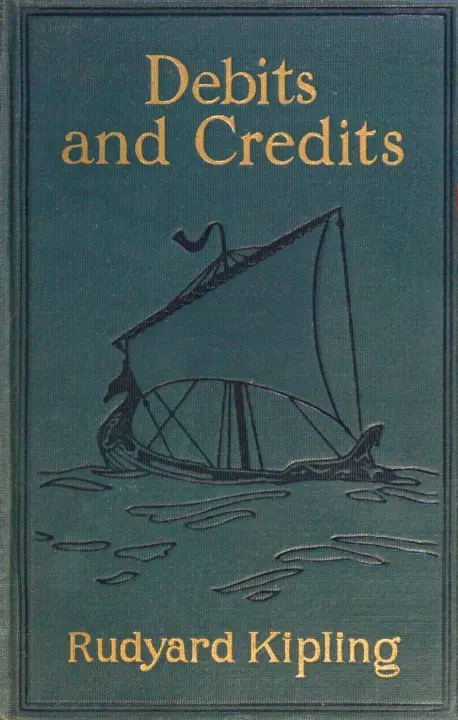
THE CLASSIC COLLECTION · 1919
"Debits and Credits" by Rudyard Kipling is a collection published in 1926. This volume gathers fourteen stories, nineteen poems, and two play scenes that range from retellings of ancient tales to accounts of World War I's impact. The stories explore diverse settings—from Sussex villages to medieval abbeys, from school pranks to wartime trenches. Kipling examines themes of love, loss, duty, and human resilience, while some poems playfully imitate the Roman poet Horace. The collection showcases Kipling's versatility across genres and subjects.
Introduction adapted from the source catalogue; source summaries may be automatically generated.
Free to read · English · 88,304 words · No account needed
MAKE TIME FOR A GOOD BOOK
On by default. Untick to stop anonymous reading totals. Each page counts after 10 seconds in view. How this works.
Anonymous counting is on unless you have switched it off.
“They are moving some beasts,” said Monsieur Voiron, cocking an ear. “Mine, I think. Yes, I hear Christophe. Our beasts do not like automobiles--so we move at night. You do not know our country--the Crau, here, or the Camargue? I was--I am now, again--of it. All France is good; but this is the best.” He spoke, as only a Frenchman can, of his own loved part of his own lovely land.
“For myself, if I were not so involved in all these affairs,” he pointed to the advertisements--“I would live on our farm with my cattle, and worship them like a Hindu. You know our cattle of the Camargue, Monsieur. No? It is not an acquaintance to rush upon lightly. There are no beasts like them. They have a mentality superior to that of others. They graze and they ruminate, by choice, facing our Mistral, which is more than some automobiles will do. Also they have in them the potentiality of thought--and when cattle think--I have seen what arrives.”
“Are they so clever as all that?” I asked idly.
“Monsieur, when your sportif chauffeur camouflaged your limousine so that she resembled one of your Army lorries, I would not believe her capacities. I bet him--ah--two to one--she would not touch ninety kilometres. It was proved that she could. I can give you no proof, but will you believe me if I tell you what a beast who thinks can achieve?”
“After the War,” said I spaciously, “everything is credible.”
“That is true! Everything inconceivable has happened; but still we learn nothing and we believe nothing. When I was a child in my father’s house--before I became a Colonial Administrator--my interest and my affection were among our cattle. We of the old rock live here--have you seen?--in big farms like castles. Indeed, some of them may have been Saracenic. The barns group round them--great white-walled barns, and yards solid as our houses. One gate shuts all. It is a world apart; an administration of all that concerns beasts. It was there I learned something about cattle. You see, they are our playthings in the Camargue and the Crau. The boy measures his strength against the calf that butts him in play among the manure-heaps. He moves in and out among the cows, who are--not so amiable. He rides with the herdsmen in the open to shift the herds. Sooner or later, he meets as bulls the little calves that knocked him over. So it was with me--till it became necessary that I should go to our Colonies.” He laughed. “Very necessary. That is a good time in youth, Monsieur, when one does these things which shock our parents. Why is it always Papa who is so shocked and has never heard of such things--and Mamma who supplies the excuses?... And when my brother--my elder who stayed and created the business--begged me to return and help him, I resigned my Colonial career gladly enough. I returned to our own lands, and my well-loved, wicked white and yellow cattle of the Camargue and the Crau. My Faith, I could talk of them all night, for this stuff unlocks the heart, without making repentance in the morning.... Yes! It was after the War that this happened. There was a calf, among Heaven knows how many of ours--a bull-calf--an infant indistinguishable from his companions. He was sick, and he had been taken up with his mother into the big farmyard at home with us. Naturally the children of our herdsmen practised on him from the first. It is in their blood. The Spaniards make a cult of bull-fighting. Our little devils down here bait bulls as automatically as the English child kicks or throws balls. This calf would chase them with his eyes open, like a cow when she hunts a man. They would take refuge behind our tractors and wine-carts in the centre of the yard: he would chase them in and out as a dog hunts rats. More than that, he would study their psychology, his eyes in their eyes. Yes, he watched their faces to divine which way they would run. He himself, also, would pretend sometimes to charge directly at a boy. Then he would wheel right or left--one could never tell--and knock over some child pressed against a wall who thought himself safe. After this, he would stand over him, knowing that his companions must come to his aid; and when they were all together, waving their jackets across his eyes and pulling his tail, he would scatter them--how he would scatter them! He could kick too, sideways like a cow. He knew his ranges as well as our gunners, and he was as quick on his feet as our Carpentier. I observed him often. Christophe--the man who passed just now--our chief herdsman, who had taught me to ride with our beasts when I was ten--Christophe told me that he was descended from a yellow cow of those days that had chased us once into the marshes. ‘He kicks just like her,’ said Christophe. ‘He can side-kick as he jumps. Have you seen, too, that he is not deceived by the jacket when a boy waves it? He uses it to find the boy. They think they are feeling him. He is feeling them always. He thinks, that one.’ I had come to the same conclusion. Yes--the creature was a thinker along the lines necessary to his sport; and he was a humorist also, like so many natural murderers. One knows the type among beasts as well as among men. It possesses a curious truculent mirth--almost indecent but infallibly significant----”
Your reading position is saved on this browser. Take it to another device with a library code. Reading pages adapt to text, rather than matching a printed edition.
Rudyard Kipling

Rudyard Kipling
Rudyard Kipling

Rudyard Kipling
BEHIND THE BOOK
This eBook is for the use of anyone anywhere in the United States and most other parts of the world at no cost and with almost no restrictions whatsoever. You may copy it, give it away or re-use it under the terms of the Project Gutenberg License included with this eBook or online at www.gutenberg.org. If you are not located in the United States, you will have to check the laws of the country where you are located before using this eBook. Read the source licence.
The original source file, including credits and licence, is retained by this library. Request an original-format copy at no charge. Please include the book title and Project Gutenberg identifier #71002.
KEEP YOUR CURIOSITY GOING
Coulson Kernahan

Maurice Baring
Frances Wright
Cécile Tormay

Frederic Jesup Stimson

W. H. P. (William Henry Pope) Jarvis