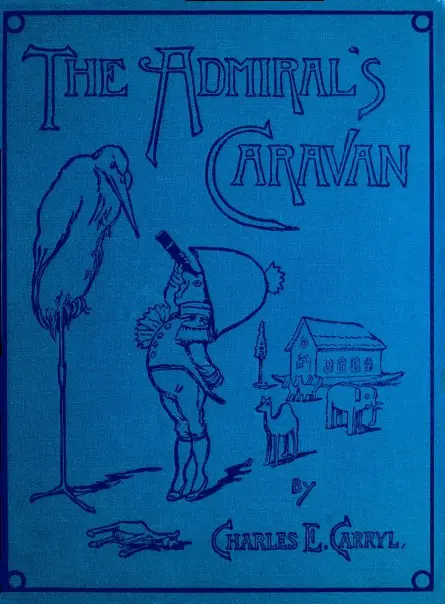
The Admiral’s Caravan
Charles E. (Charles Edward) Carryl
THE CLASSIC COLLECTION · 1884
"Davy and the Goblin" by Charles E. Carryl is a children's fantasy novel written in the late 19th century. It follows the whimsical adventures of a young boy named Davy, who encounters a peculiar goblin on a snowy Christmas Eve, igniting a journey into a world filled with fantastical creatures and thrilling experiences. The story is a playful exploration of imagination and belief, reminiscent of the enchanting tales popularized in children's literature during that era. The opening of the book sets a lively scene where Davy, after a wintry escapade outside, finds himself in a cozy room, only to discover a curious little goblin who claims he will take Davy on a "Believing Voyage." This begins after the goblin chastises Davy for not believing in fairies and other fantastical beings. Davy hesitantly agrees, prompted by a nod from a toy soldier on the shelf, and suddenly the room transforms as they embark on their extraordinary journey aboard a magical clock. The narrative blends humor and adventure as Davy encounters eccentric characters and delightful challenges, indicating that this whimsical journey will be filled with unexpected wonders and playful antics.
Introduction adapted from the source catalogue; source summaries may be automatically generated.
Free to read · English · 26,234 words · No account needed
MAKE TIME FOR A GOOD BOOK
On by default. Untick to stop anonymous reading totals. Each page counts after 10 seconds in view. How this works.
Anonymous counting is on unless you have switched it off.
When Parker saw the seamen gaze
Upon the captain's cunning ways,
Base envy thrilled him through and through.
And he became a child of two.
Now, Parker had in his employ
A mate, two seamen, and a boy;
The mate was fond as he could be
Of babies, and he says, says he,--
"Why, messmates, as we're all agreed
Sea-bathing is the thing they need,
Let's drop these hinfants off the quarter!"
(They did, in fourteen fathom water).
--and here the story came abruptly to an end.
Davy was quite distressed at this, particularly as the dreadful thought came into his mind that some babies do not know how to swim, and he was therefore very well satisfied when he saw that the old Sea-Dog had apparently changed his mind about going away, and was swaggering along toward him again.
"If you please," said Davy, as the surly creature came within hearing distance,--"if you please, sir, were the two little captains drowned?"
"Well, sticking, as it were, to the truth, they were not," replied the old Sea-Dog, very gruffly.
"Then, why don't you say so in the story?" said Davy.
Now, this was pretty bold of him, for old Sea-Dogs don't much like to have fault found with their verses, and this particular old Sea-Dog evidently did not like it at all, for, after staring at Davy for a moment, he began walking slowly around him in such a threatening manner that Davy, thinking that perhaps he meant to jump on him from behind, began also turning so as to keep his face always toward the Dog. Meanwhile, as you may well believe, he began to feel very sorry that he had said anything about the verses.
Presently the old Sea-Dog broke into a clumsy canter, like a weary old circus horse, and as he went heavily around the circle he began to explain about the story. "You see there's more of it," said he, wheezing dreadfully as he galloped; "but then I haven't had the time to put the rest of it in rhyme. It's all about old Thompson's crew as stayed aboard the 'Soaking Sue,' and saw the skippers floating by and hauled 'em out and got 'em dry, and when the little creeturs cried they gave 'em something warm inside, and being as they had no bed they stowed 'em in a bunk instead,"--but just at this moment the old Sea-Dog, who had been constantly increasing his speed, disappeared in a most extraordinary manner in a whirling cloud of sand, and Davy, who was by this time spinning around like a teetotum, discovered that he himself was rapidly boring his way, like a big screw, down into the beach. This was, of course, a very alarming state of things; but, before Davy could make an effort to free himself, the whirling cloud of sand burst upon him with a loud, roaring sound like the sea, and he felt himself going directly down through the beach, with the sand pouring in upon him as if he had been inside of a huge hour-glass. He had just time to notice that, instead of scraping him, the sand had a delightful ticklesome feeling about it, when he went completely through the beach, and landed, with a gentle thump, flat on his back, with tall grass waving about him.
Your reading position is saved on this browser. Take it to another device with a library code. Reading pages adapt to text, rather than matching a printed edition.
Charles E. (Charles Edward) Carryl
BEHIND THE BOOK
This eBook is for the use of anyone anywhere in the United States and most other parts of the world at no cost and with almost no restrictions whatsoever. You may copy it, give it away or re-use it under the terms of the Project Gutenberg License included with this eBook or online at www.gutenberg.org. If you are not located in the United States, you will have to check the laws of the country where you are located before using this eBook. Read the source licence.
The original source file, including credits and licence, is retained by this library. Request an original-format copy at no charge. Please include the book title and Project Gutenberg identifier #25031.
KEEP YOUR CURIOSITY GOING
Coulson Kernahan

Maurice Baring
Frances Wright
Cécile Tormay
Francis Greenleaf Allinson & Anne C. E. (Anne Crosby Emery) Allinson

Frederic Jesup Stimson