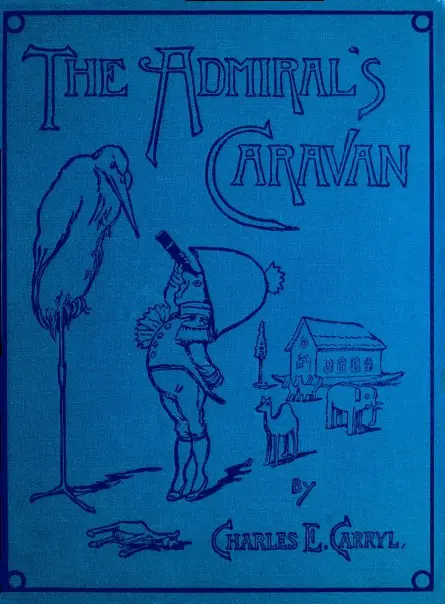
The Admiral’s Caravan
Charles E. (Charles Edward) Carryl
THE CLASSIC COLLECTION · 1884
"Davy and the Goblin" by Charles E. Carryl is a children's fantasy novel written in the late 19th century. It follows the whimsical adventures of a young boy named Davy, who encounters a peculiar goblin on a snowy Christmas Eve, igniting a journey into a world filled with fantastical creatures and thrilling experiences. The story is a playful exploration of imagination and belief, reminiscent of the enchanting tales popularized in children's literature during that era. The opening of the book sets a lively scene where Davy, after a wintry escapade outside, finds himself in a cozy room, only to discover a curious little goblin who claims he will take Davy on a "Believing Voyage." This begins after the goblin chastises Davy for not believing in fairies and other fantastical beings. Davy hesitantly agrees, prompted by a nod from a toy soldier on the shelf, and suddenly the room transforms as they embark on their extraordinary journey aboard a magical clock. The narrative blends humor and adventure as Davy encounters eccentric characters and delightful challenges, indicating that this whimsical journey will be filled with unexpected wonders and playful antics.
Introduction adapted from the source catalogue; source summaries may be automatically generated.
Free to read · English · 26,234 words · No account needed
MAKE TIME FOR A GOOD BOOK
On by default. Untick to stop anonymous reading totals. Each page counts after 10 seconds in view. How this works.
Anonymous counting is on unless you have switched it off.
Here the Goat, who apparently had been carefully thinking the matter over, said in a low, quavering voice, "Must all the halves be of the same size?"
"Certainly not," said Robinson, promptly; then, nudging Davy with his elbow, he whispered, "He's bringing his mind to bear on it. He's prodigious when he gets started!"
"Who taught him arithmetic?" said Davy, who was beginning to think Robinson didn't know much about it himself.
"Well, the fact is," said Robinson, confidentially, "he picked it up from an old Adder, that he met in the woods."
Here the Goat, who evidently was not yet quite started, inquired, "Must all the halves be of the same shape?"
"Not at all," said Robinson, cheerfully. "Have 'em any shape you like."
"Then I give it up," said the Goat.
"So do I," said the Dog.
"And I," said the Cat.
"Me, too," said the Parrot.
"Well!" exclaimed Davy, quite out of patience. "You are certainly the stupidest lot of creatures I ever saw."
At this the animals stared mournfully at him for a moment, and then rose up and walked gravely away.
"Now you've spoiled the exercises," said Robinson, peevishly. "I'm sorry I gave 'em such a staggerer to begin with."
"Pooh!" said Davy, contemptuously. "If they couldn't do that sum they
couldn't do anything."
Robinson gazed at him admiringly for a moment, and then, looking cautiously about him, to make sure that the procession was out of hearing, said coaxingly:--
"What's the right answer? Tell us, like a good fellow."
"Two, of course," said Davy.
"Is that all?" exclaimed Robinson, in a tone of great astonishment.
"Certainly," said Davy, who began to feel very proud of his learning. "Don't you know that when they divide a whole into four parts they call them fourths, and when they divide it into two parts they call them halves?"
"Why don't they call them tooths?" said Robinson, obstinately. "The fact is, they ought to call 'em teeth. That's what puzzled the Goat. Next time I'll say, 'How many teeth in a whole?'"
"Then the Cat will ask if it's a rat-hole," said Davy, laughing at the
idea.
"You positively convulse me, you're so very humorous," said Robinson, without a vestige of a smile. "You're almost as droll as Friday was. He used to call the Goat 'Pat,' because he said he was a little butter. I told him that was altogether too funny for a lonely place like this, and he went away and joined the minstrels."
Here Robinson suddenly turned pale, and, hastily reaching out for his
gun, sprang to his feet.
Your reading position is saved on this browser. Take it to another device with a library code. Reading pages adapt to text, rather than matching a printed edition.
Charles E. (Charles Edward) Carryl
BEHIND THE BOOK
This eBook is for the use of anyone anywhere in the United States and most other parts of the world at no cost and with almost no restrictions whatsoever. You may copy it, give it away or re-use it under the terms of the Project Gutenberg License included with this eBook or online at www.gutenberg.org. If you are not located in the United States, you will have to check the laws of the country where you are located before using this eBook. Read the source licence.
The original source file, including credits and licence, is retained by this library. Request an original-format copy at no charge. Please include the book title and Project Gutenberg identifier #25031.
KEEP YOUR CURIOSITY GOING
Coulson Kernahan

Maurice Baring
Frances Wright
Cécile Tormay
Francis Greenleaf Allinson & Anne C. E. (Anne Crosby Emery) Allinson

Frederic Jesup Stimson