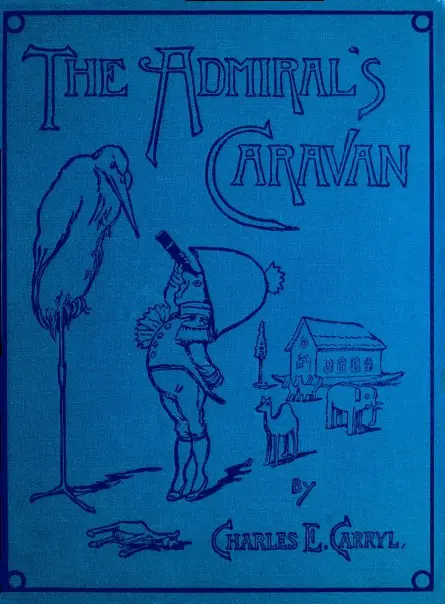
The Admiral’s Caravan
Charles E. (Charles Edward) Carryl
THE CLASSIC COLLECTION · 1884
"Davy and the Goblin" by Charles E. Carryl is a children's fantasy novel written in the late 19th century. It follows the whimsical adventures of a young boy named Davy, who encounters a peculiar goblin on a snowy Christmas Eve, igniting a journey into a world filled with fantastical creatures and thrilling experiences. The story is a playful exploration of imagination and belief, reminiscent of the enchanting tales popularized in children's literature during that era. The opening of the book sets a lively scene where Davy, after a wintry escapade outside, finds himself in a cozy room, only to discover a curious little goblin who claims he will take Davy on a "Believing Voyage." This begins after the goblin chastises Davy for not believing in fairies and other fantastical beings. Davy hesitantly agrees, prompted by a nod from a toy soldier on the shelf, and suddenly the room transforms as they embark on their extraordinary journey aboard a magical clock. The narrative blends humor and adventure as Davy encounters eccentric characters and delightful challenges, indicating that this whimsical journey will be filled with unexpected wonders and playful antics.
Introduction adapted from the source catalogue; source summaries may be automatically generated.
Free to read · English · 26,234 words · No account needed
MAKE TIME FOR A GOOD BOOK
On by default. Untick to stop anonymous reading totals. Each page counts after 10 seconds in view. How this works.
Anonymous counting is on unless you have switched it off.
A capital ship for an ocean trip
Was "The Walloping Window-blind;"
No gale that blew dismayed her crew
Or troubled the captain's mind.
The man at the wheel was taught to feel
Contempt for the wildest blow,
And it often appeared, when the weather had cleared,
That he'd been in his bunk below.
The boatswain's mate was very sedate,
Yet fond of amusement, too;
And he played hop-scotch with the starboard watch
While the captain tickled the crew.
And the gunner we had was apparently mad,
For he sat on the after-rail,
And fired salutes with the captain's boots,
In the teeth of the booming gale.
The captain sat in a commodore's hat,
And dined, in a royal way,
On toasted pigs and pickles and figs
And gummery bread, each day.
But the cook was Dutch, and behaved as such;
For the food that he gave the crew
Was a number of tons of hot-cross buns,
Chopped up with sugar and glue.
And we all felt ill as mariners will,
On a diet that's cheap and rude;
And we shivered and shook as we dipped the cook
In a tub of his gluesome food.
Then nautical pride we laid aside,
And we cast the vessel ashore
On the Gulliby Isles, where the Poohpooh smiles,
And the Anagazanders roar.
Composed of sand was that favored land,
And trimmed with cinnamon straws;
And pink and blue was the pleasing hue
Of the Tickletoeteaser's claws.
And we sat on the edge of a sandy ledge
And shot at the whistling bee;
And the Binnacle-bats wore water-proof hats
As they danced in the sounding sea.
On rubagub bark, from dawn to dark,
We fed, till we all had grown
Uncommonly shrunk,--when a Chinese junk
Came by from the torriby zone.
She was stubby and square, but we didn't much care,
And we cheerily put to sea;
And we left the crew of the junk to chew
The bark of the rubagub tree.
Here Sindbad stopped, and gazed solemnly at Davy and the Goblin.
"If you please, sir," said Davy, respectfully, "what is gummery
bread?"
"It's bread stuffed with molasses," said Sindbad; "but I never saw it anywhere except aboard of 'The Prodigal Pig.'"
"But," said Davy, in great surprise, "you said the name of your ship
was"--
"So I did, and so it was," interrupted Sindbad, testily. "The name of a ship sticks to it like wax to a wig. You can't change it."
"Who gave it that name?" said the Goblin.
"What name?" said Sindbad, looking very much astonished.
"Why, 'The Cantering Soup-tureen,'" said the Goblin, winking at Davy.
Your reading position is saved on this browser. Take it to another device with a library code. Reading pages adapt to text, rather than matching a printed edition.
Charles E. (Charles Edward) Carryl
BEHIND THE BOOK
This eBook is for the use of anyone anywhere in the United States and most other parts of the world at no cost and with almost no restrictions whatsoever. You may copy it, give it away or re-use it under the terms of the Project Gutenberg License included with this eBook or online at www.gutenberg.org. If you are not located in the United States, you will have to check the laws of the country where you are located before using this eBook. Read the source licence.
The original source file, including credits and licence, is retained by this library. Request an original-format copy at no charge. Please include the book title and Project Gutenberg identifier #25031.
KEEP YOUR CURIOSITY GOING
Coulson Kernahan

Maurice Baring
Frances Wright
Cécile Tormay
Francis Greenleaf Allinson & Anne C. E. (Anne Crosby Emery) Allinson

Frederic Jesup Stimson