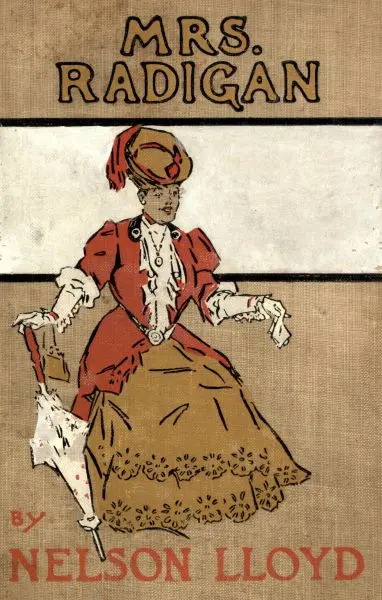
Mrs. Radigan: Her Biography, with that of Miss Pearl Veal, and the Memoirs of J. Madison Mudison
Nelson Lloyd
THE CLASSIC COLLECTION · 1913
"David Malcolm" by Nelson Lloyd is a novel written in the early 20th century. It centers on a young boy named David Malcolm, who embarks on an adventure to go fishing in the mountains, encountering various characters along the way that reflect the worries, fears, and quirks of his small-town life. The narrative begins with David's innocent defiance against his mother’s warnings and soon introduces a mysterious and complex figure, the Professor, who hints at deeper societal issues. The opening of the novel presents David as a confident, adventurous child excited about his fishing trip. As he sets off under the watchful gaze of his mother, her concerns about danger—such as falling into the water or encountering rattlesnakes—are depicted humorously, setting the tone for David’s youthful bravado. He interacts with various townsfolk, including the Reverend Mr. Pound and Squire Crumple, who voice exaggerated warnings that add an element of foreshadowing. The story takes a darker turn when David meets Penelope Blight and her father, who is soon revealed to have a troubled reputation in the village as "the Professor." This pivotal encounter sets the stage for future conflicts involving societal judgment and the price of nonconformity, foreshadowing an exploration of themes like adventure, innocence, and the struggle for identity against societal expectations.
Introduction adapted from the source catalogue; source summaries may be automatically generated.
Free to read · English · 100,974 words · No account needed
MAKE TIME FOR A GOOD BOOK
On by default. Untick to stop anonymous reading totals. Each page counts after 10 seconds in view. How this works.
Anonymous counting is on unless you have switched it off.
I was not long at McGraw University before I had attained my ambition to be like Boller of '89. I draped my legs in wide folds of shepherd's plaid; the corners of a purple silk handkerchief protruded from my top pocket; and as long as the "smoky city" was the proper form I crowned myself with one of them, and as promptly discarded it for the newer tourist's helmet, and that in turn for a yachting cap. Must I confess it?--before Boller left McGraw I had quite surpassed him as a model of fashion. But my ambition did not end here. The very conceit which had made me such an insufferable youth in my last days at home was the spur which drove me to win every honor that could come to an undergraduate. As Boller stepped out of offices I stepped into them--in presidencies and secretaryships almost innumerable, into editorships, and even captaincies. Physically timid, I endured much pain in winning these last honors. The stretch of rolling turf which we called the foot-ball field became the arena in which I suffered martyrdom daily. I hated the game. When I donned my padded toggery it was with the secret spirit I should have felt in preparing for the rack, yet I played recklessly for the eclat it gave me. To-day I have an occasional reminder of those struggles in a weak knee, which has a way of twisting unexpectedly and causing excruciating pain, but I consider that these twinges are fair payment for the pleasure with which I contemplated my picture years ago in the Harlansburg Sentinel, showing me in my foot-ball clothes, poised on a photographer's fence. The subject, the Sentinel explained, was Captain Malcolm of McGraw, who had made the winning touch-down in the Thanksgiving-Day game with the Northern University of Pennsylvania. The photographer's fence, you might think, was the summit of my career at McGraw, reached as it was in my last year there. To the admiring eyes of my fellows it was, but the McLaurins of Tuckapo and the Malcolms of Windy Valley were above all a practical people and to them I am indebted for a little common-sense, which told me that I could not play foot-ball all my life, nor would the heavy bass voice, so effective in the glee club, support a family, and deep in my heart I admitted the possibilities of a family. I might strive to keep that thought in the background, but it would rise when I dreamed of a home. That home was not a plain stone farm-house, hidden among giant trees. My view had broadened. I dreamed of a Queen Anne cottage, with many gables, and a flat clipped lawn, with a cement walk leading over it to an iron gate. I looked back with affectionate contempt to the art I had known in my youth, to the Rogers group, Lady Washington's ball, Lincoln and his cabinet, the lambrequin and the worsted motto. On my walls there would be a Colosseum, Rembrandt's portrait of himself, a smattering of Madonnas, a Winged Victory, and a Venus de Milo. To preside with me over such a house, to sit at the piano of an evening and play accompaniments while I sang sentimental songs, to fly with me over the country in a side-bar buggy, behind a fleet trotter, I thought only of Gladys Todd. She was accomplished, highly trained, it seemed to me, in all the finer arts of life. In our valley the women never rose above their petty household problems. They could talk, but only of recipes and church affairs, and if they left this narrow environment at all it was to fare far--to India and China, the foreign mission field. My view had broadened. Gladys Todd had her being in higher airs. She painted. Pastels of flowers and plaques adorned with ideal heads covered the walls of the Todd parlor. She wrote. Doctor Todd assured me, speaking without prejudice, that his daughter's essay on "The Immortality of the Soul," which she had written out of pure love of the labor, equalled, if it did not surpass, the best work of the senior class. She sang. Perhaps I see her now in the same wizard lights of distance that glorified the mountains in my boyhood, but I always recall her as a charming old-fashioned picture, sitting at her piano and babbling her little songs in French and German. Of the quality of her French and German I had no means of judging, but that she could use them at all was to me surpassingly enchanting.
Your reading position is saved on this browser. Take it to another device with a library code. Reading pages adapt to text, rather than matching a printed edition.
BEHIND THE BOOK
This eBook is for the use of anyone anywhere in the United States and most other parts of the world at no cost and with almost no restrictions whatsoever. You may copy it, give it away or re-use it under the terms of the Project Gutenberg License included with this eBook or online at www.gutenberg.org. If you are not located in the United States, you will have to check the laws of the country where you are located before using this eBook. Read the source licence.
The original source file, including credits and licence, is retained by this library. Request an original-format copy at no charge. Please include the book title and Project Gutenberg identifier #23741.
KEEP YOUR CURIOSITY GOING
Coulson Kernahan

Maurice Baring
Frances Wright
Cécile Tormay

Frederic Jesup Stimson

W. H. P. (William Henry Pope) Jarvis