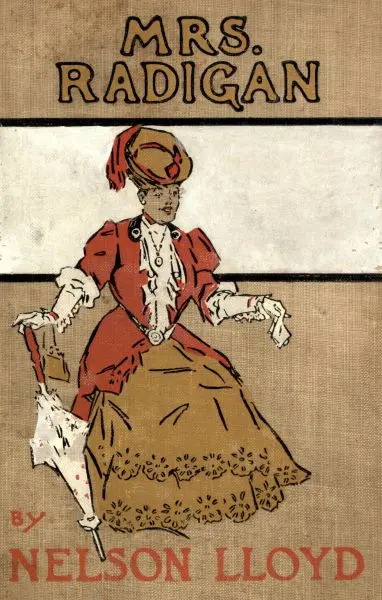
Mrs. Radigan: Her Biography, with that of Miss Pearl Veal, and the Memoirs of J. Madison Mudison
Nelson Lloyd
THE CLASSIC COLLECTION · 1913
"David Malcolm" by Nelson Lloyd is a novel written in the early 20th century. It centers on a young boy named David Malcolm, who embarks on an adventure to go fishing in the mountains, encountering various characters along the way that reflect the worries, fears, and quirks of his small-town life. The narrative begins with David's innocent defiance against his mother’s warnings and soon introduces a mysterious and complex figure, the Professor, who hints at deeper societal issues. The opening of the novel presents David as a confident, adventurous child excited about his fishing trip. As he sets off under the watchful gaze of his mother, her concerns about danger—such as falling into the water or encountering rattlesnakes—are depicted humorously, setting the tone for David’s youthful bravado. He interacts with various townsfolk, including the Reverend Mr. Pound and Squire Crumple, who voice exaggerated warnings that add an element of foreshadowing. The story takes a darker turn when David meets Penelope Blight and her father, who is soon revealed to have a troubled reputation in the village as "the Professor." This pivotal encounter sets the stage for future conflicts involving societal judgment and the price of nonconformity, foreshadowing an exploration of themes like adventure, innocence, and the struggle for identity against societal expectations.
Introduction adapted from the source catalogue; source summaries may be automatically generated.
Free to read · English · 100,974 words · No account needed
MAKE TIME FOR A GOOD BOOK
On by default. Untick to stop anonymous reading totals. Each page counts after 10 seconds in view. How this works.
Anonymous counting is on unless you have switched it off.
"And you have found her a woman grown," said I. "Now you have only to
speak to her."
He shook his head. "I've been here three months now, David, and I have seen her perhaps a score of times; and when I see her, sometimes entering that great house, sometimes driving in her carriage, always the very picture of the ideal princess, she seems a creature of another world than mine, and I laugh at myself for trying to believe that there ever was a time when she sat on my knees and talked of days to come when we should have a house like that and drive in such a carriage! Would she understand me now? Would temporary necessity condone my descending to this uniform? I tried to do better when I came here, but I couldn't. I tried even your profession, but they wanted young men. I came to this only to be near her. But I am away again, David. I must be up and doing." He had risen, and was speaking rapidly as he paced the narrow limits of the room. "Money is what I need and I will have it. Money has always seemed to me a paltry thing to work for, but now it is for Penelope's sake. There has been a plan in my mind for some time, David, only I have delayed starting on it--for Penelope's sake, you understand. I'm going to Argentina. There was a man on my ship coming out from Yokohama who was bound for Argentina, and he told me----"
The Professor launched into a glowing account of the promise of the southern country. To his mind, he had only to reach it to acquire the wealth which he wanted. The man who had failed in every undertaking, who had turned back from every goal to which he had set his eyes, would win there in a few years that for which men in other parts of the world strove a lifetime. I pointed out that the opportunity lay right at his hand, and his answer was to spread wide his arms that I might see the waiter's jacket. He had the better of the argument, but the reason lay in his own character. Then I had recourse to pleading, and my plea was made not for his sake, but for Penelope's, for only when I spoke of her would he listen. I tried to show him Penelope's danger, as it had been revealed to us that very night in Talcott's drunken talk. His reply was a laugh. He had so idealized Penelope that it was inconceivable that she should fall a victim to the attentions of such a vapid creature. He had not seen, as I had, Talcott sober and correct in deportment. He had not fallen, as I had, under the spell of Talcott's easy manner when he had just dropped in from the club to talk of last night's dance and to-morrow's opera. He did not know, as I did, that the whole company from whom Penelope might choose a mate were to the outward eye just such commonplace men whose power of fascination lay in commonplace deeds and words. The Professor, whose whole life had been spent pursuing shadows, was naturally of a romantic turn of mind, and it was even difficult for him to conceive of Penelope marrying at all. That she could be inveigled into so grave a step with a man whose sole claim to merit was well-cut clothes and a command of social patois was quite beyond his comprehension. In vain I argued that most women married just such men, and perhaps it was because the sex had attained wisdom with experience, had discovered that a brilliant mind on parade might be amusing, but that, like its duller fellows, it retired to barracks and found contentment in the same humdrum existence as they. The birth of eternal, enduring love was but a matter of propinquity. Sitting on the front doorstep of an afternoon talking and strolling down to the drugstore every evening for soda-water, Darby and Joan discovered that existence apart was worse than death. And so might Joan's richer sister in the old carved chair, under the eyes of Reynolds's majestic lady, grow accustomed to the coming and going of Darby's richer brother, confirm herself in the habit of taking narcotic conversation, talk of last night's dinner and to-morrow's dance, until he seemed to become essential to her existence. All this I explained to the Professor. He retorted that I had grown cynical. Perhaps I had grown cynical, but my cynicism was born of experience--bitter experience, I called it then. Perhaps, imbittered by my own thwarted hopes, I exaggerated the danger in which Penelope stood. Perhaps, in my own vanity and jealousy, I magnified Talcott's sins, knowing well enough that, after all, he was no worse than most of his brothers. Yet there was a danger, and its avoidance was simple could I only induce the man before me to abandon his foolish pride. At least, said I, his brother should know of the night's occurrence.
Your reading position is saved on this browser. Take it to another device with a library code. Reading pages adapt to text, rather than matching a printed edition.
BEHIND THE BOOK
This eBook is for the use of anyone anywhere in the United States and most other parts of the world at no cost and with almost no restrictions whatsoever. You may copy it, give it away or re-use it under the terms of the Project Gutenberg License included with this eBook or online at www.gutenberg.org. If you are not located in the United States, you will have to check the laws of the country where you are located before using this eBook. Read the source licence.
The original source file, including credits and licence, is retained by this library. Request an original-format copy at no charge. Please include the book title and Project Gutenberg identifier #23741.
KEEP YOUR CURIOSITY GOING
Coulson Kernahan

Maurice Baring
Frances Wright
Cécile Tormay

Frederic Jesup Stimson

W. H. P. (William Henry Pope) Jarvis