
Uncle Sam’s Boys on Field Duty; or, Winning Corporal’s Chevrons
H. Irving (Harrie Irving) Hancock
THE CLASSIC COLLECTION · 1919
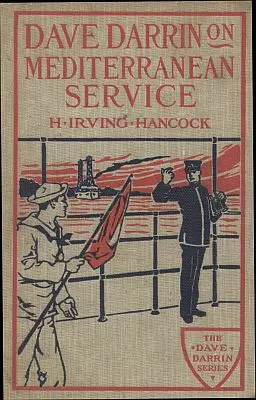
"Dave Darrin on Mediterranean Service; or, With Dan Dalzell on European Duty" by H. Irving Hancock is a naval adventure novel written in the early 20th century. The story follows two young ensigns, Dave Darrin and Dan Dalzell, as they encounter mystery and danger while serving aboard the battleship "Hudson" in the Mediterranean during World War I. The plot kicks off with the two friends in Gibraltar, where they get tangled up in a robbery involving a secret government document, setting the stage for further thrilling escapades. The opening portion introduces Darrin and Dalzell during an evening out at a theatre in Gibraltar, where they witness a brawl instigated by a suspicious character known as Mr. Green Hat. This leads to their involvement in the pursuit of a thief who steals a significant document from an American secret service agent, George Cushing. As Darrin and Dalzell navigate the ensuing chaos, they are swept into a deeper plot involving espionage that threatens to bring the United States into conflict with Great Britain. The narrative sets a gripping tone filled with camaraderie, suspense, and the perils of international intrigue, hinting at the larger challenges Darrin and Dalzell will face throughout their Mediterranean service.
Introduction adapted from the source catalogue; source summaries may be automatically generated.
Free to read · English · 50,243 words · No account needed
MAKE TIME FOR A GOOD BOOK
On by default. Untick to stop anonymous reading totals. Each page counts after 10 seconds in view. How this works.
Anonymous counting is on unless you have switched it off.
"Thank you, sir," cried Runkle, with an unmistakable wink, after which he raced for the car and the compartment in which the two young ensigns waited.
"Lieutenant Totten is holding on to the chap, sir," announced Runkle gleefully. "He won't let him go until the train's out, either."
Holding the unlocked door open a crack, Dan Dalzell watched as the train pulled away from the station.
"Totten has him, and is explaining to a policeman," Dalzell chuckled. "That spy doesn't travel with us this trip."
"What's the odds?" asked Darrin, after a pause. "Dalny must belong to a big and clever organization. He can wire ahead to spies who will board the train later on and follow us into Paris."
"Then, with your leave, sir, I'll keep my eye open for spies until we're back aboard the flagship," suggested Runkle.
"Very good, so long as you break neither laws nor bones, Runkle," Dave
laughed.
The Americans had the compartment to themselves. Had all been in uniform Runkle would not have been likely to travel in the same compartment with the young officers, but in citizen's dress much of discipline could be waived for greater safety.
Though Dan Dalzell did not now have much hope of sight-seeing in Paris, he was able, after dozing until daylight, to gaze interestedly out upon the country through which he was traveling.
Able Seaman Runkle was another absorbed window-gazer. As for Ensign Dave Darrin, while he caught many interesting glimpses of the scenery, his mind was mainly on the question of how the international plotters were planning to break the friendship between the two strongest nations on earth.
By what means could these plotters sink a British ship, and yet make it appear to be the work of Americans?
Hundreds of miles had been traveled, and one day had swung far on into another before a plausible answer came to Darrin's mind.
Then Dave fairly jumped--the thing that Admiral Timworth so dreaded
now looked quite easy.
"What's the matter?" asked Dan, staring at his chum.
"Why?" countered Dave.
"You jumped so hard," Dan replied.
"I was thinking."
"Stop it!" advised Danny Grin. "A little harder thinking than that
might wreck the train."
Dalzell enjoyed every hour of the journey. In the daylight hours he was busy "taking in" all the country through which the train passed. In the evening hours, Dan was outside on the platform, at every station, to watch the crowds, large or small.
As for Seaman Runkle, that splendid lad was absorbed, almost to the point of gloom, in watching at every station for a sign of a spy on the train with them.
Your reading position is saved on this browser. Take it to another device with a library code. Reading pages adapt to text, rather than matching a printed edition.
H. Irving (Harrie Irving) Hancock

H. Irving (Harrie Irving) Hancock

H. Irving (Harrie Irving) Hancock

H. Irving (Harrie Irving) Hancock
BEHIND THE BOOK
This eBook is for the use of anyone anywhere in the United States and most other parts of the world at no cost and with almost no restrictions whatsoever. You may copy it, give it away or re-use it under the terms of the Project Gutenberg License included with this eBook or online at www.gutenberg.org. If you are not located in the United States, you will have to check the laws of the country where you are located before using this eBook. Read the source licence.
The original source file, including credits and licence, is retained by this library. Request an original-format copy at no charge. Please include the book title and Project Gutenberg identifier #22431.
KEEP YOUR CURIOSITY GOING
Coulson Kernahan

Maurice Baring
Frances Wright
Cécile Tormay

Frederic Jesup Stimson

W. H. P. (William Henry Pope) Jarvis