
Uncle Sam’s Boys on Field Duty; or, Winning Corporal’s Chevrons
H. Irving (Harrie Irving) Hancock
THE CLASSIC COLLECTION · 1919
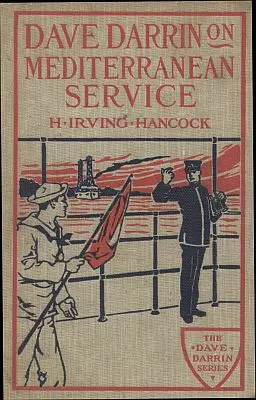
"Dave Darrin on Mediterranean Service; or, With Dan Dalzell on European Duty" by H. Irving Hancock is a naval adventure novel written in the early 20th century. The story follows two young ensigns, Dave Darrin and Dan Dalzell, as they encounter mystery and danger while serving aboard the battleship "Hudson" in the Mediterranean during World War I. The plot kicks off with the two friends in Gibraltar, where they get tangled up in a robbery involving a secret government document, setting the stage for further thrilling escapades. The opening portion introduces Darrin and Dalzell during an evening out at a theatre in Gibraltar, where they witness a brawl instigated by a suspicious character known as Mr. Green Hat. This leads to their involvement in the pursuit of a thief who steals a significant document from an American secret service agent, George Cushing. As Darrin and Dalzell navigate the ensuing chaos, they are swept into a deeper plot involving espionage that threatens to bring the United States into conflict with Great Britain. The narrative sets a gripping tone filled with camaraderie, suspense, and the perils of international intrigue, hinting at the larger challenges Darrin and Dalzell will face throughout their Mediterranean service.
Introduction adapted from the source catalogue; source summaries may be automatically generated.
Free to read · English · 50,243 words · No account needed
MAKE TIME FOR A GOOD BOOK
On by default. Untick to stop anonymous reading totals. Each page counts after 10 seconds in view. How this works.
Anonymous counting is on unless you have switched it off.
Lieutenant Whyte then unfolded, briefly, the plan of Admiral Barkham for procedure against the yacht and the submarine. To these plans Admiral Timworth quickly agreed.
"We have four large launches on the flagship," the fleet commander stated. "Three of these shall be put over the side, officered and manned and ready for instant service."
"Admiral Barkham also suggests, sir, that, during the night, the officers in command of your launches run without lights, when possible, for secrecy," Whyte continued.
"How many launches will Admiral Barkham put in service?" Admiral
Timworth inquired.
"Three, sir," responded Whyte.
"Who will be the ranking officer in your fleet of launches?"
"I believe I am to be, sir," Lieutenant Whyte replied, bowing.
"Very good," nodded Admiral Timworth. "It would not be courteous, in British waters, Mr. Whyte, for me to appoint an officer who would rank yourself, so I shall ask Captain Allen to designate Ensign Darrin as ranking officer in our launch fleet. Ensign Dalzell will naturally command another of the launches. Who will command the third, Captain?"
"Ensign Phillips," replied Captain Allen.
The courtesy of appointing an ensign to head the American launch fleet lay in the fact that an ensign is one grade lower in the service than a junior lieutenant. When naval forces of different nations act together the ranking officer, no matter what country he represents, is in command. Had Admiral Timworth put his launch fleet in charge of a lieutenant commander, for instance, then the British launches, too, would have been under the command of the American officer. As it was, Lieutenant Whyte would be ranking and commanding officer in the combined launch fleet. This was both right and courteous, as Malta is an English possession, and the waters near by are British waters.
Plans were briefly discussed, yet with the thoroughness that is given to all naval operations. Lieutenant Whyte departed, and Ensign Phillips was sent for. Admiral Timworth and Captain Allen charged the young officers with their duties, upon the successful performance of which so much depended.
"Remember, gentlemen," was Captain Allen's final word, "that, in line with what the Admiral has stated, you are merely to co-operate with, and act under the orders of, the British ranking officer. Yet, if occasion arise, you will display all needed initiative in attaining the objective, which is the capture of the scoundrelly plotters and the seizure of the submarine before it can work any mischief. You will even sink the submarine by ramming, if no other course be open to stop her wicked work."
Your reading position is saved on this browser. Take it to another device with a library code. Reading pages adapt to text, rather than matching a printed edition.
H. Irving (Harrie Irving) Hancock

H. Irving (Harrie Irving) Hancock

H. Irving (Harrie Irving) Hancock

H. Irving (Harrie Irving) Hancock
BEHIND THE BOOK
This eBook is for the use of anyone anywhere in the United States and most other parts of the world at no cost and with almost no restrictions whatsoever. You may copy it, give it away or re-use it under the terms of the Project Gutenberg License included with this eBook or online at www.gutenberg.org. If you are not located in the United States, you will have to check the laws of the country where you are located before using this eBook. Read the source licence.
The original source file, including credits and licence, is retained by this library. Request an original-format copy at no charge. Please include the book title and Project Gutenberg identifier #22431.
KEEP YOUR CURIOSITY GOING
Coulson Kernahan

Maurice Baring
Frances Wright
Cécile Tormay

Frederic Jesup Stimson

W. H. P. (William Henry Pope) Jarvis