THE CLASSIC COLLECTION✦Portraits of womenCLASSIC FREE BOOKS
Portraits of women
Gamaliel Bradford
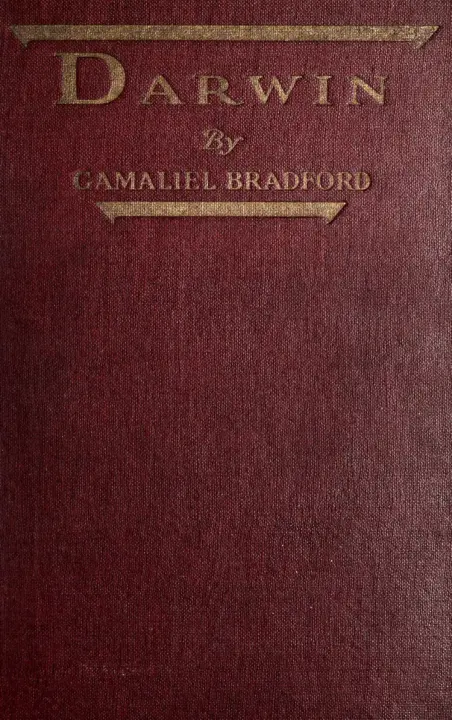
THE CLASSIC COLLECTION · 1926
"Darwin" by Gamaliel Bradford is a biographical account written in the early 20th century. This work delves into the life and mind of Charles Darwin, illustrating his profound impact on science and humanity. It explores his journey as an observer, thinker, and discoverer, unpacking how his character shaped his groundbreaking theories on evolution and natural selection. The opening of the book introduces Charles Darwin as a naturalist driven by an instinctual urge to observe the world around him. Bradford emphasizes Darwin's remarkable observational skills, recounting significant phases of his life, including his formative years, his voyage on the HMS Beagle, and his struggles with health that punctuated both his personal life and scientific pursuits. The narrative sets the stage for deeper explorations of Darwin's philosophy and scientific methodology, examining how his insights into nature were not merely academic but were also reflections of his character and humanity.
Introduction adapted from the source catalogue; source summaries may be automatically generated.
Free to read · English · 66,073 words · No account needed
MAKE TIME FOR A GOOD BOOK
On by default. Untick to stop anonymous reading totals. Each page counts after 10 seconds in view. How this works.
Anonymous counting is on unless you have switched it off.
[432] To Scott, June 6, 1863, More Letters, vol. II, p. 323.
[433] To Huxley, More Letters, vol. I, p. 125.
[434] Hooker on Darwin, Life, vol. I, p. 315.
[435] To Huxley, July 20, 1860, More Letters, vol. I, p. 158.
[436] To Günther, May 15, 1870, Life, vol. II, p. 303.
[437] To Dohrn, January 4, 1870, More Letters, vol. II, p. 444.
[438] Science and the Modern World, p. 255.
[439] Article by J. E. Harry, on the Helena of Euripides, in Journal of American Philology, October, 1925, vol. XLVI, p. 332.
[440] Speech at Royal Society Anniversary Dinner, 1894, Huxley,
Life, vol. II, p. 413.
[441] To Hooker, July 28, 1868, More Letters, vol. I, p. 305.
[442] To Farrar, August 28, 1881, More Letters, vol. I, p. 394.
[443] To Hooker, March 3, 1860, Life, vol. II, p. 85.
[444] To Lubbock, November 12, 1859, Life, vol. II, p. 14.
[445] To Carpenter, November 19, 1859, Life, vol. II, p. 19.
[446] To Madame d’Epinay, July 6, 1766, Correspondance de Voltaire (edition 1881), vol. XII, p. 329.
[447] To Hooker, 1856, More Letters, vol. I, p. 90.
[448] To Wiesner, October 25, 1881, Life, vol. II, p. 508.
[449] To Bentham, November 25, 1869, More Letters, vol. I, p. 379.
[450] To Wilson, March 5, 1879, More Letters, vol. II, p. 422.
[451] Darwin to Wallace, August 8, 1872, Life, vol. II, p. 348.
[452] Vallery-Radot, Pasteur, p. 22.
[453] To Henslow, April 1, 1848, More Letters, vol. I, p. 61.
[454] Portraits Littéraires, vol. III, p. 546.
[455] Port-Royal, vol. I, p. 55.
[456] Causeries du Lundi, vol. II, p. 268.
[457] Portraits Contemporains (1882), vol. V, p. 461.
[458] Portraits Littéraires, vol. III, p. 543.
[459] Portraits Contemporains (1882), vol. V, p. 465.
[460] Portraits Contemporains (1882), vol. V, p. 464.
[461] Portraits Littéraires, vol. III, p. 543.
[462] Journal des Goncourts, vol. II, p. 134.
[463] Conversations with Eckermann, quoted in William James, Varieties of Religious Experience, p. 137.
[464] Port-Royal, vol. VI, p. 245.
[465] To Helvetius, January 5, 1740, Correspondance (edition 1881),
vol. III, p. 356.
[466] Quoted by Sainte-Beuve, Causeries du Lundi, vol. VII, p. 47.
[467] Tristram Shandy, Book VII, chapter XXXIII.
[468] Maximen und Reflexionen, chapter III.
[469] Journal de Henri Frédéric Amiel, vol. I, p. 129.
[470] Discoveries, in Jonson’s Works (edition Cunningham), vol.
III, p. 401.
[471] Homeric Epigrams (edition Baumeister), V.
Abstemiousness, D.’s, 182.
Accuracy, D. and, in observation, 21; in statement, 22, 23; mathematical, and instruments, 24; his hobby, 59.
Achievement, motives, 96-99; D.’s attitude, 99-101.
Adams, Henry, effect of evolution on, 242.
Æsthetics, observation in, 11; D.’s attitude, 137; effect of
scientific spirit, 272, 275.
Agassiz, Alexander, on D.’s coral-reef theory, 65; on D. and candor,
105.
Agassiz, Louis, and evolution, 103.
Agnosticism, as dogma, 283, 284.
Agriculture, revolution, 11.
Ambition, as trait, D. on it, 96.
Amiel, H. F., self-dissection, 280.
Animals, D.’s love, 135, 188.
Appearance, D.’s, 168.
Appreciation, D.’s trait, 79, 80; element in scientific spirit, 263.
Architecture, D.’s attitude, 139.
Ardor, element in scientific spirit, 264.
Argument, D.’s attitude, 74.
Aristotle, on experiment, 56; and evolution, 84.
Arnold, Matthew, on Goethe, 271.
Art, D.’s attitude, 138-40; evolution and realism, 225.
Barnacles, D.’s study, 26.
Bates, H. W., and nature, 12.
Beagle, D.’s voyage, 4.
Bell, Thomas, and D., 173.
Bergson, Henri, and evolution, 235.
Bryce, Lord, on D. and Gladstone, 133; on D.’s appearance, 168.
Buckle, H. T., D. on, 143.
Your reading position is saved on this browser. Take it to another device with a library code. Reading pages adapt to text, rather than matching a printed edition.
BEHIND THE BOOK
This eBook is for the use of anyone anywhere in the United States and most other parts of the world at no cost and with almost no restrictions whatsoever. You may copy it, give it away or re-use it under the terms of the Project Gutenberg License included with this eBook or online at www.gutenberg.org. If you are not located in the United States, you will have to check the laws of the country where you are located before using this eBook. Read the source licence.
The original source file, including credits and licence, is retained by this library. Request an original-format copy at no charge. Please include the book title and Project Gutenberg identifier #70803.
KEEP YOUR CURIOSITY GOING
John L. Ransom

Herman W. Mudgett
Harriet Monroe
John Muir
Asa Gray
Asa Gray