THE CLASSIC COLLECTION✦The Little French GirlCLASSIC FREE BOOKS
The Little French Girl
Anne Douglas Sedgwick
THE CLASSIC COLLECTION · 1929
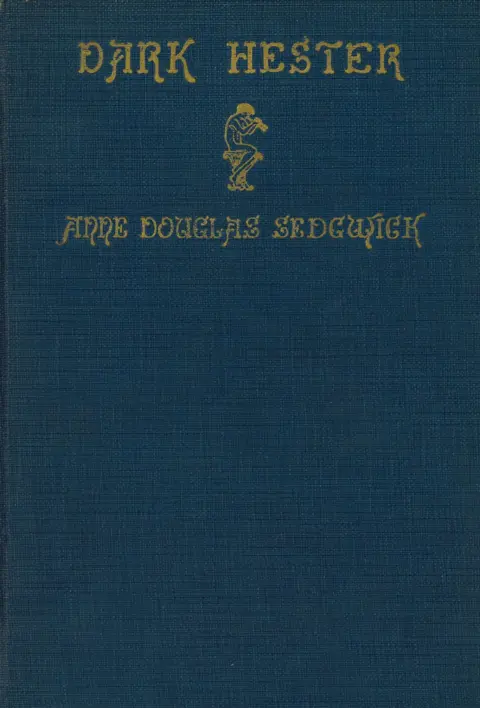
"Dark Hester" by Anne Douglas Sedgwick is a novel written in the early 20th century. It is a psychologically observant domestic drama centered on Monica Wilmott, a fiercely devoted mother unsettled by her son Clive’s marriage to the assured, modern-minded Hester Blakeston. The story probes postwar fragility, generational and cultural clashes, and the strain between tradition and avant-garde London circles, with Clive’s small son Robin and the gentle violinist Celia Bowen forming a poignant counterpoint.
The opening of the novel follows Monica living alone in Essex, thinking back to how Hester entered Clive’s life and to the first, subtle contest of wills that began with an Easter trip, a registrar’s-office wedding, and Celia’s quiet grace in defeat. We see Monica’s loneliness after she retreats from Chelsea’s modern set, her dislike of Hester’s circle, and her lingering sense that Clive has grown remote. A surprise visit brings Hester and Robin—Hester coolly diagnosing the goldfish and then announcing that she and Clive have bought The Crofts nearby—news that fills Monica with joy and dread in equal measure. Monica then visits Celia and Norah, meets Norah’s formidable uncle Captain Ingpen, and hears Norah’s fear that proximity will reopen Celia’s wounds. During a day of planning at The Crofts with Hester’s artistic friends, Monica walks with Clive and learns that the move was orchestrated—and should be credited—to Hester, a revelation that stings even as it proves their unity. At tea afterward, Hester’s set descends on Monica’s old-fashioned room; talk ranges from psychoanalysis to Chartres, while Hester’s dry dismissals and Clive’s protective tact reveal their settled bond. The section closes with Celia noting, gently but firmly, that Clive and Hester’s marriage is a true success, even as Monica feels herself shut out.
Introduction adapted from the source catalogue; source summaries may be automatically generated.
Free to read · English · 65,818 words · No account needed
MAKE TIME FOR A GOOD BOOK
On by default. Untick to stop anonymous reading totals. Each page counts after 10 seconds in view. How this works.
Anonymous counting is on unless you have switched it off.
They went slowly along the little grass track that, at the edge of the field, ran beside the copse. The sun had set and a soft evening breeze fanned their cheeks, but the golden light still enveloped them—the light in which everything could be said, and thinking of Hester’s smile just now, as she held out her hand, a smile so sweet and childlike that it brought again the sense of bewilderment and marvel, Monica asked:
‘Why did you think Clive might hate you, Hester? You haven’t told me that. It seems to me that where there is such love as that between you and Clive it is secure against all such danger.’
Hester, sustaining her arm, walked beside her, illumined in her blue against the pine-trees, and glancing at her, as she kept silence, Monica saw that it was with an effort that she now kept back her tears. ‘Tell me, Hester,’ she said.
‘Can’t you see?’ said Hester, holding her head high and keeping her eyes fixed before her. ‘It’s partly you and partly Godfrey. He couldn’t stand finding out like that. You will say that I ought to have told him at once when I found that Godfrey was living here. Perhaps I should have. Only I’m accustomed, in a way, to protecting Clive. He goes under so horribly, you know; while I’m as strong as a horse. And I couldn’t bear to make him so miserable; to bring it all up, after we’d said nothing for all these years. He begged me to say nothing more, when I told him, down in Cornwall. He didn’t want to hear the name of the man who had made me so unhappy;—though I did tell him that it was in Paris, just after I’d left Girton; but he said we’d forget it and that the only difference it made was that I was the dearer to him because of what I’d suffered. But I don’t think he ever really did forget it, poor darling,’ said Hester, smiling the bitter smile over her unshed tears. ‘I think it haunted him and tore at him, frightfully, and that the more we were to each other the more he minded. His loveliness unshackled him in so many directions, but somehow it didn’t unshackle him in that.—I mean, he felt about it, really, just as his father would have felt—if you’d had to tell him such a thing. And that was why, when I saw Godfrey again on Saturday night, I was so dreadfully upset. I knew how Clive would feel. That’s why I behaved so devilishly. I was so upset that I had to set my teeth in something; and it seemed to me that Godfrey was sneering at me and taunting me. But he was upset, too. We had parted with the most grisly quarrel—out there—at Chartres, you see;—that’s why I hate Chartres, Monica; do you remember?—and never to run into each other again, or hear of each other, and then find ourselves face to face between a husband who hadn’t forgotten and a mother-in-law who didn’t like you!—Well, you can see for yourself that it needed strong nerves. Godfrey was clever that night, wasn’t he? He played up well. I never dreamed you would find out, or guess, and thought I could manage it all and get him to go away and no one the wiser. I thought, for a day or two, that he’d go of himself, and when I found he didn’t I wrote and asked him to come and he told me—yesterday when he was with me, you know—how it had happened and the horrible ill-luck about the ring and your seeing the initials.—I saw that ring, while we played bridge that night. I gave it to him in Paris; we found it together in an old shop and I never dreamed he would have gone on wearing it.—He gave me one too; a beautiful ring; but I went out in Paris, after parting from him, and threw it into the Seine. What a little fool I was! But I couldn’t wear it myself and I couldn’t bear to think of anybody else wearing it.—Well—I seemed to see nothing while we played and while I made those imbecile mistakes—except that ring of mine on his finger.—He is going off first thing to-morrow morning, Monica. He said at once that he would go. “Give me one day to pack and settle accounts,” he said, “and none of you will ever see me again.” He left me, of course, before Clive got back. He never made muddles about things like that.—But it was too late, in a way. I mean, Clive found me crying. Can you understand that?’ Hester’s arm was steady under her mother-in-law’s hand, but Monica now saw that a slow flush had crept up to her cheek. ‘I feel as if you would. I feel as if you would understand that one might not get over the man one first loves, even if one loves someone else so much better. He tore me to pieces and made me sick with rage and shame, but I did love him most awfully, and when I saw him again, yesterday, I knew that I still did—can you understand?—And when Clive came in and found me crying, I couldn’t deny it. Why should one change because one is parted? But Clive couldn’t understand. He said he’d half killed you for my sake, because he trusted me, and that he could never forgive himself and that you had every reason to believe what you did—since half of it was true;—and I was in a rage then and said that all of it would be true, unless he were careful.—We said terrible things to each other;—for the first time.’ Hester spoke brokenly, with short, hot sentences. ‘And though we were horribly sorry afterwards and said we didn’t mean it, it’s all there still, in our minds.—For even then—even afterwards—I couldn’t tell him that I didn’t still love Godfrey, too.’
Your reading position is saved on this browser. Take it to another device with a library code. Reading pages adapt to text, rather than matching a printed edition.
Anne Douglas Sedgwick
Anne Douglas Sedgwick

Anne Douglas Sedgwick
Anne Douglas Sedgwick
BEHIND THE BOOK
This eBook is for the use of anyone anywhere in the United States and most other parts of the world at no cost and with almost no restrictions whatsoever. You may copy it, give it away or re-use it under the terms of the Project Gutenberg License included with this eBook or online at www.gutenberg.org. If you are not located in the United States, you will have to check the laws of the country where you are located before using this eBook. Read the source licence.
The original source file, including credits and licence, is retained by this library. Request an original-format copy at no charge. Please include the book title and Project Gutenberg identifier #78779.
KEEP YOUR CURIOSITY GOING
Coulson Kernahan

Maurice Baring
Frances Wright
Cécile Tormay

Frederic Jesup Stimson

W. H. P. (William Henry Pope) Jarvis