
Life of Edwin Forrest, the American Tragedian. Volume 2 (of 2)
William Rounseville Alger & Horatio, Jr. Alger
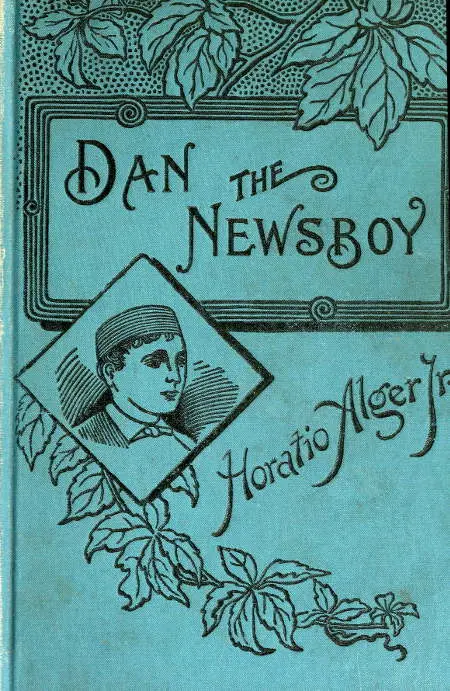
THE CLASSIC COLLECTION · 1893
"Dan, the Newsboy" by Horatio Alger, Jr. is a novel written in the late 19th century. The story revolves around a young newsboy named Dan Mordaunt, who faces the challenges of poverty after his father's death forced him and his mother into a life of hardship. The narrative explores themes of resilience, social justice, and the contrasting lives of the wealthy and the poor. At the start of the book, we meet Dan as he sells newspapers and navigates the difficulties of supporting his sick mother while dealing with the harsh realities of urban life. Dan’s character is portrayed as hardworking and caring, showing an admirable devotion to his mother. The opening chapters introduce the struggle against an unkind employer, Mr. Gripp, who withholds payment for Dan's mother's work, and highlight Dan's interactions with various characters, demonstrating his resourcefulness and determination to improve their situation. As the narrative develops, Dan encounters both kindness and cruelty, which set the stage for his personal growth and adventures ahead.
Introduction adapted from the source catalogue; source summaries may be automatically generated.
Free to read · English · 59,997 words · No account needed
MAKE TIME FOR A GOOD BOOK
On by default. Untick to stop anonymous reading totals. Each page counts after 10 seconds in view. How this works.
Anonymous counting is on unless you have switched it off.
After calling at Donovan's, on the day when Dan recovered Althea, John Hartley crossed the Courtlandt street ferry, and took a train to Philadelphia with Blake, his accomplice in the forged certificates. The two confederates had raised some Pennsylvania railway certificates, which they proposed to put on the Philadelphia market.
They spent several days in the Quaker City, and thus Hartley heard nothing of the child's escape.
Donovan did not see fit to inform him, as this would stop the weekly remittance for the child's board, and, moreover, draw Hartley's indignation down upon his head.
One day, in a copy of the New York Herald, which he purchased at the news-stand in the Continental Hotel, Hartley observed the arrival of Harriet Vernon at the Fifth Avenue Hotel.
"I thought she would come," he said to himself, with a smile. "I have her in my power at last. She must submit to my terms, or lose sight of the child altogether."
"Blake," he said, aloud, "I must take the first train to New York."
"Why, what's up, partner?" asked Blake, in surprise. "Anything gone
wrong?"
"On the contrary, I see a chance of making a good haul."
"How?"
"Not in our line. It's some private business of my own."
"All right. I wish you success. When will you return?"
"That I can't exactly say. I will write or telegraph you."
In the evening of the same day Mrs. Vernon sat in her room at the Fifth Avenue Hotel. A servant brought up a card bearing the name of John Hartley.
"He is prompt," she said to herself, with a smile. "Probably he has not heard of Althea's escape from the den to which he carried her. I will humor him, in that case, and draw him out."
"I will see the gentleman in the parlor," she said.
Five minutes later she entered the ladies' parlor. Hartley rose to receive her with a smile of conscious power, which told Harriet Vernon that he was ignorant of the miscarriage of his plans.
"I heard of your unexpected arrival, Mrs. Vernon," he commenced, "and have called to pay my respects."
"Your motive is appreciated, John Hartley," she said, coldly. "I
expected to see you."
"That's pleasant," he said, mockingly. "May I beg to apologize for constraining you to cross the Atlantic?"
"Don't apologize; you have merely acted out your nature."
"Probably that is not meant to be complimentary. However, it can't be
helped."
"I suppose you have something to say to me, John Hartley," said Mrs. Vernon, seating herself. "Pray proceed."
"You are quite right. I wrote you that I had ferreted out your cunningly devised place of concealment for my daughter."
"You did."
Your reading position is saved on this browser. Take it to another device with a library code. Reading pages adapt to text, rather than matching a printed edition.
William Rounseville Alger & Horatio, Jr. Alger

William Rounseville Alger & Horatio, Jr. Alger

Horatio, Jr. Alger

Horatio, Jr. Alger
BEHIND THE BOOK
This eBook is for the use of anyone anywhere in the United States and most other parts of the world at no cost and with almost no restrictions whatsoever. You may copy it, give it away or re-use it under the terms of the Project Gutenberg License included with this eBook or online at www.gutenberg.org. If you are not located in the United States, you will have to check the laws of the country where you are located before using this eBook. Read the source licence.
The original source file, including credits and licence, is retained by this library. Request an original-format copy at no charge. Please include the book title and Project Gutenberg identifier #53345.
KEEP YOUR CURIOSITY GOING
Cécile Tormay

Moritz Busch
Coulson Kernahan
John L. Ransom

Maurice Baring
Frances Wright