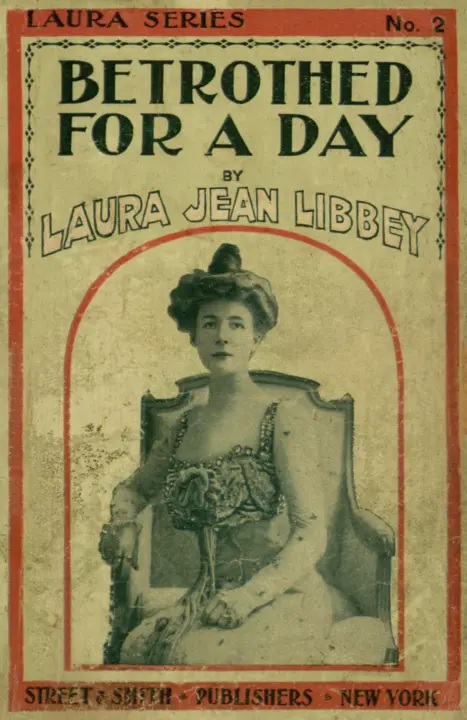
Betrothed for a day: Or, Queenie Trevalyn’s love test
Laura Jean Libbey
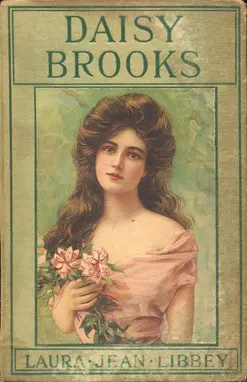
THE CLASSIC COLLECTION · 1883
"Daisy Brooks; Or, A Perilous Love" by Laura Jean Libbey is a romantic novel written in the late 19th century. The story revolves around Daisy Brooks, a young girl with a humble background, and her tumultuous relationship with Rex Lyon, a wealthy young man, intertwined with themes of class disparity, jealousy, and love. As the characters navigate their challenges, the narrative showcases the trials faced by Daisy, especially from the haughty heiress Pluma Hurlhurst, whose relationship with Rex complicates matters. The opening of the novel sets an anxious tone, introducing the return of Basil Hurlhurst with his new bride on a stormy night at Whitestone Hall. Tension mounts as his daughter, Pluma, exhibits a fierce and rebellious nature towards her father's new wife—hinting at future conflicts. Meanwhile, Daisy Brooks is introduced as a hardworking girl living under the care of her Uncle John and Aunt Septima. The narrative quickly transitions to Daisy's first encounter with Rex, which blossoms despite the looming external pressures and social hierarchies that threaten their budding romance. The dramatic backdrop of both characters' circumstances foreshadows a struggle for love in the face of societal expectations and personal ambitions.
Introduction adapted from the source catalogue; source summaries may be automatically generated.
Free to read · English · 84,755 words · No account needed
MAKE TIME FOR A GOOD BOOK
On by default. Untick to stop anonymous reading totals. Each page counts after 10 seconds in view. How this works.
Anonymous counting is on unless you have switched it off.
The agitation on his face was almost alarming. His grand old face was as white as his linen. His eyes were full of eager, painful suspense and excitement. With a violent effort at self-control he restrained his emotions, sinking back in his arm-chair like one who had received an unexpected blow.
Daisy never remembered in what words she told him the startling truth. He never interrupted her until she had quite finished.
"You will not blame Rex," she pleaded, her sweet voice choking with emotion; "he believes me dead."
Basil Hurlhurst did not answer; his thoughts were too confused. Yes, it was but too true--the marriage could not go on. He reached hastily toward the bell-rope.
"You will not let my--Rex know until I am far away," she cried,
piteously, as she put her marriage certificate in Mr. Hurlhurst's
hand.
"I am going to send for Rex to come here at once," he made answer.
With a low, agonized moan, Daisy grasped his outstretched hand,
scarcely knowing what she did.
"Oh, please do not, Mr. Hurlhurst," she sobbed. "Rex must not see me; I should die if you sent for him; I could not bear it--indeed, I could not." She was looking at him, all her heart in her eyes, and, as if he felt magnetically the power of her glance, he turned toward her, meeting the earnest gaze of the blue, uplifted eyes.
The light fell full upon her fair, flushed face, and the bonnet and veil she wore had fallen back from the golden head.
A sudden mist seemed to come before his eyes, and he caught his breath
with a sharp gasp.
"What did you say your name was before you were married?" he asked, in a low, intense voice. "I--I--did not quite understand."
"Daisy Brooks, your overseer's niece," she answered, simply.
She wondered why he uttered such a dreary sigh as he muttered, half aloud, how foolish he was to catch at every straw of hope.
Carefully he examined the certificate. It was too true. It certainly certified Rexford Lyon and Daisy Brooks were joined together in the bonds of matrimony nearly a year before. And then he looked at the paper containing the notice of her tragic death, which Daisy had read and carefully saved. Surely no blame could be attached to Rex, in the face of these proofs.
He was sorry for the beautiful, haughty heiress, to whom this terrible news would be a great shock; he was sorry for Rex, he had grown so warmly attached to him of late, but he felt still more sorry for the fair child-bride, toward whom he felt such a yearning, sympathetic pity.
Your reading position is saved on this browser. Take it to another device with a library code. Reading pages adapt to text, rather than matching a printed edition.
Laura Jean Libbey
Laura Jean Libbey
Laura Jean Libbey
Laura Jean Libbey
BEHIND THE BOOK
This eBook is for the use of anyone anywhere in the United States and most other parts of the world at no cost and with almost no restrictions whatsoever. You may copy it, give it away or re-use it under the terms of the Project Gutenberg License included with this eBook or online at www.gutenberg.org. If you are not located in the United States, you will have to check the laws of the country where you are located before using this eBook. Read the source licence.
The original source file, including credits and licence, is retained by this library. Request an original-format copy at no charge. Please include the book title and Project Gutenberg identifier #30137.
KEEP YOUR CURIOSITY GOING
Coulson Kernahan

Maurice Baring
Frances Wright
Cécile Tormay

Frederic Jesup Stimson

W. H. P. (William Henry Pope) Jarvis