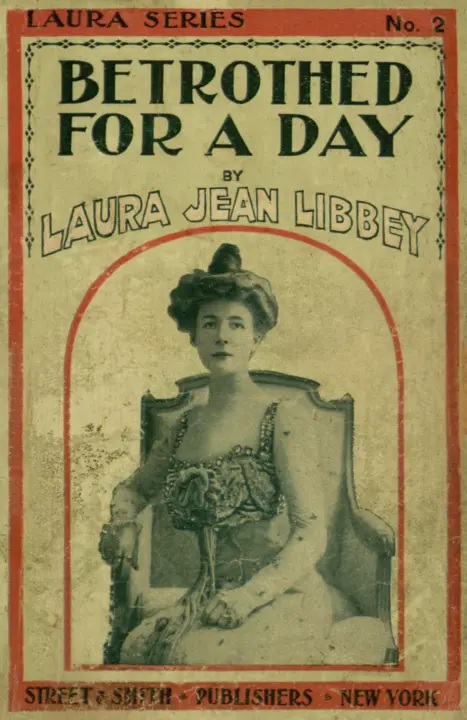
Betrothed for a day: Or, Queenie Trevalyn’s love test
Laura Jean Libbey

THE CLASSIC COLLECTION · 1883
"Daisy Brooks; Or, A Perilous Love" by Laura Jean Libbey is a romantic novel written in the late 19th century. The story revolves around Daisy Brooks, a young girl with a humble background, and her tumultuous relationship with Rex Lyon, a wealthy young man, intertwined with themes of class disparity, jealousy, and love. As the characters navigate their challenges, the narrative showcases the trials faced by Daisy, especially from the haughty heiress Pluma Hurlhurst, whose relationship with Rex complicates matters. The opening of the novel sets an anxious tone, introducing the return of Basil Hurlhurst with his new bride on a stormy night at Whitestone Hall. Tension mounts as his daughter, Pluma, exhibits a fierce and rebellious nature towards her father's new wife—hinting at future conflicts. Meanwhile, Daisy Brooks is introduced as a hardworking girl living under the care of her Uncle John and Aunt Septima. The narrative quickly transitions to Daisy's first encounter with Rex, which blossoms despite the looming external pressures and social hierarchies that threaten their budding romance. The dramatic backdrop of both characters' circumstances foreshadows a struggle for love in the face of societal expectations and personal ambitions.
Introduction adapted from the source catalogue; source summaries may be automatically generated.
Free to read · English · 84,755 words · No account needed
MAKE TIME FOR A GOOD BOOK
On by default. Untick to stop anonymous reading totals. Each page counts after 10 seconds in view. How this works.
Anonymous counting is on unless you have switched it off.
"He is thinking of Pluma's mother," thought Mrs. Corliss--but she made
no answer.
"He likes to talk to me," pursued the child, rolling the empty spools to and fro with her crutch, "for he pities me because I am lame."
"Bless your dear little heart," said Mrs. Corliss, softly stroking the little girl's curls; "it is seldom poor old master takes to any one as he has to you."
"Do I look anything like the little child that died?" questioned
Birdie.
A low, gasping cry broke from Mrs. Corliss's lips, and her face grew
ashen white. She tried to speak, but the words died away in her
throat.
"He talks to me a great deal about her," continued Birdie, "and he weeps such bitter tears, and has such strange dreams about her. Why, only last night he dreamed a beautiful, golden-haired young girl came to him, holding out her arms, and crying softly: 'Look at me, father; I am your child. I was never laid to rest beneath the violets, in my young mother's tomb. Father, I am in sore distress--come to me, father, or I shall die!' Of course it was only a dream, but it makes poor Mr. Hurlhurst cry so; and what do you think he said?"
The child did not notice the terrible agony on the old housekeeper's face, or that no answer was vouchsafed her.
"'My dreams haunt me night and day,' he cried. 'To still this wild, fierce throbbing of my heart I must have that grave opened, and gaze once more upon all that remains of my loved and long-lost bride, sweet Evalia and her little child.' He was--"
Birdie never finished her sentence.
A terrible cry broke from the housekeeper's livid lips.
"My God!" she cried, hoarsely, "after nearly seventeen years the sin of my silence is about to find me out at last."
"What is the matter, Mrs. Corliss? Are you ill?" cried the startled
child.
A low, despairing sob answered her, as Mrs. Corliss arose from her seat, took a step or two forward, then fell headlong to the floor in a deep and death-like swoon.
Almost any other child would have been terrified, and alarmed the
household.
Birdie was not like other children. She saw a pitcher of ice-water on an adjacent table, which she immediately proceeded to sprinkle on the still, white, wrinkled face; but all her efforts failed to bring the fleeting breath back to the cold, pallid lips.
At last the child became fairly frightened.
"I must go and find Rex or Mr. Hurlhurst," she cried, grasping her crutch, and limping hurriedly out of the room.
Your reading position is saved on this browser. Take it to another device with a library code. Reading pages adapt to text, rather than matching a printed edition.
Laura Jean Libbey
Laura Jean Libbey
Laura Jean Libbey
Laura Jean Libbey
BEHIND THE BOOK
This eBook is for the use of anyone anywhere in the United States and most other parts of the world at no cost and with almost no restrictions whatsoever. You may copy it, give it away or re-use it under the terms of the Project Gutenberg License included with this eBook or online at www.gutenberg.org. If you are not located in the United States, you will have to check the laws of the country where you are located before using this eBook. Read the source licence.
The original source file, including credits and licence, is retained by this library. Request an original-format copy at no charge. Please include the book title and Project Gutenberg identifier #30137.
KEEP YOUR CURIOSITY GOING
Coulson Kernahan

Maurice Baring
Frances Wright
Cécile Tormay

Frederic Jesup Stimson

W. H. P. (William Henry Pope) Jarvis