
A Son of Ishmael: A Novel
L. T. Meade
THE CLASSIC COLLECTION · 1900
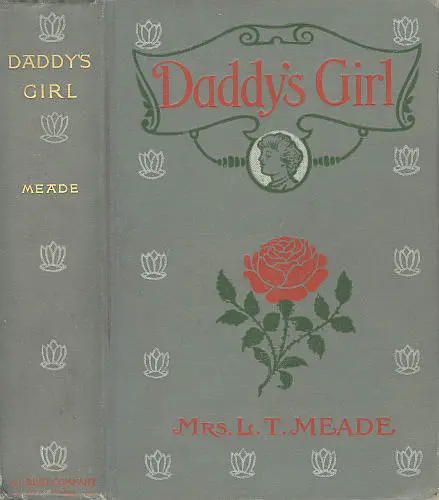
"Daddy's Girl" by L. T. Meade is a novel written during the late 19th century. The story revolves around an eight-year-old girl named Sibyl Ogilvie, affectionately referred to as "the Angel," who navigates the complexities of her family dynamics, including her quarrelling parents and her own understanding of love, beauty, and perfection. The book explores themes of innocence, the longing for parental approval, and the perceived perfection of childhood versus the reality of adult relationships. At the start of the novel, we are introduced to young Sibyl, who remains blissfully unaware of the discord between her parents, Philip and Mildred Ogilvie. While her father seems to cherish her without any conditions, her mother only doles out affection when Sibyl presents herself as pretty, leading the child to reflect deeply on relationships and her own self-worth. As Sibyl prepares for an important occasion, her innocent thoughts are colored by the stark realities of her parents’ marriage, setting the stage for a narrative rich in emotional complexity and the exploration of familial love.
Introduction adapted from the source catalogue; source summaries may be automatically generated.
Free to read · English · 75,662 words · No account needed
MAKE TIME FOR A GOOD BOOK
On by default. Untick to stop anonymous reading totals. Each page counts after 10 seconds in view. How this works.
Anonymous counting is on unless you have switched it off.
Ogilvie raised the stimulant to his lips. He took a few sips, and the color returned to his face.
"Now sign," said Rycroft again.
"Where is the pen?" asked Ogilvie.
He was all too anxious now to take the fatal plunge. His signature, firm and bold, was put to the document. He pushed it from him and stood up. Rycroft hastily added his beneath that of Ogilvie's.
"Now our work is done," cried Rycroft, "and Her Majesty's mail does the rest. By the way, I cabled a brilliant report an hour back. Grayleigh seemed anxious. There have been ominous reports in some of the London papers."
"This will set matters right," said Ogilvie. "Put it in an envelope. If I sail to-morrow, I may as well take it myself."
"Her Majesty's mail would be best," answered Rycroft. "You can see Grayleigh almost as soon as he gets the report. Remember, I am responsible for it as well as you, and it would be best for it to go in the ordinary way." As he spoke, he stretched out his hand, took the document and folded it up.
Just at this moment there came a tap at the door. Rycroft cried, "Come in," and a messenger entered with a cablegram.
"For Mr. Ogilvie," he said.
"From Grayleigh, of course," said Rycroft, "how impatient he gets! Wait outside," he continued to the messenger.
The man withdrew, and Ogilvie slowly opened the telegram. Rycroft watched him as he read. He read slowly, and with no apparent change of feature. The message was short, but when his eyes had travelled to the end, he read from the beginning right through again. Then, without the slightest warning, and without even uttering a groan, the flimsy paper fluttered from his hand, he tumbled forward, and lay in an unconscious heap on the floor.
Rycroft ran to him. He took a certain interest in Ogilvie, but above all things on earth at that moment he wanted to get the document which contained the false report safely into the post. Before he attempted to restore the stricken man, he took up the cablegram and read the contents. It ran as follows:--
"Sibyl has had bad fall from pony. Case hopeless. Come home
at once."
"So Sibyl, whoever Sibyl may be, is at the bottom of Ogilvie's fall," thought Rycroft. "Poor chap! he has got a fearful shock. Best make all safe. I must see things through."
Without an instant's hesitation Rycroft took the already signed document, thrust it into an envelope, directed it in full and stamped it. Then he went to the telegraph messenger who was still waiting outside.
Your reading position is saved on this browser. Take it to another device with a library code. Reading pages adapt to text, rather than matching a printed edition.
BEHIND THE BOOK
This eBook is for the use of anyone anywhere in the United States and most other parts of the world at no cost and with almost no restrictions whatsoever. You may copy it, give it away or re-use it under the terms of the Project Gutenberg License included with this eBook or online at www.gutenberg.org. If you are not located in the United States, you will have to check the laws of the country where you are located before using this eBook. Read the source licence.
The original source file, including credits and licence, is retained by this library. Request an original-format copy at no charge. Please include the book title and Project Gutenberg identifier #30333.
KEEP YOUR CURIOSITY GOING
Coulson Kernahan

Maurice Baring
Frances Wright
Cécile Tormay

Frederic Jesup Stimson

W. H. P. (William Henry Pope) Jarvis


