THE CLASSIC COLLECTION✦An outlaw’s diary: the CommuneCLASSIC FREE BOOKS
An outlaw’s diary: the Commune
Cécile Tormay
THE CLASSIC COLLECTION · 1865
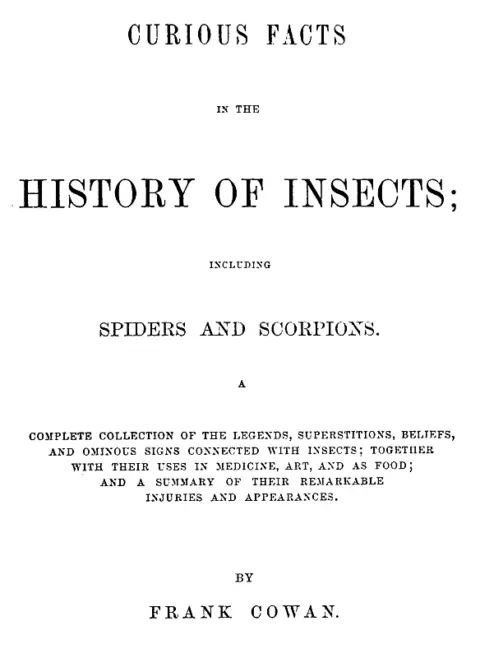
"Curious Facts in the History of Insects; Including Spiders and Scorpions" by Frank Cowan is a scientific publication written in the mid-19th century. The work explores entomology through the lens of legends, superstitions, beliefs, and various uses of insects, alongside their historical significance in medicine, art, and as food. The focus is not just on biological facts, but also on the fascinating folklore and cultural narratives associated with these creatures. At the start of the text, the author outlines his ambition to compile intriguing historical accounts related to insects, moving beyond traditional scientific boundaries. He emphasizes collecting facts from unusual sources, including chronicles and travel books, to illustrate the connections between human culture and the insect world. The opening sets the stage for a detailed examination of specific insects, beginning with the Ladybird, discussing its folklore across different cultures, and thus combining scientific classifications with rich, anecdotal history.
Introduction adapted from the source catalogue; source summaries may be automatically generated.
Free to read · English · 139,897 words · No account needed
MAKE TIME FOR A GOOD BOOK
On by default. Untick to stop anonymous reading totals. Each page counts after 10 seconds in view. How this works.
Anonymous counting is on unless you have switched it off.
Barbot, after mentioning a famine that happened in North Guinea in 1681, which destroyed many thousands of the inhabitants of the Continent, and forced many to sell themselves for slaves, to only get sustenance, says these fearful famines are also some years occasioned by the dreadful swarms of Locusts, which come from the eastward and spread over the whole country in such prodigious multitudes, that they darken the very air, passing over head like mighty clouds. They leave nothing that is green wheresoever they come, either on the ground or trees, and fly so swiftly from place to place, that whole provinces are devastated in a very short time. Barbot adds, terrific storms of hail, wind, and such like judgments from Heaven, are nothing to compare to this, which when it happens, there is no question to be made but that multitudes of the natives must starve, having no neighboring countries to supply them with corn, because those round about them are no better husbands than themselves, and are no less liable to the same calamities.[331]
Of a swarm, which in the year 1693 covered four square miles of ground, a German author has made the following estimate. Observing that, when he trod on the ground, at least three were crushed, and that in a square German measure, less than an English foot, ten were destroyed; and after determining the number of these square measures in the four miles, he concluded that ninety-two billions, one hundred and sixty millions of Locusts were congregated on the surface. This is altogether a very moderate calculation, for not only is their number more compact in breadth, but they are often piled knee-high on the earth.[332]
In 1724, Dr. Shaw was a witness of the devastations of these insects in Barbary. He has given us a description of their habits.[333] For four successive years, from 1744 to 1747, Locusts ravaged the southern provinces of Spain and Portugal.[334] In a letter from Transylvania, dated August 22d, 1747, a graphic description is given of two vast columns that overswept that country. “They form,” says the writer, “a close compact column about fifteen yards deep, in breadth about four musket-shot, and in length about four leagues; they move with such force, or rather precipitation, that the air trembles to such a degree as to shake the leaves upon the trees, and they darkened the sky in such a manner, that when they passed over us I could not see my people at twenty feet distance.”[335] This flight was four hours in passing over the Red Tower. The guards here attempted to stop them, by firing cannon at them; and where, indeed, the balls and shot swept through the swarm, they gave way and divided; but, having filled up their ranks in a moment, they proceeded on their journey.[336] In an item dated Hermanstadt, July 24, 1748, it is stated that on the day before, a hussar, coming from the plague committee, saw such a host of these insects near Szanda, that they covered the country for a mile round, and were so thick, that he was obliged to dismount from his horse, and halt for three hours, until the inhabitants of the district, coming with all sorts of instruments, beat about and forced with loud cries these pests to quit the spot.[337] In another item, dated Warsaw, August 15, 1748, it is stated that a certain prince sent out soldiers against the Locusts, who fired upon them not only with small arms, but with cannons. They succeeded in dividing the Locusts, but unluckily with the noise frightened away the storks and cranes which daily consume many of these insects.[338] Some stragglers from these swarms which so desolated Wallachia, Moldavia, Transylvania, Hungary, and Poland, in the years 1747 and ’48, made their way into England, where they caused some alarm.[339] During this grand invasion of Europe, they even crossed the Baltic, and visited Sweden in 1749. Charles the Twelfth, in Bessarabia, imagined himself, it is said, assailed by a hurricane, mingled with tremendous hail, when a cloud of these insects suddenly falling, and covering both men and horses, arrested his entire army in its march.[340]
Your reading position is saved on this browser. Take it to another device with a library code. Reading pages adapt to text, rather than matching a printed edition.
BEHIND THE BOOK
This eBook is for the use of anyone anywhere in the United States and most other parts of the world at no cost and with almost no restrictions whatsoever. You may copy it, give it away or re-use it under the terms of the Project Gutenberg License included with this eBook or online at www.gutenberg.org. If you are not located in the United States, you will have to check the laws of the country where you are located before using this eBook. Read the source licence.
The original source file, including credits and licence, is retained by this library. Request an original-format copy at no charge. Please include the book title and Project Gutenberg identifier #41625.
KEEP YOUR CURIOSITY GOING
Cécile Tormay

Moritz Busch
John L. Ransom

Maurice Baring
Frances Wright
Cécile Tormay