THE CLASSIC COLLECTION✦An outlaw’s diary: the CommuneCLASSIC FREE BOOKS
An outlaw’s diary: the Commune
Cécile Tormay
THE CLASSIC COLLECTION · 1865
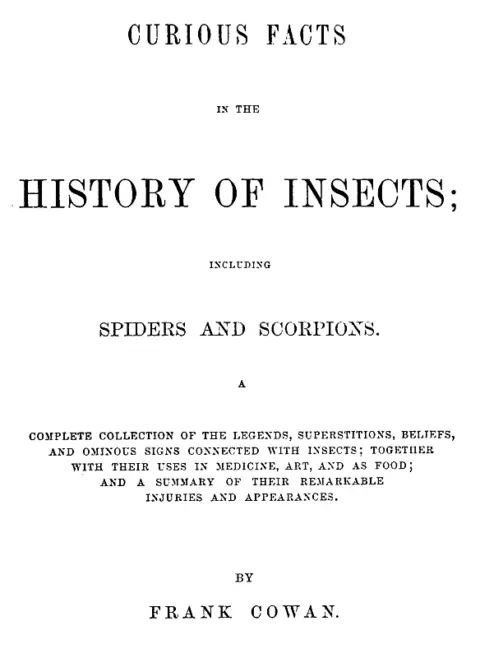
"Curious Facts in the History of Insects; Including Spiders and Scorpions" by Frank Cowan is a scientific publication written in the mid-19th century. The work explores entomology through the lens of legends, superstitions, beliefs, and various uses of insects, alongside their historical significance in medicine, art, and as food. The focus is not just on biological facts, but also on the fascinating folklore and cultural narratives associated with these creatures. At the start of the text, the author outlines his ambition to compile intriguing historical accounts related to insects, moving beyond traditional scientific boundaries. He emphasizes collecting facts from unusual sources, including chronicles and travel books, to illustrate the connections between human culture and the insect world. The opening sets the stage for a detailed examination of specific insects, beginning with the Ladybird, discussing its folklore across different cultures, and thus combining scientific classifications with rich, anecdotal history.
Introduction adapted from the source catalogue; source summaries may be automatically generated.
Free to read · English · 139,897 words · No account needed
MAKE TIME FOR A GOOD BOOK
On by default. Untick to stop anonymous reading totals. Each page counts after 10 seconds in view. How this works.
Anonymous counting is on unless you have switched it off.
At the present time, children in France practice the same method of capturing Crickets for amusement; substituting, however, an ant for the “sillie flie,” and a long straw for “the haire of one’s head.” Hence comes the common proverb in France, il est sot comme un grillon. A ruse for capturing the larva of the Cicindela, now commonly practiced by entomologists, is founded on the same principle.
Pliny further says: “The Cricquets above rehearsed, either reduced into a liniment, or else bound too, whole as they be, cureth the accident of the lap of the eare, wounds, contusions, bruises,” etc.[300]
Dr. James, quoting Schroder and Dale, says: “The ashes of the Cricket (Gryllus domesticus) exhibited, are said to be diuretic; the expressed juice, dropped into the eyes, is a remedy for weakness of the sight, and alleviates disorders of the tonsils, if rubbed on them.”[301]
The English name Cricket, the French Cri-cri, the Dutch Krekel, and the Welsh Cricell and Cricella, are evidently derived from the creak-ing sounds of these insects.
Gryllidæ--Grasshoppers.
Mr. Hughes, after describing an ash-colored Grasshopper (which may be his ash-colored cricket before mentioned),[302] remarks that the superstitious of the inhabitants of Barbados are very apprehensive of some approaching illness to the family, whenever this insect flies into their houses in the evening or in the night.[303]
Athenæus tells us the ancient Greeks used to eat the common Grasshopper and the Monkey-grasshopper as provocatives of the appetite. Aristophanes says:
How can you, in God’s name, like Grasshoppers, Catching them with a reed, and Cercopes?[304]
Turpin tells us there is a kind of brown Grasshopper in Siam, which the natives consider a delicate food.[305]
“Fernandus Oniedus declareth furthermore,” says Peter Martyr in his History of the West Indies, “that in a certain region called Zenu, lying fourescore and tenne miles from Darrina Eastwarde, they exercise a strange kinde of marchaundize: For in the houses of the inhabitantes they found great chests and baskets, made of twigges and leaves of certaine trees apt for that purpose, being all ful of Grasshoppers, Grilles, Crabbes, Crefishes, Snails also, and Locustes, which destroie the fields of corne, all well dried and salted. Being demanded why they reserved such a multitude of these beastes: they answered, that they kept them to be sowlde (sold) to the borderors, which dwell further within the lande, and that for the exchange of these pretious birdes, and salted fishes, they received of them certayne straunge thinges, wherein partly they take pleasure, and partly use them for the necessarie affaires.”[306]
Your reading position is saved on this browser. Take it to another device with a library code. Reading pages adapt to text, rather than matching a printed edition.
BEHIND THE BOOK
This eBook is for the use of anyone anywhere in the United States and most other parts of the world at no cost and with almost no restrictions whatsoever. You may copy it, give it away or re-use it under the terms of the Project Gutenberg License included with this eBook or online at www.gutenberg.org. If you are not located in the United States, you will have to check the laws of the country where you are located before using this eBook. Read the source licence.
The original source file, including credits and licence, is retained by this library. Request an original-format copy at no charge. Please include the book title and Project Gutenberg identifier #41625.
KEEP YOUR CURIOSITY GOING
Cécile Tormay

Moritz Busch
John L. Ransom

Maurice Baring
Frances Wright
Cécile Tormay