THE CLASSIC COLLECTION✦An outlaw’s diary: the CommuneCLASSIC FREE BOOKS
An outlaw’s diary: the Commune
Cécile Tormay
THE CLASSIC COLLECTION · 1865
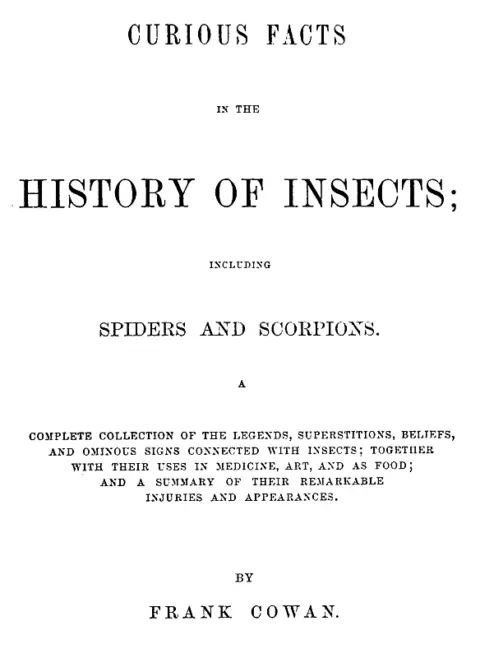
"Curious Facts in the History of Insects; Including Spiders and Scorpions" by Frank Cowan is a scientific publication written in the mid-19th century. The work explores entomology through the lens of legends, superstitions, beliefs, and various uses of insects, alongside their historical significance in medicine, art, and as food. The focus is not just on biological facts, but also on the fascinating folklore and cultural narratives associated with these creatures. At the start of the text, the author outlines his ambition to compile intriguing historical accounts related to insects, moving beyond traditional scientific boundaries. He emphasizes collecting facts from unusual sources, including chronicles and travel books, to illustrate the connections between human culture and the insect world. The opening sets the stage for a detailed examination of specific insects, beginning with the Ladybird, discussing its folklore across different cultures, and thus combining scientific classifications with rich, anecdotal history.
Introduction adapted from the source catalogue; source summaries may be automatically generated.
Free to read · English · 139,897 words · No account needed
MAKE TIME FOR A GOOD BOOK
On by default. Untick to stop anonymous reading totals. Each page counts after 10 seconds in view. How this works.
Anonymous counting is on unless you have switched it off.
Dr. Colin, of Philadelphia, has mentioned, also, on the authority of a missionary, a “vegetable fly,” similar to the last mentioned, on the Ohio River.[275]
The inhabitants of the Sechell Islands raise the Mantis siccifolia, or Dry-leaf Mantis, as an object of commerce and natural history.
Achetidæ--Crickets.
In the Island of Barbados, the natives look upon the creaking chirp of a species of Cricket, to which Hughes has given the name of the Ash-colored or Sickly Cricket, when heard in the house, as an omen of death to some one of the family.[277]
In England, also, is the Cricket’s chirp sometimes looked upon as prognosticating death. “When Blonzelind expired,” Gay, in his Pastoral Dirge, says,
And shrilling Crickets in the chimney cry’d.[278]
So also in Reed’s Old Plays is the Cricket’s cry ominous of death:
And the strange Cricket i’ th’ oven sings and hops.
The same superstition is found in the following line from the Œdipus of
Dryden and Lee:
Owels, ravens, Crickets, seem the watch of death.
Gaule mentions, among other vain observations and superstitious ominations thereupon, “the Cricket’s chirping behind the chimney stack, or creeping on the foot-pace.”[279]
Dr. Nathaniel Horne, after saying that “by the flying and crying of ravens over their houses, especially in the dusk of evening, and when one is sick, they conclude death,” adds, “the same they conclude of a Cricket crying in a house where there was wont to be none.”[280]
“Some sort of people,” says Mr. Ramsay, in his Elminthologia, “at every turn, upon every accident, how are they therewith terrified! If but a Cricket unusually appear, or they hear but the clicking of a Death-watch, as they call it, they, or some one else in the family, shall die!”[281]
Gilbert White, the accurate naturalist of Selborne, speaking of Crickets, says: “They are the house-wife’s barometer, foretelling her when it will rain; and are prognostics sometimes, she thinks, of ill or good luck, of the death of a near relation, or the approach of an absent lover. By being the constant companions of her solitary hours, they naturally become the objects of her superstition.”[282]
The voice of the Cricket, says the Spectator, has struck more terror
than the roaring of a lion.
Mrs. Bray also notices that the Cricket’s chirp in England, which in almost all other countries, and in that too in some families, as will be shown hereafter, is considered a cheerful and a welcome note, the harbinger of joy,--is deemed by the peasantry ominous of sorrow and evil.[283]
Your reading position is saved on this browser. Take it to another device with a library code. Reading pages adapt to text, rather than matching a printed edition.
BEHIND THE BOOK
This eBook is for the use of anyone anywhere in the United States and most other parts of the world at no cost and with almost no restrictions whatsoever. You may copy it, give it away or re-use it under the terms of the Project Gutenberg License included with this eBook or online at www.gutenberg.org. If you are not located in the United States, you will have to check the laws of the country where you are located before using this eBook. Read the source licence.
The original source file, including credits and licence, is retained by this library. Request an original-format copy at no charge. Please include the book title and Project Gutenberg identifier #41625.
KEEP YOUR CURIOSITY GOING
Cécile Tormay

Moritz Busch
John L. Ransom

Maurice Baring
Frances Wright
Cécile Tormay