THE CLASSIC COLLECTION✦An outlaw’s diary: the CommuneCLASSIC FREE BOOKS
An outlaw’s diary: the Commune
Cécile Tormay
THE CLASSIC COLLECTION · 1865
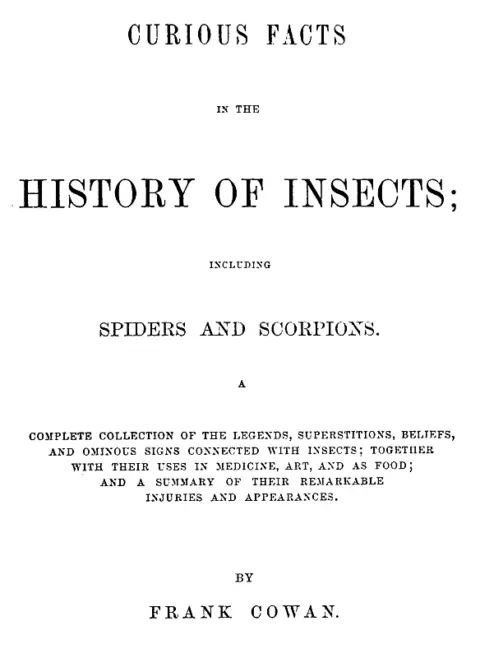
"Curious Facts in the History of Insects; Including Spiders and Scorpions" by Frank Cowan is a scientific publication written in the mid-19th century. The work explores entomology through the lens of legends, superstitions, beliefs, and various uses of insects, alongside their historical significance in medicine, art, and as food. The focus is not just on biological facts, but also on the fascinating folklore and cultural narratives associated with these creatures. At the start of the text, the author outlines his ambition to compile intriguing historical accounts related to insects, moving beyond traditional scientific boundaries. He emphasizes collecting facts from unusual sources, including chronicles and travel books, to illustrate the connections between human culture and the insect world. The opening sets the stage for a detailed examination of specific insects, beginning with the Ladybird, discussing its folklore across different cultures, and thus combining scientific classifications with rich, anecdotal history.
Introduction adapted from the source catalogue; source summaries may be automatically generated.
Free to read · English · 139,897 words · No account needed
MAKE TIME FOR A GOOD BOOK
On by default. Untick to stop anonymous reading totals. Each page counts after 10 seconds in view. How this works.
Anonymous counting is on unless you have switched it off.
To this account, in the Hist. of Insects printed by John Murray, 1830, i. 269, is added: “The governor of the Bastile hearing that this unfortunate prisoner had found a solace in the society of a Spider, paid Pelisson a visit, desiring to see the manœuvres of the insect. The Basque struck up his notes, the Spider instantly came to be fed by his friend; but the moment it appeared on the floor of the cell, the governor placed his foot on its body, and crushed it to death.”
[1134] The Mirror, xxvii. 69.
[1135] Hone’s Ev. Day Book, i. 334.
[1136] Stray Leaves from the Book of Nature.
[1137] Quart. Rev. for Jan. 1844.
[1138] This passage from Pliny is thus translated by Bostock and Riley: “Presages are also drawn from the Spider, for when a river is about to swell, it will suspend its web higher than usual. In calm weather these insects do not spin, but when it is cloudy they do, and hence it is, that a great number of cobwebs is a sure sign of showery weather.”--Nat. Hist., xi. 24 (28). Trans., iii. 28.
[1139] Brande’s Pop. Antiq., iii. 223.
[1140] Ev. Day Bk., i. 931. Quot. also in Chamb. Journ., 1st Ser.,
vi. 95.
[1141] Paus. Hist. of Greece, B. 9, c. 6.
[1142] Fosbr. Encycl. of Antiq.
[1143] Jamieson’s Scottish Dict.
[1144] Brande’s Pop. Antiq., iii. 223.
[1145] N. and Q., iii. 3.
[1146] Worthies, p. 58. Pt. II. Ed. 1662.
[1147] N. and Q., ii. 165.
[1148] Aulul., A. i. Sc. 3.
[1149] Thorpe’s North. Antiq., iii. 329.
[1150] N. and Q., 2d ed. iv. 298.
[1151] Ibid., iv. 377.
[1152] Gent. Mag., June, 1771, xli. 251.
[1153] N. and Q., 2d ed. iv. 523.
[1154] Ibid., iv. 421.
[1155] Ibid., iv. 298.
[1156] Vulg. Err., B. iii. c. 277. Works, ii. 527.
[1157] Pliny says the Spider, poised in its web, will throw itself upon the head of a serpent as it lies stretched beneath the shade of the tree where it has built, and with its bite pierce its brain; such is the shock, he continues, that the creature will hiss from time to time, and then, seized with vertigo, coil round and round, while it finds itself unable to take to flight, or so much as to break the web of the Spider, as it hangs suspended above; this scene, he concludes, only ends with its death.--Nat. Hist., x. 95.
[1158] Browne’s Works, ii. 524, note.
[1159] Med. Dict., sub Araneus.
[1160] Univers. Hist., i. 48, also Gent. Mag., xli. 400.
[1161] Trav., p. 322, and Astley’s Col. of Voy. and Trav., ii. 726. Bosman says this “was the greatest piece of ignorance and stupidity he observed in the negroes.”
[1162] Churchill’s Col. of V. and T., v. 222.
[1163] N. and Q., vii. 431.
[1164] Chamb. Misc., vol. xi. No. 100.
[1165] Ibid.
[1166] The Mirror, xxvii. 69.
[1167] B. 7, c. xv. p. 665. Printed 1613.
[1168] Eliz. Cook’s Journ., vii. 378.
[1169] Wanley’s Wonders, i. 20.
[1170] Silliman’s Journal, xxvii. 307-10.
Your reading position is saved on this browser. Take it to another device with a library code. Reading pages adapt to text, rather than matching a printed edition.
BEHIND THE BOOK
This eBook is for the use of anyone anywhere in the United States and most other parts of the world at no cost and with almost no restrictions whatsoever. You may copy it, give it away or re-use it under the terms of the Project Gutenberg License included with this eBook or online at www.gutenberg.org. If you are not located in the United States, you will have to check the laws of the country where you are located before using this eBook. Read the source licence.
The original source file, including credits and licence, is retained by this library. Request an original-format copy at no charge. Please include the book title and Project Gutenberg identifier #41625.
KEEP YOUR CURIOSITY GOING
Cécile Tormay

Moritz Busch
John L. Ransom

Maurice Baring
Frances Wright
Cécile Tormay