THE CLASSIC COLLECTION✦An outlaw’s diary: the CommuneCLASSIC FREE BOOKS
An outlaw’s diary: the Commune
Cécile Tormay
THE CLASSIC COLLECTION · 1865
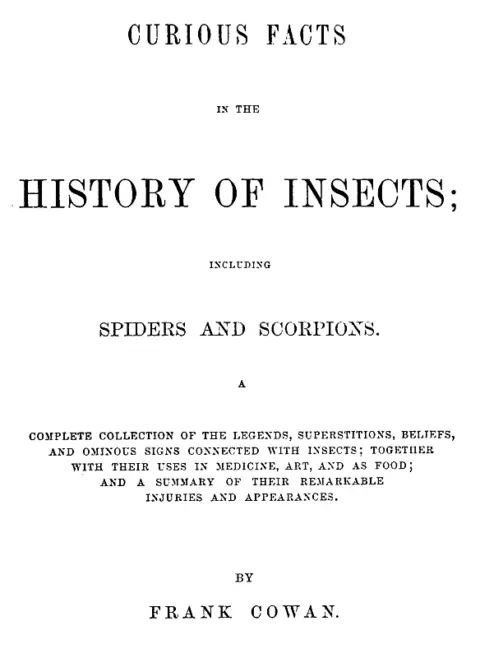
"Curious Facts in the History of Insects; Including Spiders and Scorpions" by Frank Cowan is a scientific publication written in the mid-19th century. The work explores entomology through the lens of legends, superstitions, beliefs, and various uses of insects, alongside their historical significance in medicine, art, and as food. The focus is not just on biological facts, but also on the fascinating folklore and cultural narratives associated with these creatures. At the start of the text, the author outlines his ambition to compile intriguing historical accounts related to insects, moving beyond traditional scientific boundaries. He emphasizes collecting facts from unusual sources, including chronicles and travel books, to illustrate the connections between human culture and the insect world. The opening sets the stage for a detailed examination of specific insects, beginning with the Ladybird, discussing its folklore across different cultures, and thus combining scientific classifications with rich, anecdotal history.
Introduction adapted from the source catalogue; source summaries may be automatically generated.
Free to read · English · 139,897 words · No account needed
MAKE TIME FOR A GOOD BOOK
On by default. Untick to stop anonymous reading totals. Each page counts after 10 seconds in view. How this works.
Anonymous counting is on unless you have switched it off.
[797] Reaumur considers this cry to be produced by the friction of the palpi against the proboscis (Memoires, ii. 293). Huber, but without mentioning the particulars, says he has ascertained that Reaumur was quite mistaken (On Bees, p. 313, note). Schroeter ascribes the sound to the rubbing of the tongue against the head; and Rösel to the friction of the chest upon the abdomen. M. de Johet thinks it is produced by the air being suddenly propelled against these scales by the action of the wings. M. Lorry states that the sound arises from the air escaping rapidly through peculiar cavities communicating with the spiracles, and furnished with a fine tuft of hairs on the sides of the abdomen (Cuv. An. Kingd.--Ins., ii. 678). Mr. E. L. Layard seems to be of the same opinion (Tennent’s Nat. Hist. of Ceylon, p. 427). But M. Passerini, curator of the Museum of Nat. Hist. at Florence, has lately investigated the subject more minutely. He traced the origin of the sound to the interior of the head, in which he discovered a cavity at the passage where muscles are placed for impelling and expelling the air. M. Dumeril has since discovered a sort of membrane stretched over this cavity, like, as he says, to the head of a drum. M. Duponchel has also confirmed by experiment the opinions of Passerini and Dumeril, and confutes Lorry, whose notion was generally adopted, by stating that the noise is produced from the head when the body of the insect is removed (Annales des Sci. Nat., Mars., 1828).
[798] Cf. Penny Encycl., sub. Sphinx, and The Mirror, xix. 212.
[799] Hist. of Ins., p. 191.
[800] Reaumur, ii. 289. Shaw, Zool., vi. 217.
[801] Saturday Mag., xix. 102.
[802] Notes and Queries, xii. 200.
[803] Bonnet, Œvres, ii. 124.
[804] China, p. 253. Astley’s Col. of Voy. and Trav., iv. 138.
[805] Williams’ Middle Kingdom, ii. 121-2.
[806] Colebrook, Asiat. Research., v. 61.
[807] Aristotle, v. 17-9. Pliny, ix. 20.
[808] Paus. Hist. of Greece, B. 6, c. 26.
[809] Aristot. Hist. An., v. 19.
[810] Pliny, Nat. Hist., xi. 23.
[811] Ibid., xi. 22.
[812] Tacitus, Ann., B. 2, c. 33.
[813] Nat. Hist., xi. 22.
[814] Cf. Gibbon’s Decl. and Fall of Rom. Em., c. 40.
[815] Some authors, however, assert that the name was suggested by the resemblance of the Morea to the shape of the mulberry-leaf, a less plausible opinion by far than the former.
[816] Thuanus, in contradiction to most other writers, makes the manufacture of silk to be introduced into Sicily two hundred years later, by Robert the Wise, King of Sicily and Count of Provence.
[817] Burgon’s Life of Sir Thomas Gresham, 1839, i. 110, 302.
[818] Stow’s Chronicle, edit. 1631, p. 887.
[819] Keysler, Trav., i. 289.
[820] Olin, Travels.
[821] Polit. Essay on N. Spain, iii. 59.
[822] Skinner’s Pres. State of Peru, p. 346, note. Southey’s Hist. of Brazil, iii. 644. Calancha’s Augustine Hist. of Peru, i. 66.
Your reading position is saved on this browser. Take it to another device with a library code. Reading pages adapt to text, rather than matching a printed edition.
BEHIND THE BOOK
This eBook is for the use of anyone anywhere in the United States and most other parts of the world at no cost and with almost no restrictions whatsoever. You may copy it, give it away or re-use it under the terms of the Project Gutenberg License included with this eBook or online at www.gutenberg.org. If you are not located in the United States, you will have to check the laws of the country where you are located before using this eBook. Read the source licence.
The original source file, including credits and licence, is retained by this library. Request an original-format copy at no charge. Please include the book title and Project Gutenberg identifier #41625.
KEEP YOUR CURIOSITY GOING
Cécile Tormay

Moritz Busch
John L. Ransom

Maurice Baring
Frances Wright
Cécile Tormay