THE CLASSIC COLLECTION✦An outlaw’s diary: the CommuneCLASSIC FREE BOOKS
An outlaw’s diary: the Commune
Cécile Tormay
THE CLASSIC COLLECTION · 1865
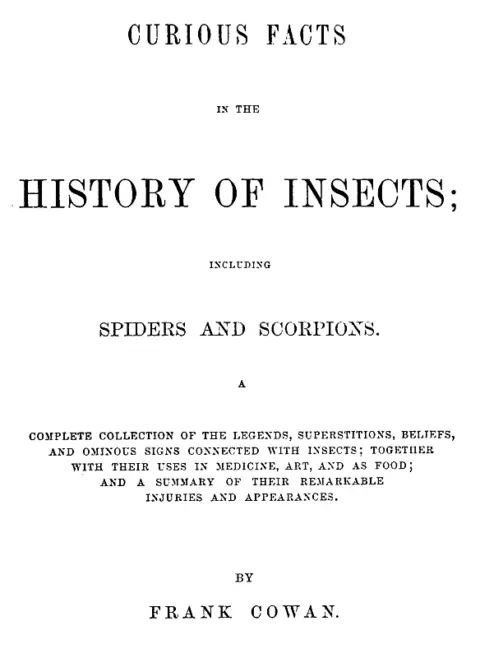
"Curious Facts in the History of Insects; Including Spiders and Scorpions" by Frank Cowan is a scientific publication written in the mid-19th century. The work explores entomology through the lens of legends, superstitions, beliefs, and various uses of insects, alongside their historical significance in medicine, art, and as food. The focus is not just on biological facts, but also on the fascinating folklore and cultural narratives associated with these creatures. At the start of the text, the author outlines his ambition to compile intriguing historical accounts related to insects, moving beyond traditional scientific boundaries. He emphasizes collecting facts from unusual sources, including chronicles and travel books, to illustrate the connections between human culture and the insect world. The opening sets the stage for a detailed examination of specific insects, beginning with the Ladybird, discussing its folklore across different cultures, and thus combining scientific classifications with rich, anecdotal history.
Introduction adapted from the source catalogue; source summaries may be automatically generated.
Free to read · English · 139,897 words · No account needed
MAKE TIME FOR A GOOD BOOK
On by default. Untick to stop anonymous reading totals. Each page counts after 10 seconds in view. How this works.
Anonymous counting is on unless you have switched it off.
Hare, feet of, to drive away Bugs, 266;
urine of, in a prescription, 76.
Harp, Cicada emblem of, 252.
Harts, their antidote for poison, 353.
Hawking with Butterflies, 230.
Hawk, Scarab figured with head of, 34.
Hawk-moths, 232-234.
Headache, Scarab on an emerald for, 45.
Head-dresses, Butterflies on, 230.
Heart, worm in the, of a horse, 365.
Hedge-hog kept to kill Roaches, 78.
Heliocantharus of the ancients, 27.
Heliogabalus estimates population of Rome
from collection of Spiders, 334.
Hemorrhages, Ants for, 162;
Galls, 145.
Hen, dung of, for sting of Scorpions, 326;
moisture from mouth of, for same, 327.
Hercules-beetle, 45-47.
Hercules, god of the Flies, 292.
Heteroptera, 265-277.
Hieroglyphics, Cicadas as, 253;
Scarab, 35, 37, 43, n.
Hispaniola ravaged by Ants, 166.
History, study of, from cabinet of insects, 369.
Hiving Bees, curious practice at, 189.
Hoax: bloody-rain in Tennessee, 224.
Holy men, Lice nourished by, 317.
Holy water, Caterpillars destroyed with, 243;
Locusts, 116.
Homoptera, 250-264.
Honey, 208-211.
Honey-dew, 257.
Hops, Aphides and Lady-birds killed on, 21;
injury to, from Hop-fly, 258.
Hornets, 170-174, 194.
Horns of Scarabæi in medicine, 26.
Horse-hair, Gnats destroyed by, 285.
Horse-leeches eaten in Cumana, 98.
Horses, Bots in, 303;
dung of, for sting of Scorpions, 326;
diseases of, Hornets’ nest for, 172;
in descriptions of Locusts, 118;
Hornets generated from carcass of, 171, 184;
Wasps, 170.
Hottentots, Bee-dance of, 211;
make floors of clay of Ant-hills, 135;
origin of Locusts, 123;
worship of Mantis, 84-88.
House-fly, 41, 287-301.
House-leek for sting of Scorpions, 326.
Humble-bees, 213.
Hundred hives of Bees, cannot have, 188.
Hungary, Fleas in, 308;
poisonous Fly, 303;
shower of insects, 365.
Hydrophobia, Oil-beetles for, 63.
Hymenoptera, 142-215.
Hymn, singing of, when hiving Bees, 190.
Hysteria, Bed-bugs for, 267.
Ibis in Egypt, 43, n.
Iceland, bloody-rain in, 218.
Ideographic, Scarab as an, 35.
Ignatius, Lice nourished by, 317.
Illness, omen of, from Black-beetle, 82;
Grasshopper, 98.
Incantations, Locusts destroyed by, 116.
Incontinence detected by Bees, 181.
India, Ants in, 152;
Blister-flies, 63;
Buprestidæ, 50;
Dung-beetle, 29;
fabled gold-loving Ants of, 146;
Fire-flies in, 57;
larva of beetle eaten in, 70;
Mantis in, 83;
Silk-worms, 235;
Spiders, 342;
Termites, 132-137.
Indians, American, Butterfly totem of, 229;
Caterpillars destroyed by, 244;
Cicadas eaten, 254;
Cut-worms destroyed, 247;
Grasshoppers eaten, 99;
name for Bees, 197.
Ingenuity of Ants, 154.
Ink, Galls in manufacture of, 145.
Inquisitive persons compared to Flies, 291.
Ireland, Bees in, 181;
Coffin-cutter, 368;
Gnats, 281;
May-bugs, 48;
Spiders, 358.
Irish oak, Spiders repelled by, 340.
Isis, respect of Scorpions for, 328;
Scarab figured with the head of, 34.
Italy, Blister-flies in, 63;
Glow-worms, 57;
Gnats, 281;
Locusts, 102-130;
Scorpions, 324;
Silk-worms, 237.
Ivory, Ants carved out of, 170.
Jack-’o-lanterns, Glow-worms supposed to be, 57;
Mole-crickets, 57.
James I., anecdote of, 239.
Jamaica, Cantharis maxima, in, 64;
Cockroaches, 78;
Crickets, 96;
Dragon-flies, 140;
frogs, 55;
Gnats, 282.
Japan, Grasshoppers in, 100;
Moths and Night-flies, 242.
Jaundice, Blatta of Pliny for, 67;
Lice, 319;
Oil of Scorpions, 330.
Java, larvæ of beetle eaten in, 70;
Mantis in, 87.
Jays preserved to kill Locusts, 114.
Jerusalem saved by Locusts, 119.
Jews, Locusts eaten by, 101;
as playthings for children, 130;
massacred on account of bloody-rain, 218;
not permitted to burn Fleas, 311.
Jiggers, 314.
Julian the Apostate, army of, routed by Mosquitoes, 282.
July, swarm of Bees in, 192.
June, swarm of Bees in, 192.
Jupiter in the form of an Ant, 151.
Your reading position is saved on this browser. Take it to another device with a library code. Reading pages adapt to text, rather than matching a printed edition.
BEHIND THE BOOK
This eBook is for the use of anyone anywhere in the United States and most other parts of the world at no cost and with almost no restrictions whatsoever. You may copy it, give it away or re-use it under the terms of the Project Gutenberg License included with this eBook or online at www.gutenberg.org. If you are not located in the United States, you will have to check the laws of the country where you are located before using this eBook. Read the source licence.
The original source file, including credits and licence, is retained by this library. Request an original-format copy at no charge. Please include the book title and Project Gutenberg identifier #41625.
KEEP YOUR CURIOSITY GOING
Cécile Tormay

Moritz Busch
John L. Ransom

Maurice Baring
Frances Wright
Cécile Tormay