THE CLASSIC COLLECTION✦An outlaw’s diary: the CommuneCLASSIC FREE BOOKS
An outlaw’s diary: the Commune
Cécile Tormay
THE CLASSIC COLLECTION · 1865
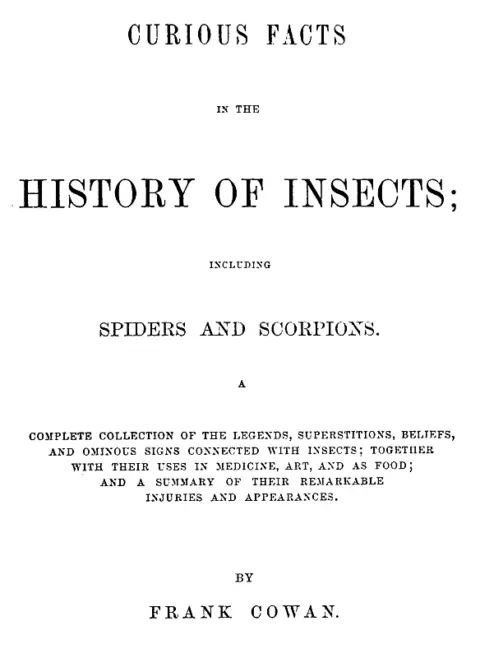
"Curious Facts in the History of Insects; Including Spiders and Scorpions" by Frank Cowan is a scientific publication written in the mid-19th century. The work explores entomology through the lens of legends, superstitions, beliefs, and various uses of insects, alongside their historical significance in medicine, art, and as food. The focus is not just on biological facts, but also on the fascinating folklore and cultural narratives associated with these creatures. At the start of the text, the author outlines his ambition to compile intriguing historical accounts related to insects, moving beyond traditional scientific boundaries. He emphasizes collecting facts from unusual sources, including chronicles and travel books, to illustrate the connections between human culture and the insect world. The opening sets the stage for a detailed examination of specific insects, beginning with the Ladybird, discussing its folklore across different cultures, and thus combining scientific classifications with rich, anecdotal history.
Introduction adapted from the source catalogue; source summaries may be automatically generated.
Free to read · English · 139,897 words · No account needed
MAKE TIME FOR A GOOD BOOK
On by default. Untick to stop anonymous reading totals. Each page counts after 10 seconds in view. How this works.
Anonymous counting is on unless you have switched it off.
Ear, Beetle in the, of Capt. Speke, 79, n.;
Cockroach in the, of a Swede, 79;
Blatta of Pliny for diseases of the, 66;
Bugs, 267;
Cockroaches, 78;
Crickets, 97;
Spiders, 357;
Stag-beetles, 26;
worms extracted from children’s, 371.
Ear-wigs, 76, 77.
East Indies, Locusts in, 112, 113;
Termites, 137.
Egypt, Beetles eaten by the women in, 65;
buried with the dead, 24;
bloody-waters, 223, n.;
Buprestis, 29;
Copris, 29;
Cicadas, 253;
frontiers of, made known from inscriptions on Scarabæi, 35;
Gnats in, 282;
insects embalmed in, 41;
Locusts in, 101, 113;
Scarab worshiped, 29-42;
Scorpions in, 328.
Egyptian pottery, Flies on, 292;
worship of animals, theory on, 43, n.
Elateridæ, 51-55.
Elater noctilucus, 51-55, 255.
Elephant named Lucas, 24;
put to flight by Ants, 157.
Elf-shot, cattle said to be, 303.
Elizabeth, Queen, silk stockings worn by, 238.
Eloquence foretold by Bees, 178.
Embalmed, Buprestis, 30;
House-fly, 41;
Scarab, 41.
Embalming, Honey used for, 208.
Embroidered, Spiders, on ladies’ dresses, 354.
Emerald, Beetle engraven on, against witchcraft, 44.
Emmets, 146-170.
Emperor of China and the Locusts, 128.
Enchantment, counter-charm for, 192.
Encouragement taken from an Ant, 154;
Spider, 333.
Enemies represented by a Scorpion and a Crocodile fighting, 324; sign of, from dreams of Flies, 289.
England, Aphides in, 258;
Bed-bugs, 265, 299;
beetles buried with the dead, 24;
Bees, 181-184;
bloody-rain, 217;
Buprestidæ, 50;
Caterpillars, 242;
Crickets, 92-94;
Death’s-head Moth, 233;
Fleas, 314;
Flies, 287;
Gnats, 278;
hedge-hogs kept to kill roaches, 78;
Lady-birds in, 17-23;
Locusts, 107;
silk and silk-worms, 238;
Spiders, 336;
Stag-beetles, 25.
Engravers, Scarab used by, to steady their sight, 44.
Enormous prices paid for insects, 46, 64.
Equator, Lice leave sailors when crossing, 317.
Epeira clavipes, 362.
Ephemeridæ, 138.
Epigram compared to a Scorpion, 331;
on an Ant, 169;
Bee, 212;
Silk-worm, 241.
Epilepsy, larvæ of Bots for, 302.
Epitaph, cure for worms, on account of an, 363.
Erinaceus Europæus, 78.
Eruca officinalis, 245.
Esteem for Ant-lions, 141.
Etruscans, Egyptian Scarab adopted by, 39.
Etymology of Cricket, 97;
Locust, 130;
Pulex, 305.
Eucharist, holy, respect of Bees for, 174-177.
Eumeta, 245.
Eumolpus auratus, 23.
Eunota amphyoxis, 224.
Euplexoptera, 67-77.
Euplœa coras, 228.
prothoe, 228.
Europe, Antler-moth in, 246;
Bee-caravans, 199;
Deaths’-head moth, 233;
Dragon-flies, 139;
insect ornaments, 44;
Locusts in, 102-130;
Mantis, 83;
Silk-worms, 235;
Termites, 132-137;
trade in insects, 366.
Eutimis nobilis, 68.
Evil eye, silk-worms susceptible to, 239.
Exorcised, Ants, 169;
Locusts, 116;
Turnip-fly, 74.
Eyes, cobwebs for defluxions of, 356;
green Scarab for, 44;
Honey in preparation for, 209;
oil of Scorpions for, 330;
Scarab for protuberating, 44.
Eynchitus aureus, 71.
Fairies, Ants supposed to be, 152;
Gossamer spun by, 349.
Famine foretold by Grasshoppers, 100;
maggot, 143;
Mantis, 83.
Farriers, Cantharides employed by, 64.
Fat, beetle eaten by women to become, 65.
Fecundity, Scarab symbolical of, 33;
eaten to cause, 33.
Fever, Bugs medicine for, 367;
Honey-dew, 257;
Spiders, 357, 359;
sign of, from dreams of Flies, 289.
Fever, man dead from, Scarab symbol of, 33.
Figs, caprification of, 144;
for sting of scorpions, 326.
Fighting, beetles kept for, 368;
Mantis, 87.
Fire, alarms of, occasioned by Gnats, 278.
Fire-flies, 51-55.
Fires occasioned by Stag-beetles, 25;
Scorpion surrounded with, 328;
to destroy Canker-worms, 248.
Fish killed by a Spider, 346;
Locusts hatched from spawn, 118;
for sting of Scorpions, 326;
spawn of, sold for eggs of silk-worms, 241.
Flata limbata, 254.
Flatterers compared to Flies, 291.
Fleas, 266, 273, 135, 305-315.
Fleur de lis, origin of, on arms of France, 196.
Your reading position is saved on this browser. Take it to another device with a library code. Reading pages adapt to text, rather than matching a printed edition.
BEHIND THE BOOK
This eBook is for the use of anyone anywhere in the United States and most other parts of the world at no cost and with almost no restrictions whatsoever. You may copy it, give it away or re-use it under the terms of the Project Gutenberg License included with this eBook or online at www.gutenberg.org. If you are not located in the United States, you will have to check the laws of the country where you are located before using this eBook. Read the source licence.
The original source file, including credits and licence, is retained by this library. Request an original-format copy at no charge. Please include the book title and Project Gutenberg identifier #41625.
KEEP YOUR CURIOSITY GOING
Cécile Tormay

Moritz Busch
John L. Ransom

Maurice Baring
Frances Wright
Cécile Tormay