THE CLASSIC COLLECTION✦An outlaw’s diary: the CommuneCLASSIC FREE BOOKS
An outlaw’s diary: the Commune
Cécile Tormay
THE CLASSIC COLLECTION · 1865
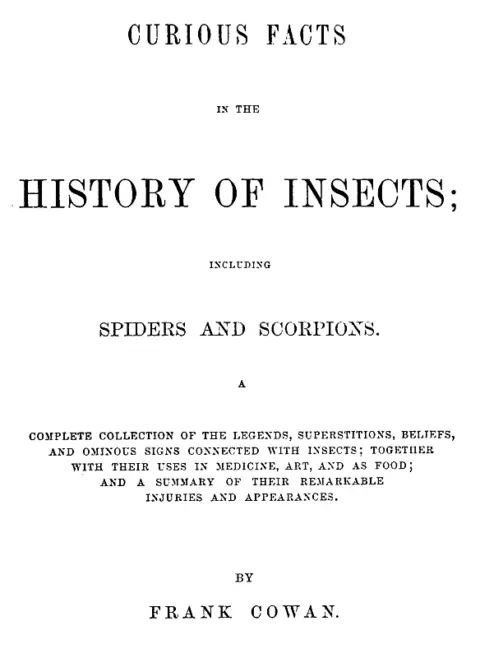
"Curious Facts in the History of Insects; Including Spiders and Scorpions" by Frank Cowan is a scientific publication written in the mid-19th century. The work explores entomology through the lens of legends, superstitions, beliefs, and various uses of insects, alongside their historical significance in medicine, art, and as food. The focus is not just on biological facts, but also on the fascinating folklore and cultural narratives associated with these creatures. At the start of the text, the author outlines his ambition to compile intriguing historical accounts related to insects, moving beyond traditional scientific boundaries. He emphasizes collecting facts from unusual sources, including chronicles and travel books, to illustrate the connections between human culture and the insect world. The opening sets the stage for a detailed examination of specific insects, beginning with the Ladybird, discussing its folklore across different cultures, and thus combining scientific classifications with rich, anecdotal history.
Introduction adapted from the source catalogue; source summaries may be automatically generated.
Free to read · English · 139,897 words · No account needed
MAKE TIME FOR A GOOD BOOK
On by default. Untick to stop anonymous reading totals. Each page counts after 10 seconds in view. How this works.
Anonymous counting is on unless you have switched it off.
This is most probably but a sleight-of-hand performance, since “worms, like those which breed in musty weevily flower,” could easily be obtained and concealed in her hand or sleeve; imagination would then effect the cure, as probably it had done the disease.
Dr. Livingstone and his party, in traveling in South Africa, sometimes suffered considerably from scarcity of meat, though not from absolute want of food. And the natives, says this traveler, to show their sympathy, gave the children, who suffered most, a large kind of caterpillar, which they seemed to relish. He concluded these insects could not be unwholesome, for the natives devoured them in large quantities themselves.[1265]
Abortion, Ant to cause, 170;
from hurt, Cochineal to prevent, 262.
Abraxas for curing diseases, 37-39.
Acanthocinus ædilis, 73.
tribulus, 74.
Acaridæ, 321.
Acarus, 320, 321.
Acheta domestica, 92-97.
Achetidæ, 92-97.
Acid made from Ants, 161.
Acridites lincola, 126.
Acridophagi, account of the, 120.
Adultery, insect to detect, 367.
Africa, Ants in, 156-7;
Bees, 191, 200;
Butterflies, 227, 231;
Caterpillars, 372;
Crickets, 95;
Dragon-flies, 140;
Flies, 288;
Gnats, 282;
Goliath-beetle, 46;
Larvæ, 71;
Lice, 317;
Locusts, 101-130;
Mantis, 84-88;
Soap from beetle, 23;
Spiders, 354;
Termites, 132-137.
Agaric-Gnat, 286.
Agestrata luconica, 49.
Agrotis telifera, 247.
Ague, Bed-bugs as a remedy for, 67;
Dung-beetle, 44;
Oil of Scorpions, 330;
Spiders, 357-360;
Stag-beetle, 26.
Albugo, Cobwebs remedy for, 357.
Ali Gamooni, forger of Scarab-gems, 38, n.
Alopecia, Bees remedy for, 206.
Altars ornamented with Chrysalids, 231.
Amber, Ant inclosed in, 169;
Bee, 212.
America, Bees in, 197;
Crickets, 95;
Fleas, 313;
Gnats, 281;
Lady-birds, 21;
Lice, 318;
Musk-beetle, 73;
Spiders, 354.
Amputation on account of Chigoes, 315.
Animals becoming plants, 90-92;
Egyptian worship of, theory on, 43, n.
Anobium pertinax, 61.
striatum, 61.
tesselatum, 58-61.
Anopleura, 316-320.
Ant-hills, ovens made of, 134.
Antipathy to Beetles, 74;
Spiders, 344.
Antler-moth, 246.
Ant-lions, 141.
Ants, 146-170, 196, 295, 322, 327, 356.
Anus, prolapsed, Scarab remedy for, 44.
Aphaniptera, 305-315.
Aphidæ, 257-259.
Aphis humuli, 258.
Apidæ, 174-215.
Apis centuncularis, 213.
Apple-blossoms, May-bugs produced with, 47.
Apocalypse, symbolical Locusts of the, 123.
Apollo, Locusts destroyed by, 128.
Aquitaine, bloody-rain in, 218.
Arabia, beetle eaten by women of, 65;
Silk-worms in, 239.
Arachnida, 321-362.
Araneidæ, 332-362.
Aranea diadema, 361.
Aranea edulis, 354.
obtextrix, 347.
tarantula, 351.
Arctiidæ, 242-245.
Arctia chrysorrhœa, 242.
Armies routed by Mosquitoes, 282.
Armpits, Silk-worms hatched under, 240.
Arms, Bees on coat of, 196;
Butterfly, 229.
Army-worm, 247.
Arrows tipped with poison of an Ant, 161.
Artificial flowers, beetles upon, 23.
Artillery employed against Ants, 168;
Locusts, 106.
Ascarides in human stomach, 67.
Asia, Honey-dew in, 257;
Locusts, 103-130.
Ass, dung of, for sting of Scorpions, 326;
Fleas do not bite, 310;
Hornets generated from carcass of, 171;
Locusts, 101;
Scarabs, 170;
Scarab supposed to make its balls of the dung of, 28;
Silk woven by an, 241;
sting of Scorpions transferred to, 325;
Wasps generated from carcass of, 170.
Assyria, Egyptian Scarab-gems among ruins of, 39-41.
Assyrians, Locusts eaten by the, 126.
Astringent, Galls as an, 145.
Astronomical subjects, Scarab connected with, 33, 37.
Ateuchus Ægyptorum, 29.
sacer, 29-43.
Athenians, golden cicadas worn by, 251;
Locusts eaten by, 120.
Athens, so-called Flies at, 291, n.
Atrophy, Lice remedy for, 319.
Auks, snow colored red by, 220, n.
Australia, Butterflies in, 231;
Flies, 288;
larvæ eaten in, 70.
Automaton Flies, 294.
Your reading position is saved on this browser. Take it to another device with a library code. Reading pages adapt to text, rather than matching a printed edition.
BEHIND THE BOOK
This eBook is for the use of anyone anywhere in the United States and most other parts of the world at no cost and with almost no restrictions whatsoever. You may copy it, give it away or re-use it under the terms of the Project Gutenberg License included with this eBook or online at www.gutenberg.org. If you are not located in the United States, you will have to check the laws of the country where you are located before using this eBook. Read the source licence.
The original source file, including credits and licence, is retained by this library. Request an original-format copy at no charge. Please include the book title and Project Gutenberg identifier #41625.
KEEP YOUR CURIOSITY GOING
Cécile Tormay

Moritz Busch
John L. Ransom

Maurice Baring
Frances Wright
Cécile Tormay