THE CLASSIC COLLECTION✦An outlaw’s diary: the CommuneCLASSIC FREE BOOKS
An outlaw’s diary: the Commune
Cécile Tormay
THE CLASSIC COLLECTION · 1865
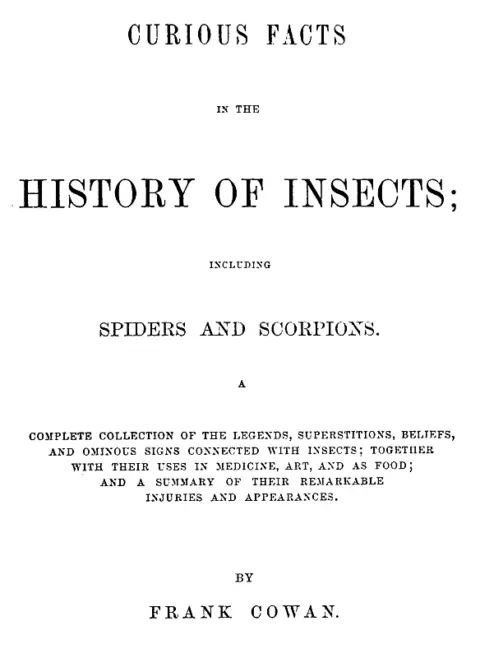
"Curious Facts in the History of Insects; Including Spiders and Scorpions" by Frank Cowan is a scientific publication written in the mid-19th century. The work explores entomology through the lens of legends, superstitions, beliefs, and various uses of insects, alongside their historical significance in medicine, art, and as food. The focus is not just on biological facts, but also on the fascinating folklore and cultural narratives associated with these creatures. At the start of the text, the author outlines his ambition to compile intriguing historical accounts related to insects, moving beyond traditional scientific boundaries. He emphasizes collecting facts from unusual sources, including chronicles and travel books, to illustrate the connections between human culture and the insect world. The opening sets the stage for a detailed examination of specific insects, beginning with the Ladybird, discussing its folklore across different cultures, and thus combining scientific classifications with rich, anecdotal history.
Introduction adapted from the source catalogue; source summaries may be automatically generated.
Free to read · English · 139,897 words · No account needed
MAKE TIME FOR A GOOD BOOK
On by default. Untick to stop anonymous reading totals. Each page counts after 10 seconds in view. How this works.
Anonymous counting is on unless you have switched it off.
“Among the approved Remedies of Sir Matthew Lister, I find,” says Dr. James, “that the distilled water of black Spiders is an excellent cure for wounds, and that this was one of the choice secrets of Sir Walter Raleigh....
“The Spider is said to avert the paroxisms of fevers, if it be applied to the pulse of the wrist, or the temples; but it is peculiarly recommended against a quartan, being enclosed in the shell of a hazlenut....
“The Spider, which some call the catcher, or wolf, being beaten into a plaister, then sewed up in linen, and applied to the forehead and temples, prevents the return of the tertian.... There is another kind of Spider, which spins a white, fine, and thick web. One of this sort, wrapped in leather, and hung about the arm, will, it is said, avert the fit of a quartan. Boiled in oil of roses, and distilled into the ears, it eases (says Dioscorides, ii. 68) pains in those parts....
“The country people have a tradition, that a small quantity of Spiders’ web, given about an hour before the fit of an ague, and repeated immediately before it, is effectual in curing that troublesome, and sometimes obstinate distemper.... The Indians about North Carolina have great dependence on this remedy for ague, to which they are much subject.”[1227]
“Of the cod or bags of Spiders, M. Bon caused a sort of drops to be made, in imitation of those of Goddard, because they contain a great quantity of volatile salt.”[1228]
Moufet, in Theatrum Insectorum, has the following: “Also that knotty whip of God, and mock of all physicians, the Gowt, which learned men say can be cured by no remedy, findes help and cure by a Spider layed on, if it be taken at that time when neither sun nor moon shine, and the hinder legs pulled off, and put into a deer’s skin and bound to the pained foot, and be left on it for some time. Also for the most part we finde those people to be free from the gowt of hands or feet (which few medicaments can doe), in whose houses the Spiders breed much, and doth beautifie them with her tapestry and hangings.... Our chirurgeons cure warts thus: They wrap a Spider’s ordinary web into the fashion of a ball, and laying it on the wart, they set it on fire, and so let it burn to ashes; by this means the wart is rooted out by the roots, and will never grow again.... I cannot but repeat a history that I formerly heard from our dear friend worthy to be believed, Bruerus. A lustfull nephew of his, having spent his estate in rioting and brothel-houses, being ready to undertake anything for money, to the hazzard of his life; when he heard of a rich matron of London, that was troubled with a timpany, and was forsaken of all physicians as past cure, he counterfeited himself to be a physician in practice, giving forth that he would cure her and all diseases. But as the custom is, he must have half in hand, and the other half under her hand, to be payed when she was cured. Then he gave her a Spider to drink, as supposing her past cure, promising to make her well in three dayes, and so in a coach with four horses he presently hastes out of town, lest there being a rumor of the death of her (which he supposed to be very neer) he should be apprehended for killing her. But the woman shortly after by the force of the venome was cured, and the ignorant physician, who was the author of so great a work, was not known. After some moneths this good man returns, not knowing what had happened, and secretly enquiring concerning the state of that woman, he heard she was recovered. Then he began to boast openly, and to ask her how she had observed her diet, and he excused his long absence, by reason of the sickenesse of a principal friend, and that he was certain that no harm could proceed from so healthful physick; also he asked confidently for the rest of his reward, and to be given him freely.”[1229]
Your reading position is saved on this browser. Take it to another device with a library code. Reading pages adapt to text, rather than matching a printed edition.
BEHIND THE BOOK
This eBook is for the use of anyone anywhere in the United States and most other parts of the world at no cost and with almost no restrictions whatsoever. You may copy it, give it away or re-use it under the terms of the Project Gutenberg License included with this eBook or online at www.gutenberg.org. If you are not located in the United States, you will have to check the laws of the country where you are located before using this eBook. Read the source licence.
The original source file, including credits and licence, is retained by this library. Request an original-format copy at no charge. Please include the book title and Project Gutenberg identifier #41625.
KEEP YOUR CURIOSITY GOING
Cécile Tormay

Moritz Busch
John L. Ransom

Maurice Baring
Frances Wright
Cécile Tormay