THE CLASSIC COLLECTION✦An outlaw’s diary: the CommuneCLASSIC FREE BOOKS
An outlaw’s diary: the Commune
Cécile Tormay
THE CLASSIC COLLECTION · 1865
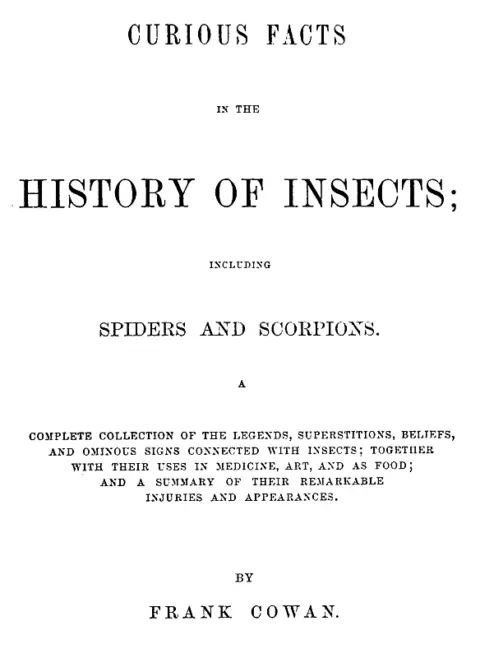
"Curious Facts in the History of Insects; Including Spiders and Scorpions" by Frank Cowan is a scientific publication written in the mid-19th century. The work explores entomology through the lens of legends, superstitions, beliefs, and various uses of insects, alongside their historical significance in medicine, art, and as food. The focus is not just on biological facts, but also on the fascinating folklore and cultural narratives associated with these creatures. At the start of the text, the author outlines his ambition to compile intriguing historical accounts related to insects, moving beyond traditional scientific boundaries. He emphasizes collecting facts from unusual sources, including chronicles and travel books, to illustrate the connections between human culture and the insect world. The opening sets the stage for a detailed examination of specific insects, beginning with the Ladybird, discussing its folklore across different cultures, and thus combining scientific classifications with rich, anecdotal history.
Introduction adapted from the source catalogue; source summaries may be automatically generated.
Free to read · English · 139,897 words · No account needed
MAKE TIME FOR A GOOD BOOK
On by default. Untick to stop anonymous reading totals. Each page counts after 10 seconds in view. How this works.
Anonymous counting is on unless you have switched it off.
In a modern account of Scotland, written by an English gentleman, and printed in the year 1670, we find the following: “In that interval between Adam and Moses, when the Scottish Chronicle commences, the country was then baptized (and most think with the sign of the cross) by the venerable name of Scotland, from Scota, the daughter of Pharaoh, King of Egypt. Hence came the rise and name of these present inhabitants, as their Chronicle informs us, and is not to be doubted of, from divers considerable circumstances; the plagues of Egypt being entailed upon them, that of Lice (being a judgment unrepealed) is an ample testimony, these loving animals accompanied them from Egypt, and remain with them to this day, never forsaking them (but as rats leave a house) till they tumble into their graves.”[1079]
Linnæus, seemingly very anxious to become an apologist for the Lice, gravely observes that they probably preserve children who are troubled with them, from a variety of complaints to which they would be liable![1080]
As an attempt toward discovering the intention of Providence in permitting the frequency of these tormenting animals, the following lines of Serenus may be given:
See nature, kindly provident ordain
Her gentle stimulants to harmless pain;
Lest Man, the slave of rest, should waste away
In torpid slumber life’s important day!
Of the horrible disease, Phthiriasis, occasioned by myriads of Lice, Pediculi, and sometimes by Mites, Acari, and Larvæ in general, I shall but mention that the inhuman Pheretrina, Antiochus Epiphanes, the Dictator Sylla, the two Herods, the Emperor Maximin, and Philip the Second were among the number carried off by it.
Quintus Serenus speaks thus of the death of Sylla:
Great Sylla too the fatal scourge hath known;
Slain by a host far mightier than his own.
According to Pliny, Nits are destroyed by using dog’s fat, eating serpents cooked like eels, or else taking their sloughs in drink.[1081]
In Leyden’s Notes to Complaynt of Scotland are recorded the following few rhymes of the Gyre-carlin--the bug-bear of King James V.
The Mouse, the Louse, and Little Rede,
Were a’ to mak’ a gruel in a lead.
The two first associates desire Little Rede to go to the door, to “see what he could see.” He declares that he saw the gyre-carlin coming,
With spade, and shool, and trowel,
To lick up a’ the gruel.
Upon which the party disperse:
The Louse to the claith,
And the Mouse to the wa’,
Little Rede behind the door,
And licket up a’.[1082]
Acaridæ--Mites.
Your reading position is saved on this browser. Take it to another device with a library code. Reading pages adapt to text, rather than matching a printed edition.
BEHIND THE BOOK
This eBook is for the use of anyone anywhere in the United States and most other parts of the world at no cost and with almost no restrictions whatsoever. You may copy it, give it away or re-use it under the terms of the Project Gutenberg License included with this eBook or online at www.gutenberg.org. If you are not located in the United States, you will have to check the laws of the country where you are located before using this eBook. Read the source licence.
The original source file, including credits and licence, is retained by this library. Request an original-format copy at no charge. Please include the book title and Project Gutenberg identifier #41625.
KEEP YOUR CURIOSITY GOING
Cécile Tormay

Moritz Busch
John L. Ransom

Maurice Baring
Frances Wright
Cécile Tormay