THE CLASSIC COLLECTION✦An outlaw’s diary: the CommuneCLASSIC FREE BOOKS
An outlaw’s diary: the Commune
Cécile Tormay
THE CLASSIC COLLECTION · 1865
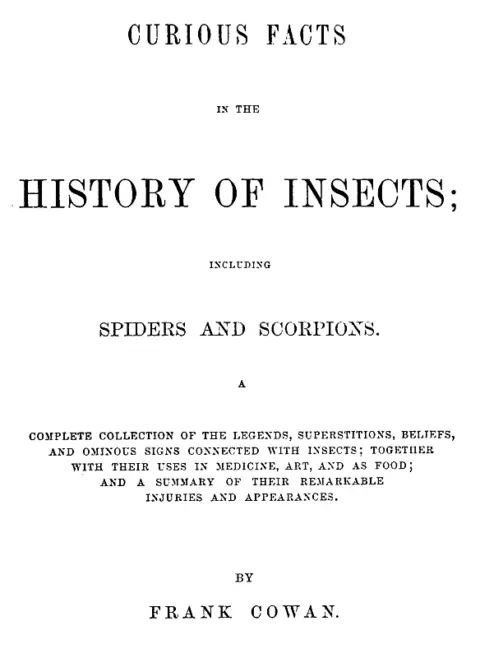
"Curious Facts in the History of Insects; Including Spiders and Scorpions" by Frank Cowan is a scientific publication written in the mid-19th century. The work explores entomology through the lens of legends, superstitions, beliefs, and various uses of insects, alongside their historical significance in medicine, art, and as food. The focus is not just on biological facts, but also on the fascinating folklore and cultural narratives associated with these creatures. At the start of the text, the author outlines his ambition to compile intriguing historical accounts related to insects, moving beyond traditional scientific boundaries. He emphasizes collecting facts from unusual sources, including chronicles and travel books, to illustrate the connections between human culture and the insect world. The opening sets the stage for a detailed examination of specific insects, beginning with the Ladybird, discussing its folklore across different cultures, and thus combining scientific classifications with rich, anecdotal history.
Introduction adapted from the source catalogue; source summaries may be automatically generated.
Free to read · English · 139,897 words · No account needed
MAKE TIME FOR A GOOD BOOK
On by default. Untick to stop anonymous reading totals. Each page counts after 10 seconds in view. How this works.
Anonymous counting is on unless you have switched it off.
It has been conjectured that the Fly, under which Baalzebub was represented, was the Tumble-bug, Scarabæus pilluarius; in which case, says Dr. Smith, Baalzebub and Beelzebub might be used indifferently.[995]
“Urspergensis saith that the Devil did very frequently appear in the form of a Fly; whence it was that some of the heathens called their familiar spirit Musca or Fly: perchance alluding to that of Plautus:
Hic pol musca est, mi pater,
Sive profanum, sive publicum, nil clam illum haberi potest:
Quin adsit ibi illico, et rem omnem tenet.--
This man, O my father, is a Fly, nothing can be concealed from him, be it secret or publick, he is presently there, and knowes all the matter.”[996]
Loke, the deceiver of the gods, is fabled in the Northern Mythology, to have metamorphosed himself into a Fly: and demons, in the shape of Flies, were kept imprisoned by the Finlanders, to be let loose on men and beasts.[997]
In Scotland, a tutelary Fly, believed immortal, presided over a fountain in the county of Banff: and here also a large blue Fly, resting on the bark of trees, was distinguished as a witch.[998]
Among the games and plays of the ancient Greeks was the Χαλκη Μυῖα, or Brazen Fly:--a variety of blind-man’s-buff, in which a boy having his eyes bound with a fillet, went groping round, calling out, “I am seeking the Brazen Fly.” His companions replied, “You may seek, but you will not find it”--at the same time striking him with cords made of the inner bark of the papyros; and thus they proceeded till one of them was taken.[999]
This is most probably an allusion to some species of Fly of a bronze color which is most difficult to catch, as, for instance, the little fly found in summer beneath arbors, apparently standing motionless in the air.
Petrus Ramus tells us of an iron Fly, made by Regiomontanus, a famous mathematician of Nuremberg, which, at a feast, to which he had invited his familiar friends, flew forth from his hand, and taking a round, returned to his hand again, to the great astonishment of the beholders. Du Bartas thus expresses this:
Once as this artist, more with mirth than meat, Feasted some friends whom he esteemed great, Forth from his hand an iron Fly flew out; Which having flown a perfect round-about, With weary wings return’d unto her master: And as judicious on his arm he plac’d her. O! wit divine, that in the narrow womb Of a small fly, could find sufficient room For all those springs, wheels, counterpoise and chains, Which stood instead of life, and blood, and veins![1000]
Your reading position is saved on this browser. Take it to another device with a library code. Reading pages adapt to text, rather than matching a printed edition.
BEHIND THE BOOK
This eBook is for the use of anyone anywhere in the United States and most other parts of the world at no cost and with almost no restrictions whatsoever. You may copy it, give it away or re-use it under the terms of the Project Gutenberg License included with this eBook or online at www.gutenberg.org. If you are not located in the United States, you will have to check the laws of the country where you are located before using this eBook. Read the source licence.
The original source file, including credits and licence, is retained by this library. Request an original-format copy at no charge. Please include the book title and Project Gutenberg identifier #41625.
KEEP YOUR CURIOSITY GOING
Cécile Tormay

Moritz Busch
John L. Ransom

Maurice Baring
Frances Wright
Cécile Tormay