THE CLASSIC COLLECTION✦An outlaw’s diary: the CommuneCLASSIC FREE BOOKS
An outlaw’s diary: the Commune
Cécile Tormay
THE CLASSIC COLLECTION · 1865
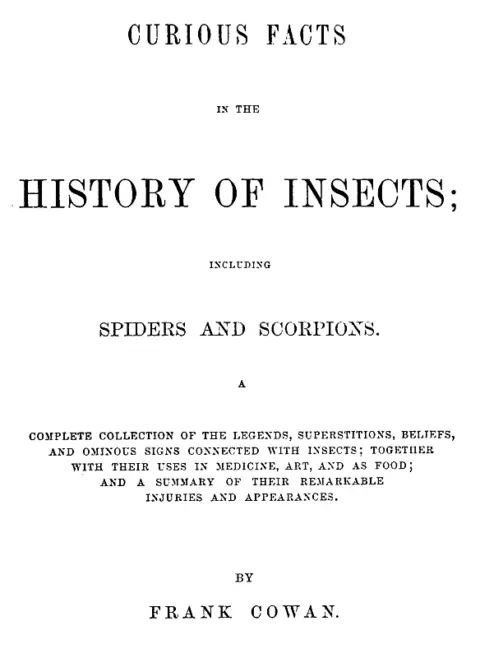
"Curious Facts in the History of Insects; Including Spiders and Scorpions" by Frank Cowan is a scientific publication written in the mid-19th century. The work explores entomology through the lens of legends, superstitions, beliefs, and various uses of insects, alongside their historical significance in medicine, art, and as food. The focus is not just on biological facts, but also on the fascinating folklore and cultural narratives associated with these creatures. At the start of the text, the author outlines his ambition to compile intriguing historical accounts related to insects, moving beyond traditional scientific boundaries. He emphasizes collecting facts from unusual sources, including chronicles and travel books, to illustrate the connections between human culture and the insect world. The opening sets the stage for a detailed examination of specific insects, beginning with the Ladybird, discussing its folklore across different cultures, and thus combining scientific classifications with rich, anecdotal history.
Introduction adapted from the source catalogue; source summaries may be automatically generated.
Free to read · English · 139,897 words · No account needed
MAKE TIME FOR A GOOD BOOK
On by default. Untick to stop anonymous reading totals. Each page counts after 10 seconds in view. How this works.
Anonymous counting is on unless you have switched it off.
Rev. Stephen Olin tells us that the Mohammedans of Arabia will not allow strangers to look into their cocooneries, on account of their superstitious fear of the evil eye, of the influence of which the Silk-worms are thought to be peculiarly susceptible.[820]
The silk of the nests of the social caterpillar of the Bombyx Madrona, was an object of commerce in Mexico in the time of Montecusuma; and the ancient Mexicans pasted together the interior layers, which may be written upon without preparation, to form a white, glossy pasteboard. Handkerchiefs are still manufactured of it in the Intendency of Oaxaca.[821]
A complete nest of these Silk-worms, called in Brazil sustillo, was sent by the Academy of Sciences and Natural History to the King of Spain. The naturalist, Don Antonio Pineda, sent also a piece of this natural silk paper, measuring a yard and a half, of an elliptical shape, which, however, is peculiar to them all.[822]
The Chinese fix on rings with threads the females of two species of wild Bombyx, whose caterpillars produce silk, and place these insects on a tree, or on some body situated in the open air, to allow the males, guided by their scent, to visit them.[823]
“The manner of the Chinese is,” we read in Purchas’s Pilgrims, “in the Spring time to revive the Silke-worms (that lye dead all the Winter) by laying them in the warme sunne, and (to hasten their quickening, that they may sooner goe to worke) to put them into bagges, and so hang them under their childrens armes.”[824]
In China, the pupæ of the Silk-worms after the silk is wound off, and the larvæ of a species of Sphinx-moth, furnish articles for the table, and are considered delicacies.[825] The natives of Madagascar, who eat all kinds of insects, consider also Silk-worms a great luxury.[826]
Aldrovandus states that the German soldiers sometimes fry and eat
Silk-worms.[827]
Dr. James says: “Silk-worms dried, and reduced to a powder, are, by some, applied to the crown of the head for removing vertigos and convulsions. The silk, and case or coat, are of a due temperament between heat and cold, and corroborate and recruit the vital, natural, and animal spirits.”[828] The cocoons are also the basis of Goddard’s Drops, and enter into several other compositions, such as the Confectio de Hyacintho, when made in the best manner.[829]
With respect to the coloring of silk, we find in “Tseën Tse Wan,” or thousand character classic, a work that has been a school-book in China for the last 1200 years, that an ancient sage by the name of Mih, seeing the white silk colored, wept on account of its original purity being destroyed.[830]
Your reading position is saved on this browser. Take it to another device with a library code. Reading pages adapt to text, rather than matching a printed edition.
BEHIND THE BOOK
This eBook is for the use of anyone anywhere in the United States and most other parts of the world at no cost and with almost no restrictions whatsoever. You may copy it, give it away or re-use it under the terms of the Project Gutenberg License included with this eBook or online at www.gutenberg.org. If you are not located in the United States, you will have to check the laws of the country where you are located before using this eBook. Read the source licence.
The original source file, including credits and licence, is retained by this library. Request an original-format copy at no charge. Please include the book title and Project Gutenberg identifier #41625.
KEEP YOUR CURIOSITY GOING
Cécile Tormay

Moritz Busch
John L. Ransom

Maurice Baring
Frances Wright
Cécile Tormay