THE CLASSIC COLLECTION✦An outlaw’s diary: the CommuneCLASSIC FREE BOOKS
An outlaw’s diary: the Commune
Cécile Tormay
THE CLASSIC COLLECTION · 1865
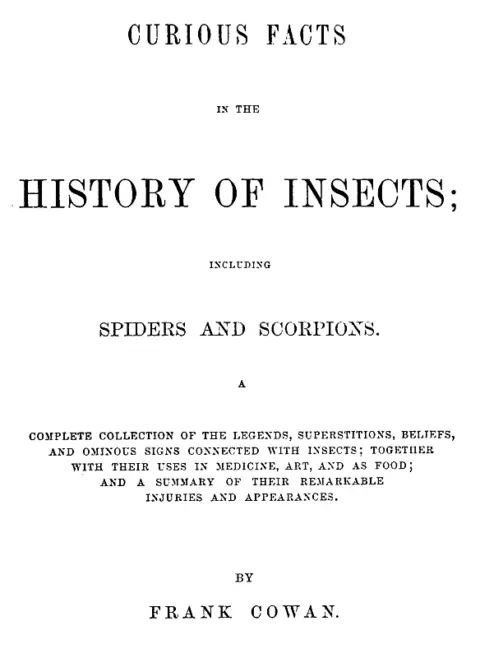
"Curious Facts in the History of Insects; Including Spiders and Scorpions" by Frank Cowan is a scientific publication written in the mid-19th century. The work explores entomology through the lens of legends, superstitions, beliefs, and various uses of insects, alongside their historical significance in medicine, art, and as food. The focus is not just on biological facts, but also on the fascinating folklore and cultural narratives associated with these creatures. At the start of the text, the author outlines his ambition to compile intriguing historical accounts related to insects, moving beyond traditional scientific boundaries. He emphasizes collecting facts from unusual sources, including chronicles and travel books, to illustrate the connections between human culture and the insect world. The opening sets the stage for a detailed examination of specific insects, beginning with the Ladybird, discussing its folklore across different cultures, and thus combining scientific classifications with rich, anecdotal history.
Introduction adapted from the source catalogue; source summaries may be automatically generated.
Free to read · English · 139,897 words · No account needed
MAKE TIME FOR A GOOD BOOK
On by default. Untick to stop anonymous reading totals. Each page counts after 10 seconds in view. How this works.
Anonymous counting is on unless you have switched it off.
There is a peculiar substance formed by a species of Bee in the Orinoco country, which, says Captain Stedman, the roosting tribes burn incessantly in their habitations, and which effectually protects them from all winged insects. They call it Comejou; Gumilla says it is neither earth nor wax.[712]
Concerning the medicinal virtues of Bees, Dr. James says: “Their salts are very volatile, and highly exalted; for this reason, when dry’d, powder’d, and taken internally, they are diuretic and diaphoretic. If this powder is mixed in unguents, with which the head is anointed, it is said to cure the Alopecia, and to contribute to the growth of hair upon bald places.”[713]
Another, an old writer, says: “If Bees, when dead, are dried to powder, and given to either man or beast, this medicine will often give immediate ease in the most excruciating pain, and remove a stoppage in the body when all other means have failed.” A tea made by pouring boiling water upon Bees has recently been prescribed, by high medical authority, for violent strangury; while the poison of the Bee, under the name of apis, is a great homœopathic remedy.[714]
Concerning wax, Dr. James says: “All wax is heating, mollifying, and moderately incarning. It is mixed in sorbile liquors as a remedy for dysentery; and ten bits, of the size of a grain of millet, swallowed, prevent the curdling of milk in the breast of nurses.”[715]
[If we might credit the history of former times, says Jamieson, in his Scottish Dictionary, sub. Walx, iv. 642-3, there must have been a considerable demand for this article (wax) for the purpose of witchcraft. It was generally found necessary, it would seem, as the medium of inflicting pain on the bodies of men.
“To some others at these times he teacheth, how to make pictures of waxe or clay, that by the wasting thereof, the persons that they beare the name of, may be continually melted or dried away by continuall sickenesse.” K. James’s Dæmonologie, B. II. c. 5.
In order to cause acute pain in the patient, pins, we are told, were stuck in that part of the body of the image, in which they wished the person to suffer.
The same plan was adopted for inspiring another with the ardor of love.
Then mould her form of fairest wax,
With adder’s eyes and feet of horn;
Place this small scroll within its breast,
Which I, your friend, have hither borne.
Then make a blaze of alder wood,
Before your fire make this to stand;
And the last night of every moon
The bonny May’s at your command.
Hogg’s Mountain Bard, p. 35.
Your reading position is saved on this browser. Take it to another device with a library code. Reading pages adapt to text, rather than matching a printed edition.
BEHIND THE BOOK
This eBook is for the use of anyone anywhere in the United States and most other parts of the world at no cost and with almost no restrictions whatsoever. You may copy it, give it away or re-use it under the terms of the Project Gutenberg License included with this eBook or online at www.gutenberg.org. If you are not located in the United States, you will have to check the laws of the country where you are located before using this eBook. Read the source licence.
The original source file, including credits and licence, is retained by this library. Request an original-format copy at no charge. Please include the book title and Project Gutenberg identifier #41625.
KEEP YOUR CURIOSITY GOING
Cécile Tormay

Moritz Busch
John L. Ransom

Maurice Baring
Frances Wright
Cécile Tormay