THE CLASSIC COLLECTION✦An outlaw’s diary: the CommuneCLASSIC FREE BOOKS
An outlaw’s diary: the Commune
Cécile Tormay
THE CLASSIC COLLECTION · 1865
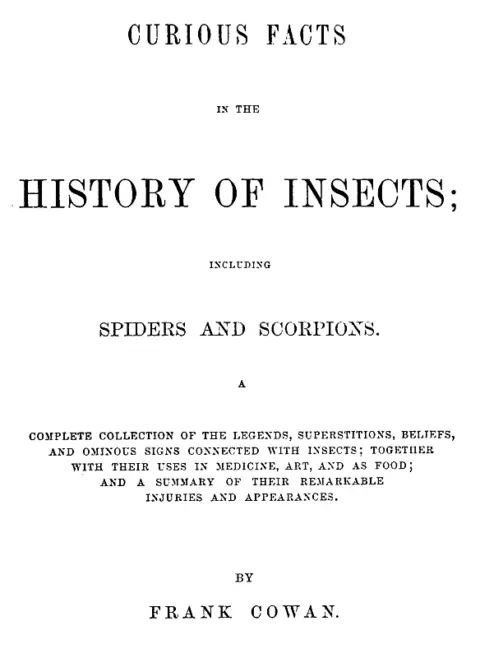
"Curious Facts in the History of Insects; Including Spiders and Scorpions" by Frank Cowan is a scientific publication written in the mid-19th century. The work explores entomology through the lens of legends, superstitions, beliefs, and various uses of insects, alongside their historical significance in medicine, art, and as food. The focus is not just on biological facts, but also on the fascinating folklore and cultural narratives associated with these creatures. At the start of the text, the author outlines his ambition to compile intriguing historical accounts related to insects, moving beyond traditional scientific boundaries. He emphasizes collecting facts from unusual sources, including chronicles and travel books, to illustrate the connections between human culture and the insect world. The opening sets the stage for a detailed examination of specific insects, beginning with the Ladybird, discussing its folklore across different cultures, and thus combining scientific classifications with rich, anecdotal history.
Introduction adapted from the source catalogue; source summaries may be automatically generated.
Free to read · English · 139,897 words · No account needed
MAKE TIME FOR A GOOD BOOK
On by default. Untick to stop anonymous reading totals. Each page counts after 10 seconds in view. How this works.
Anonymous counting is on unless you have switched it off.
An old English proverb, relative to the swarming of Bees, is,--
A swarm of Bees in May,
Is worth a load of hay;
A swarm of Bees in June,
Is worth a silver spoon;
A swarm of Bees in July,
Is not worth a fly.[659]
In Tusser’s Five Hundred Points of Husbandry, under the month of May,
are these lines:
Take heed to thy Bees, that are ready to swarme, The losse thereof now is a crown’s worth of harme.
On which is the following observation in Tusser Redivivus, 1744, p. 62: “The tinkling after them with a warming-pan, frying-pan, kettle, is of good use to let the neighbors know you have a swarm in the air, which you claim wherever it lights; but I believe of very little purpose to the reclaiming of the Bees, who are thought to delight in no noise but their own.”
Ill fortune attends the killing of Bees,--a common saying. This, doubtless, arose from the thrift and usefulness of these insects.
That swarms of Bees, or fields, houses, stalls of cattle, or workshops, may not be affected by enchantment, Leontinus says: “Dig in the hoof of the right side of a sable ass under the threshold of the door, and pour on some liquid pitchy resin, salt, Heracleotic origanum, cardamonium, cumin, some fine bread, squills, a chaplet of white or of crimson wool, the chaste tree, vervain, sulphur, pitchy torches; and lay on some amaranthus every month, and lay on the mould; and, having scattered seeds of different kinds, let them remain.”[660]
To cure the stings of Bees, we have the following remedies: “Rue,” says Pliny, “is an hearbe as medicinable as the best ... and is available against the stings of Bees, Hornets, and Wasps, and against the poison of the Cantharides and Salamanders.[661]
“Yea, and it is an excellent thing for them that be stung, to take the very Bees in drinke; for it is an approved cure.[662]
“Baulme is a most present remedy not only against their stings, but also of Wespes, Spiders, and Scorpions.[663]
“The Laurell, both leafe, barke, and berrie, is by nature hot; and applied as a liniment, be singular good for the pricke or sting of Wasps, Hornets, and Bees.[664]
“For the sting of Bees, Wasps, and Hornets, the Howlat (owlet) is counted a soveraigne thing, by a certaine antipathie in nature.[665]
“Moreover, as many as have about them the bill of a Woodspeck (Woodpecker) when they come to take honey out of the hive, shall not be stung by Bees.”[666]
Your reading position is saved on this browser. Take it to another device with a library code. Reading pages adapt to text, rather than matching a printed edition.
BEHIND THE BOOK
This eBook is for the use of anyone anywhere in the United States and most other parts of the world at no cost and with almost no restrictions whatsoever. You may copy it, give it away or re-use it under the terms of the Project Gutenberg License included with this eBook or online at www.gutenberg.org. If you are not located in the United States, you will have to check the laws of the country where you are located before using this eBook. Read the source licence.
The original source file, including credits and licence, is retained by this library. Request an original-format copy at no charge. Please include the book title and Project Gutenberg identifier #41625.
KEEP YOUR CURIOSITY GOING
Cécile Tormay

Moritz Busch
John L. Ransom

Maurice Baring
Frances Wright
Cécile Tormay