THE CLASSIC COLLECTION✦An outlaw’s diary: the CommuneCLASSIC FREE BOOKS
An outlaw’s diary: the Commune
Cécile Tormay
THE CLASSIC COLLECTION · 1865
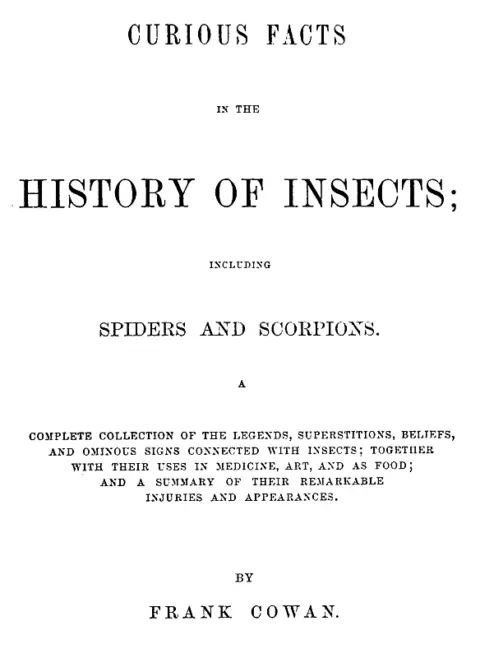
"Curious Facts in the History of Insects; Including Spiders and Scorpions" by Frank Cowan is a scientific publication written in the mid-19th century. The work explores entomology through the lens of legends, superstitions, beliefs, and various uses of insects, alongside their historical significance in medicine, art, and as food. The focus is not just on biological facts, but also on the fascinating folklore and cultural narratives associated with these creatures. At the start of the text, the author outlines his ambition to compile intriguing historical accounts related to insects, moving beyond traditional scientific boundaries. He emphasizes collecting facts from unusual sources, including chronicles and travel books, to illustrate the connections between human culture and the insect world. The opening sets the stage for a detailed examination of specific insects, beginning with the Ladybird, discussing its folklore across different cultures, and thus combining scientific classifications with rich, anecdotal history.
Introduction adapted from the source catalogue; source summaries may be automatically generated.
Free to read · English · 139,897 words · No account needed
MAKE TIME FOR A GOOD BOOK
On by default. Untick to stop anonymous reading totals. Each page counts after 10 seconds in view. How this works.
Anonymous counting is on unless you have switched it off.
The Bees flew buzzing through the liquid air: And pitcht upon the top o’ th’ laurel tree; When the Soothsayers saw this sight full rare, They did foretell th’ approach of th’ enemie.
That which Herodotus, Pausanias, Dio Cassius, Plutarch, Julius Cæsar, Julius Capitolinus, and other historians with greater observation then reason have confirmed. Saon Acrephniensis, when he could by no means finde the oracle Trophonius; Pausanias in his œticks saith he was lead thither by a swarm of Bees. Moreover, Plutarch, Pausanias, Ælian, Alex. Alexandrinus, Theocritus and Textor are authors that Jupiter Melitæus, Hiero of Syracuse, Plato, Pindar, Apius Comatus, Xenophon, and last of all Ambrose, when their nurses were absent, had honey dropt into their mouths by Bees, and so were preserved.”[616]
In East Norfolk, England, if Bees swarm on rotten wood, it is considered portentous of a death in the family.[617] This superstition is as old at least as the time of Gay, for, among the signs that foreshadowed the death of Blonzelind, it is mentioned:
Swarmed on a rotten stick the Bees I spy’d
Which erst I saw when Goody Dobson dy’d.[618]
In Ireland, the mere swarming of Bees is looked upon as prognosticating a death in the family of the owner.
In parts of England it is believed, that if a swarm of Bees come to a house, and are not claimed by their owner, there will be a death in the family that hives them.[619]
It is a very ancient superstition that Bees, by their acute sense of smell, quickly detect an unchaste woman, and strive to make her infamy known by stinging her immediately. In a pastoral of Theocritus, the shepherd in a pleasant mood tells Venus to go away to Anchises to be well stung by Bees for her lewd behavior.
Now go thy way to Ida mount--
Go to Anchises now,
Where mighty oaks, where banks along
Of square Cypirus grow,
Where hives and hollow trunks of trees,
With honey sweet abound,
Where all the place with humming noise
Of busie Bees resound.
Incontinence in men, as well as unchastity in women, was thought to be punished by these little insects. Thus in the lines of Pindarus:
Thou painful Bee, thou pretty creature,
Who honey-combs six angled, as the be,
With feet doest frame, false Phœcus and impure,
With sting has prickt for his lewd villany.[620]
Pliny says: “Certain it is, that if a menstruous woman do no more but touch a Bee-hive, all the Bees will be gone and never more come to it again.”[621]
In Western Pennsylvania, it is believed that Bees will invariably sting red-haired persons as soon as they approach the hives.
Your reading position is saved on this browser. Take it to another device with a library code. Reading pages adapt to text, rather than matching a printed edition.
BEHIND THE BOOK
This eBook is for the use of anyone anywhere in the United States and most other parts of the world at no cost and with almost no restrictions whatsoever. You may copy it, give it away or re-use it under the terms of the Project Gutenberg License included with this eBook or online at www.gutenberg.org. If you are not located in the United States, you will have to check the laws of the country where you are located before using this eBook. Read the source licence.
The original source file, including credits and licence, is retained by this library. Request an original-format copy at no charge. Please include the book title and Project Gutenberg identifier #41625.
KEEP YOUR CURIOSITY GOING
Cécile Tormay

Moritz Busch
John L. Ransom

Maurice Baring
Frances Wright
Cécile Tormay