THE CLASSIC COLLECTION✦An outlaw’s diary: the CommuneCLASSIC FREE BOOKS
An outlaw’s diary: the Commune
Cécile Tormay
THE CLASSIC COLLECTION · 1865
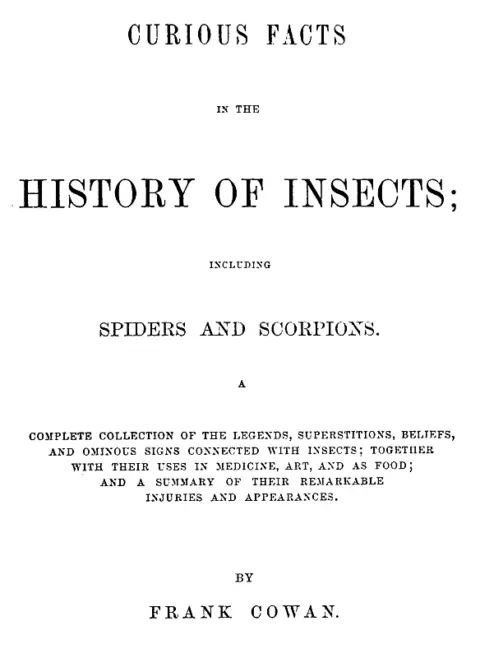
"Curious Facts in the History of Insects; Including Spiders and Scorpions" by Frank Cowan is a scientific publication written in the mid-19th century. The work explores entomology through the lens of legends, superstitions, beliefs, and various uses of insects, alongside their historical significance in medicine, art, and as food. The focus is not just on biological facts, but also on the fascinating folklore and cultural narratives associated with these creatures. At the start of the text, the author outlines his ambition to compile intriguing historical accounts related to insects, moving beyond traditional scientific boundaries. He emphasizes collecting facts from unusual sources, including chronicles and travel books, to illustrate the connections between human culture and the insect world. The opening sets the stage for a detailed examination of specific insects, beginning with the Ladybird, discussing its folklore across different cultures, and thus combining scientific classifications with rich, anecdotal history.
Introduction adapted from the source catalogue; source summaries may be automatically generated.
Free to read · English · 139,897 words · No account needed
MAKE TIME FOR A GOOD BOOK
On by default. Untick to stop anonymous reading totals. Each page counts after 10 seconds in view. How this works.
Anonymous counting is on unless you have switched it off.
The classification of Mr. Westwood, in the arrangement of the orders and families, I have followed as closely as was possible, except in one or two instances: and where Insects have common and familiar names, they have been given together with their scientific ones.
To Dr. J. M. Toner, of Washington, for his suggestions and assistance in collecting material, I tender my thanks; the same also to N. Bushnell, Esq., and Hon. O. H. Browning, of Quincy, Ill., for the use of their several libraries.
I am much indebted, too, to Mrs. A. L. Ruter Dufour, of Washington, for many superstitions and two pieces of poetry contained in this volume. I beg her to accept my thanks.
GREENSBURG, PENNA.,
July 10th, 1865.
Coccinellidæ--Lady-birds.
The Lady-bird, Coccinella septempunctata, in Scandinavia was dedicated to the Virgin Mary, and is there to this day called Nyckelpiga--Our Lady’s Key-maid,[1] and (in Sweden, more particularly) Jung-fru Marias Gullhona--the Virgin Mary’s Golden-hen.[2] A like reverence was paid to this beautiful insect in other countries: in Germany they have been called Frauen or Marien-käfer--Lady-beetles of the Virgin Mary; and in France are now known by the names of Vaches de Dieu--Cows of the Lord, and Bêtes de la Vierge--Animals of the Virgin.[3] The names we know them by, Lady-bird, Lady-bug, Lady-fly, Lady-cow,[4] Lady-clock, Lady-couch (a Scottish name),[5] etc., have reference also to this same dedication, or, at least, respect.
The Lady-bird in Europe, and particularly in Germany, where it probably is the greatest favorite, and whence most of the superstitions connected with it are supposed to have originated, is always connected with fine weather. At Vienna, the children throw it into the air, crying,--
Käferl’, käferl’, käferl’,
Flieg nach Mariabrunn,
Und bring uns ä schone sun.
Or,--
Little birdie, birdie,
Fly to Marybrunn,
And bring us a fine sun.
Marybrun being a place about twelve English miles from the Austrian capital, with a miracle-working image of the Virgin (still connected with the Virgin), who often sends good weather to the merry Viennese.[6]
And, from the marsh of the Elbe, to this little insect the following
words are addressed:
Maikatt,
Flug weg,
Stuff weg,
Bring me morgen goet wedder med.
Or,--
May-cat,
Fly away,
Hasten away,
Bring me good weather with you to-morrow.[7]
In England, the children are wont to be afraid of injuring the Lady-bird
lest it should rain.
Your reading position is saved on this browser. Take it to another device with a library code. Reading pages adapt to text, rather than matching a printed edition.
BEHIND THE BOOK
This eBook is for the use of anyone anywhere in the United States and most other parts of the world at no cost and with almost no restrictions whatsoever. You may copy it, give it away or re-use it under the terms of the Project Gutenberg License included with this eBook or online at www.gutenberg.org. If you are not located in the United States, you will have to check the laws of the country where you are located before using this eBook. Read the source licence.
The original source file, including credits and licence, is retained by this library. Request an original-format copy at no charge. Please include the book title and Project Gutenberg identifier #41625.
KEEP YOUR CURIOSITY GOING
Cécile Tormay

Moritz Busch
John L. Ransom

Maurice Baring
Frances Wright
Cécile Tormay