Things to be Remembered in Daily Life With Personal Experiences and Recollections
John Timbs
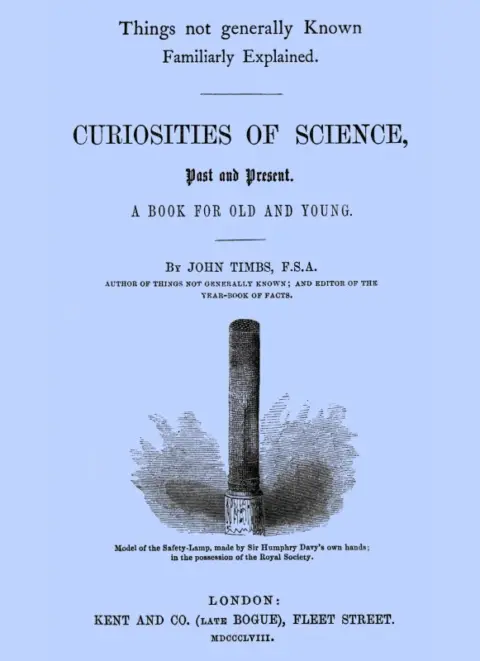
THE CLASSIC COLLECTION · 1859
"Curiosities of Science, Past and Present" by John Timbs is a collection of scientific explorations written in the mid-19th century. This work aims to present intriguing aspects of various scientific fields, including astronomy, geology, and physics, that capture the interest of readers both young and old. It serves as an engaging introduction to lesser-known phenomena and discoveries that have shaped our understanding of the natural world. At the start of the volume, the author reflects on the extensive research and reading that informed his work, highlighting a long career of compilation and observation. Timbs sets the tone by addressing the increasing accessibility of scientific knowledge and the author's hope to make these curiosities both sound and popular. He prepares the reader for a journey through exciting scientific topics, such as the historical progress of painting, the principles of the safety lamp, and discusses the impact of famous scientists. Overall, the introduction invites readers into a world of scientific wonders that promises to expand their understanding and curiosity about the world around them.
Introduction adapted from the source catalogue; source summaries may be automatically generated.
Free to read · English · 114,993 words · No account needed
MAKE TIME FOR A GOOD BOOK
On by default. Untick to stop anonymous reading totals. Each page counts after 10 seconds in view. How this works.
Anonymous counting is on unless you have switched it off.
[55] These illustrations have been in the main selected and abridged from papers in the Companion to the Almanac, 1858, and the Penny Cyclopædia, 2d supp.
[56] Newton was, however, much pestered with inquirers; and a Correspondent of the Gentleman’s Magazine, in 1784, relates that he once had a transient view of a Ms. in Pope’s handwriting, in which he read a verified anecdote relating to the above period. Sir Isaac being often interrupted by ignorant pretenders to the discovery of the longitude, ordered his porter to inquire of every stranger who desired admission whether he came about the longitude, and to exclude such as answered in the affirmative. Two lines in Pope’s Ms., as the Correspondent recollects, ran thus:
“‘Is it about the longitude you come?’ The porter asks: ‘Sir Isaac’s not at home.’”
[57] In trying the merits of Harrison’s chronometers, Dr. Maskelyne acquired that knowledge of the wants of nautical astronomy which afterwards led to the formation of the Nautical Almanac.
[58] A slight electric shock is given to a man at a certain portion of the skin; and he is directed the moment he feels the stroke to make a certain motion, as quickly as he possibly can, with the hands or with the teeth, by which the time-measuring current is interrupted.
[59] Through the calculations of M. Le Verrier.
Abodes of the Blest, 58.
Acarus of Crosse and Weeks, 218.
Accuracy of Chinese Observers, 159.
Adamant, What was it?, 123.
Aeronautic Voyage, Remarkable, 169.
Agassiz, Discoveries of, 127.
Air, Weight of, 14.
All the World in Motion, 11.
Alluvial Land of Egypt, 110.
Ancient World, Science of the, 1.
Animals in Geological Times, 128.
Anticipations of the Electric Telegraph, 220-224.
Arago on Protection from Storms, 159.
Arctic Climate, Phenomena of, 162.
Arctic Explorations, Rae’s, 162.
Arctic Regions, Scenery and Life of, 180.
Arctic Temperature, 161.
Armagh Observatory Level, Change of, 144.
Artesian Fire-Springs, 118.
Artesian Well of Grenelle, 114.
Astronomer, Peasant, 101.
Astronomer’s Dream verified, 88.
Astronomers, Triad of Contemporary, 100.
Astronomical Observations, Nicety of, 102.
Astronomy and Dates on Monuments, 55.
Astronomy and Geology, Identity of, 104.
Astronomy, Great Truths of, 54.
Atheism, Folly of, 3.
Atlantic, Basin of the, 171.
Atlantic, Gales of the, 171.
Atlantic Telegraph, the, 226-228.
Atmosphere, Colours of the, 147.
Atmosphere compared to a Steam-engine, 152.
Atmosphere, Height of, 147.
Atmosphere, the, 146.
Atmosphere, the purest, 150.
Atmosphere, Universality of the, 147.
Atmosphere weighed by Pascal, 148.
Atoms of Elementary Bodies, 13.
Atoms, the World of, 13.
Aurora Borealis, Halley’s hypothesis of, 198.
Aurora Borealis, Splendour of the, 165.
Australian Cavern, Inmates of, 137.
Australian Pouch-Lion, 137.
Axis of Rotation, the, 11.
Barometer, Gigantic, 151.
Barometric Measurement, 151.
Batteries, Minute and Vast, 204.
Birds, Gigantic, of New Zealand, Extinct, 139.
“Black Waters, the,” 182.
Bodies, Bright, the Smallest, 31.
Bodies, Compression of, 12.
Bodies, Fall of, 16.
Bottles and Currents at Sea, 172.
Boulders, How transported to Great Heights, 105.
Boyle on Colours, 49.
Boyle, Researches of, 6.
Your reading position is saved on this browser. Take it to another device with a library code. Reading pages adapt to text, rather than matching a printed edition.
John Timbs
John Timbs
John Timbs
John Timbs
BEHIND THE BOOK
This eBook is for the use of anyone anywhere in the United States and most other parts of the world at no cost and with almost no restrictions whatsoever. You may copy it, give it away or re-use it under the terms of the Project Gutenberg License included with this eBook or online at www.gutenberg.org. If you are not located in the United States, you will have to check the laws of the country where you are located before using this eBook. Read the source licence.
The original source file, including credits and licence, is retained by this library. Request an original-format copy at no charge. Please include the book title and Project Gutenberg identifier #48516.
KEEP YOUR CURIOSITY GOING

John Muir

Asa Gray
Asa Gray

Florence Nightingale
Elizabeth Robins Pennell
Denison Olmsted