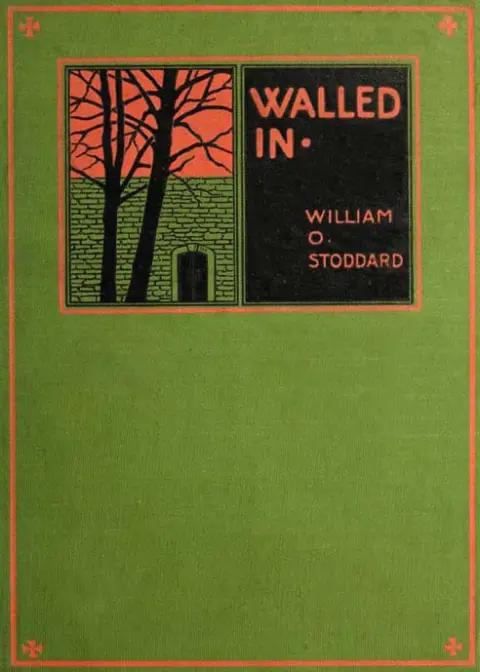
Walled In: A True Story of Randall’s Island
William O. Stoddard
THE CLASSIC COLLECTION · 1890
"Crowded Out o' Crofield; or, The Boy who made his Way" by William O. Stoddard is a novel written in the late 19th century. The story centers around a young boy, Jack Ogden, who dreams of escaping the confines of his small village, Crofield, to seek adventure and opportunity in the city. Through a series of daring escapades, including saving runaway horses and fishing exploits, Jack illustrates the spirit of determination and resourcefulness emblematic of youth. At the start of the tale, Jack stands at the door of the blacksmith shop, fueled by aspirations of adventure as he contemplates his small-town existence. The narrative introduces Jack's character as he faces the challenges of home life, expresses his desire to explore the wider world, and showcases his bravery when he intervenes to stop a runaway wagon. Additionally, the story hints at the budding romantic connection with his sister Mary, who also yearns for a life beyond their small town. The opening sets the stage for Jack’s journey from the constraints of Crofield to the possibilities of the city, filled with hope and youthful determination.
Introduction adapted from the source catalogue; source summaries may be automatically generated.
Free to read · English · 57,042 words · No account needed
MAKE TIME FOR A GOOD BOOK
On by default. Untick to stop anonymous reading totals. Each page counts after 10 seconds in view. How this works.
Anonymous counting is on unless you have switched it off.
He took an impression of the form of type that was in the press and
read it.
"I see," he said. "They print that on their paper bags for an advertisement. I'll show it to Mr. Gifford. There are plenty of blank ones lying around here, all ready to print."
He walked up to the desk and handed in the proof, asking:
"Is that all right?"
"No," said Mr. Gifford. "We let our stock of bags run down because the name of the firm was changed. I want to add several things. I'll send for somebody to have the proof corrections made."
"You needn't," said Jack. "Tell me what you want. Any boy who's ever worked in a newspaper office can do a little thing like that."
"How do you come to know so much about machinery?" asked Mr. Gifford,
trying not to laugh.
"Oh," said Jack, "I was brought up a blacksmith, but I've worked at other trades, and it was easy enough to adjust those things."
"That's what you've been up to is it?" said Mr. Gifford. "I saw you hammering and filing, and I wondered what you'd accomplished. I want the new paper bags to be,"--and he told Jack what changes were required, and added:
"Then, of course, I shall need some circulars--three kinds--and some
cards."
"That press will run over a thousand an hour when it's geared right. You'll see," said Jack, positively.
"Well, here's a true Jack-at-all-trades!" exclaimed Mr. Gifford, opening his eyes. "I begin to wish we had a place for you!"
It was nearly noon before Jack had another sample of printing ready to show. There was a good supply of type, to be sure, but he was not much of a printer, and type-setting did not come easily to him. He worked almost desperately, however, and meanwhile his brains were as busy as the coffee-mills. He succeeded finally, and it was time, for a salesman was just reporting:
"Mr. Gifford, we're out of paper bags."
"We must have some right away," said Mr. Gifford. "I wish that
youngster really knew how to print them. He's tinkering at it over
there."
"Is that right?" asked Jack only a second later, holding out a printed
bag.
"Why, yes, that's the thing. Go ahead," said the surprised coffee-dealer. "I thought you'd failed this time."
"I'll run off a lot," said Jack, "and then I'll go out and get
something to eat."
"No, you won't," said Mr. Gifford promptly. "No going out, during business hours, in this house. I'll have a luncheon brought to you. I'll try you to-day, anyhow."
Back went Jack without another word, but he thought silently, "That
saves me ten cents."
Your reading position is saved on this browser. Take it to another device with a library code. Reading pages adapt to text, rather than matching a printed edition.
William O. Stoddard
William O. Stoddard
William O. Stoddard
William O. Stoddard
BEHIND THE BOOK
This eBook is for the use of anyone anywhere in the United States and most other parts of the world at no cost and with almost no restrictions whatsoever. You may copy it, give it away or re-use it under the terms of the Project Gutenberg License included with this eBook or online at www.gutenberg.org. If you are not located in the United States, you will have to check the laws of the country where you are located before using this eBook. Read the source licence.
The original source file, including credits and licence, is retained by this library. Request an original-format copy at no charge. Please include the book title and Project Gutenberg identifier #21846.
KEEP YOUR CURIOSITY GOING
Coulson Kernahan

Maurice Baring
Frances Wright
Cécile Tormay

Frederic Jesup Stimson

W. H. P. (William Henry Pope) Jarvis