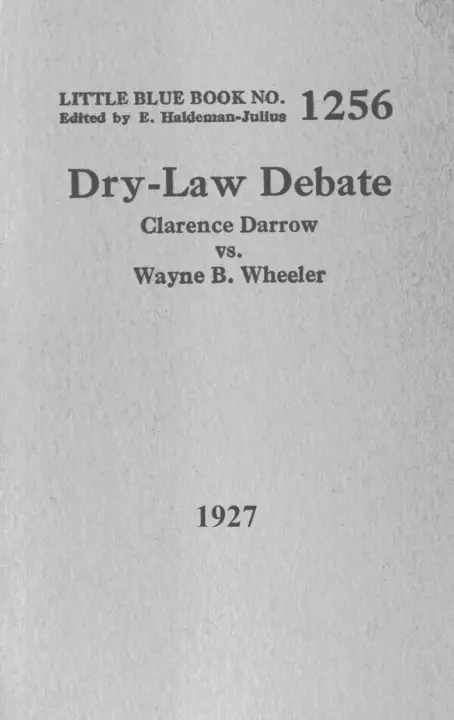
Dry-law debate
Clarence Darrow & Wayne Bidwell Wheeler
THE CLASSIC COLLECTION · 1922
"Crime: Its Cause and Treatment" by Clarence Darrow is a scientific publication written in the early 20th century during a time of great social reflection on justice and reform. The book delves into the complexities surrounding crime, exploring its causes through the lenses of biology, psychology, and social environment. Darrow seeks to shift the conceptual understanding of crime from a moral failing to a behavioral expression influenced by a myriad of factors. The opening of the text begins with a preface where Darrow outlines his extensive experience in the courtroom and introduces his mission to unravel the intricate dynamics of human behavior concerning crime. He emphasizes that traditional perspectives classify criminal acts as purely moral failures, overlooking the scientific principles of human conduct that suggest behavior is a function of environmental and hereditary influences. As an introductory exploration, he defines "crime" as actions forbidden by law rather than intrinsically evil acts, contending that societal norms shape legal definitions, and that punishment often stems from vengeance rather than reformation. This lays the groundwork for a deeper investigation into the societal and psychological mechanisms at play in criminal behavior, questioning the foundations of legal practices and moral judgments regarding those labeled as criminals.
Introduction adapted from the source catalogue; source summaries may be automatically generated.
Free to read · English · 67,187 words · No account needed
MAKE TIME FOR A GOOD BOOK
On by default. Untick to stop anonymous reading totals. Each page counts after 10 seconds in view. How this works.
Anonymous counting is on unless you have switched it off.
Dante, the hell of, 15.
Death penalty, methods of inflicting, 163.
Defectives, discussion of the, 183 ff.;
in prisons, 184-185;
proposed isolation or sterilization of, 233-249.
Disease, treatment of crime contrasted with that of, 139-140, 154,
230-232;
crime, accidents, and, 250-253.
Doctors, employment of, in trials, as experts, 143-149.
Dugdale, R.L., study of "The Jukes" by, 244-248.
Education, a response to suggestion, 65;
importance of, to the child, 77-78;
of the subnormal and the backward, 237.
Edwards, Jonathan, view held by, of punishment as vengeance, 17-19.
Emerson, R. W., on non-obedience to law, 114.
Emotions, factor of, in human action, 46-55;
lack of satisfaction of, in American scheme of things, 55.
England, system of justice in, 281.
Environment, man the product of heredity and, 34-36;
relation of heredity and, 37-40;
adjustment of, to heredity, 41-43, 277-278;
relation of, to development of criminal, 57-69;
effects of, 201-202;
necessity of improving, shown by studies of the Jukes and the
Kallikaks, 244-249.
Experts, medical, in courts, 143-149.
Factory system, growth of cities due to, 76;
and crime, 203-212;
Fear, emotion of, in man, 46-47;
instilling of, an object of punishment, 165.
Feeble-minded, distinguishing between the normal and, 185-188.
See Defectives.
Feuds, family, 12.
Flight, instinct of, in man, 46-47.
Folk-ways, crime defined as violation of, 6-7;
enforcement of, by primitive man, 8;
present-day laws descended from, 28;
are still a guide to man, 99-100.
Forgers, development of, 66-68.
Freedom of speech, loss of, as result of World War, 220.
Gang, the boy's, 79.
Genius, a frequent indication of insanity, 239.
Girls, protected life of, as compared with boys, 72;
sex crimes among, 90-91.
Glands, the ductless, and their use, 33-34, 38, 174.
Grant, General, on repealing of bad law, 130.
Grasset, Joseph, "The Semi-Insane and the Semi-Responsible," cited, 239.
Gregariousness, instinct of, in man, 47-48, 50.
Hatred, punishment actuated by, 12-19;
killings traceable to, 83.
Heredity, view of man as the product of environment and, 34-36;
relation of environment and, 37-40;
problem of future, to adjust environment to, 41-43, 277-278;
responsibility of, for the criminal, 57-65;
child criminal as result of, 78-79;
accounting for accused men's actions by, 126-129;
effects of, 201-202;
laws of, not sufficiently known to justify sterilization, 237-238.
Homicide, the crime of, 81-87.
Ignorance, disease due to, 252.
Illinois, operation of parole law in, 267
Incest, crime of, 89-90.
Indeterminate sentence, the, 268-271, 278.
Industrialism and crime, 76, 203-212.
Insane, restraint of, a measure of self-protection, 26;
treatment of, 144;
in prisons, 184-185;
allowances for, in criminal codes, 187-190;
legal tests of, not logical or humane, 190-192.
Instinct, human action largely governed by, 44-54;
stress placed on, as motive power of life, 81-83.
Intelligence tests, use of, 185-186.
Intolerance, a persisting source of evil, 228-229.
Isolation of the subnormal, 233-249.
Your reading position is saved on this browser. Take it to another device with a library code. Reading pages adapt to text, rather than matching a printed edition.
Clarence Darrow & Wayne Bidwell Wheeler
Clarence Darrow
Clarence Darrow
Clarence Darrow
BEHIND THE BOOK
This eBook is for the use of anyone anywhere in the United States and most other parts of the world at no cost and with almost no restrictions whatsoever. You may copy it, give it away or re-use it under the terms of the Project Gutenberg License included with this eBook or online at www.gutenberg.org. If you are not located in the United States, you will have to check the laws of the country where you are located before using this eBook. Read the source licence.
The original source file, including credits and licence, is retained by this library. Request an original-format copy at no charge. Please include the book title and Project Gutenberg identifier #12027.
KEEP YOUR CURIOSITY GOING
Coulson Kernahan

Maurice Baring
Frances Wright
Cécile Tormay

Frederic Jesup Stimson

W. H. P. (William Henry Pope) Jarvis