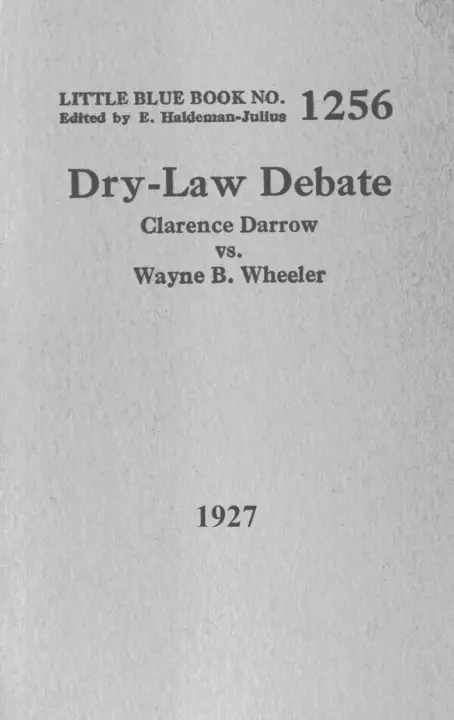
Dry-law debate
Clarence Darrow & Wayne Bidwell Wheeler
THE CLASSIC COLLECTION · 1922
"Crime: Its Cause and Treatment" by Clarence Darrow is a scientific publication written in the early 20th century during a time of great social reflection on justice and reform. The book delves into the complexities surrounding crime, exploring its causes through the lenses of biology, psychology, and social environment. Darrow seeks to shift the conceptual understanding of crime from a moral failing to a behavioral expression influenced by a myriad of factors. The opening of the text begins with a preface where Darrow outlines his extensive experience in the courtroom and introduces his mission to unravel the intricate dynamics of human behavior concerning crime. He emphasizes that traditional perspectives classify criminal acts as purely moral failures, overlooking the scientific principles of human conduct that suggest behavior is a function of environmental and hereditary influences. As an introductory exploration, he defines "crime" as actions forbidden by law rather than intrinsically evil acts, contending that societal norms shape legal definitions, and that punishment often stems from vengeance rather than reformation. This lays the groundwork for a deeper investigation into the societal and psychological mechanisms at play in criminal behavior, questioning the foundations of legal practices and moral judgments regarding those labeled as criminals.
Introduction adapted from the source catalogue; source summaries may be automatically generated.
Free to read · English · 67,187 words · No account needed
MAKE TIME FOR A GOOD BOOK
On by default. Untick to stop anonymous reading totals. Each page counts after 10 seconds in view. How this works.
Anonymous counting is on unless you have switched it off.
As long as men collectively impose their will upon the individual units, they should consider that this imposition calls for intelligence, kindliness, tolerance and a large degree of sympathy and understanding. In considering the welfare of the public: the accused, his family and his friends should be included as a part. It need not be expected that all maladjustments can ever be wiped out. Organization with its close relation of individual units implies conflict. Nevertheless, the effort should be to remove all possible inducement for the violent clashing of individuals and to minimize the severity of such conflicts as are inevitable.
Accidents, inevitability of, 48;
conditions affecting chances of, 253;
law of averages in, 259.
Acquisition, instinct for, 49-50, 51;
power of, not a measure of brain capacity, 51-54.
Adultery, crime of, 90-91.
Adventure, chance for, an incentive to crime, 54, 55, 79, 93.
Age, relation of, to crime, 251;
and disease, 252, 253.
Alcohol, relation of crime to use of, 197-198.
America, emotional side of man neglected in, 55;
high ratio of property crimes per capita in, 98;
system of justice in, superior to that of European countries, 281.
Ancestry, effects of, 126-128.
See Heredity.
Anger, as one underlying motive in punishment, 12;
the cause of killings, 83.
Animal, man a predatory, 94-100.
Animal life, man's origin and development the same as that of other, 29-34.
"Anti-social," significance of term, 5-6.
Art, satisfaction of emotions by, 55.
Automobile, effect of the, on crime, 208-211.
Beauty, appeal of, to man's emotional side, 55.
Bible, vengeance as purpose of punishment shown by, 13-14.
Boys, development of criminals from, 58-64, 75-80;
sex crimes among, 90-91;
and the automobile lure, 210-211.
Buckle, H. T., "History of Civilization," cited, 102-103.
Burglar, development of a, 58-60, 62, 92-93.
Burglary, crime of, 92-93.
Capital punishment, question of, 166-171.
Chance, man as subject to element of, 255-262.
Children, as criminals, 75-80;
sex crimes among, 90;
rights of property unknown to, 107.
Christianity, Pliny's correspondence with Trajan regarding, 225-228.
Christians, belief of early, in punishment as vengeance, 14-19.
Cities, relative prevalence of crime in, 75-79, 207-208;
crimes against property in, 99.
Civilization, limitations built up around heredity by, 42-43;
growth of crime coincident with growth of, 203-211;
the road to decay, 211-212;
does not mean the humanizing of men, 228-229;
new evils and new complexities with each new, 229.
Confidence game in obtaining property, law against, 137.
Conscience, as a guide to conduct, 4-5, 109.
Conspiracy, statute concerning, 136-137.
Convicts, in prison and after 120-123, 230-232;
good found in, 181.
Courts, growth in number and kind of, 139.
Crime, defined, 1-11;
purpose of punishment of, 12-27;
failure of punishment as a deterrent from, 21-24;
need for better understanding of, by the public, 27;
responsibility for, 28-36;
part played by heredity and environment in, 36;
among women, 71-74;
of homicide, 81-87;
due to sex relations, 88-91;
of robbery and burglary, 92-93;
performed against property, 101-108;
question of increase in, 134-142;
industrialism and, 203-208;
increase of, due to the automobile, 208-211;
war and, 213-220;
disease, accident, and, 250-254;
elements of luck and chance as related to, 255-262;
remedies for, 273-285.
Criminal, scope of word, 1-6;
one who violates "folk-ways" of his community, 6-9;
purpose of punishment of the, 12-27;
need for better understanding of, 27;
reasons for existence of, 56-70;
the female, 71-74;
the juvenile, 75-80;
attitude of the, 109-115;
the law and the, 116-129;
effect on others of punishment of, 158-160;
stigmata of, 172-177;
the good in the, 178-182;
pardon, parole, and placing on probation of, 263-272.
Criminal conduct, psychology of, 44-55.
Your reading position is saved on this browser. Take it to another device with a library code. Reading pages adapt to text, rather than matching a printed edition.
Clarence Darrow & Wayne Bidwell Wheeler
Clarence Darrow
Clarence Darrow
Clarence Darrow
BEHIND THE BOOK
This eBook is for the use of anyone anywhere in the United States and most other parts of the world at no cost and with almost no restrictions whatsoever. You may copy it, give it away or re-use it under the terms of the Project Gutenberg License included with this eBook or online at www.gutenberg.org. If you are not located in the United States, you will have to check the laws of the country where you are located before using this eBook. Read the source licence.
The original source file, including credits and licence, is retained by this library. Request an original-format copy at no charge. Please include the book title and Project Gutenberg identifier #12027.
KEEP YOUR CURIOSITY GOING
Coulson Kernahan

Maurice Baring
Frances Wright
Cécile Tormay

Frederic Jesup Stimson

W. H. P. (William Henry Pope) Jarvis