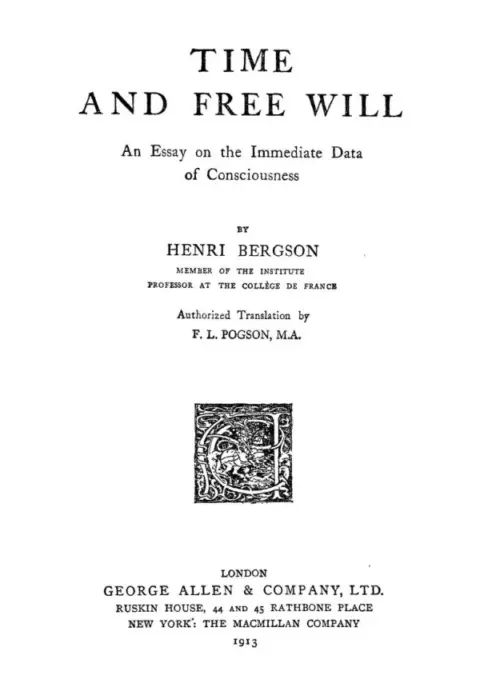
Time and Free Will: An Essay on the Immediate Data of Consciousness
Henri Bergson
THE CLASSIC COLLECTION · 1911
"Creative Evolution" by Henri Bergson is a philosophical work published in 1907. The book challenges Darwin's theory of natural selection, proposing instead that evolution is driven by élan vital—a vital creative impulse within life itself. Bergson explores concepts of subjective time and "duration," suggesting these can only be grasped through intuition rather than rational analysis. His ideas profoundly influenced modernist writers and thinkers, making the book enormously popular in the early twentieth century.
Introduction adapted from the source catalogue; source summaries may be automatically generated.
Free to read · English · 134,128 words · No account needed
MAKE TIME FOR A GOOD BOOK
On by default. Untick to stop anonymous reading totals. Each page counts after 10 seconds in view. How this works.
Anonymous counting is on unless you have switched it off.
Bodies, 156, 188, 189, 300-1, 360. See Inert matter as a relaxation of the unextended into the extended defined as bundles of qualities, 349
Bois-Reymond (Du), 38
Boltzmann, 245
Bombines, social instincts in, 171
Bouvier, 142 note
Bow, strain of, illustrating indivisibility of motion, 308-10
Brain and consciousness, 5, 109, 110, 179-80, 183-4, 212 note, 252, 261-4, 270, 354, 356, 366. See Nervous System in man and lower animals, 183, 184, 263-5
Brandt, 66 note
Breast-Plate, in reference to animal mobility, 130, 131.
See Carapace, Cellulose envelope
Brown-Séquard, 80-2
Bulb, medullary, in the development of the nervous system, 110, 252
Busquet, 259 note
Bütschli, 33 note
Buttel-Reepen, 171 note
Butterflies, in illustration of variation from evolutionary type, 72
Caelo (De), of Aristotle, 322 note, 324 note
Calcareous sheath, in reference to animal mobility, 130-1
Calkins, 16 note
Canal, in illustration of the relation of function and structure, 93
Canalization, in illustration of the function of animal organisms, 93,
95, 110, 126, 256, 270
Canvas, embroidering "something" on the, of "nothing," 297
Caprice, an attribute not of freedom but of mechanism, 47
Carapace, in reference to animal mobility, 130-1
Carbohydrates, in reference to the function of the animal organism, 121-2
Carbon, in reference to the function of organisms, 107, 113, 114, 117,
254, 255
Carbonic acid, in reference to the function of organisms, 254, 255
Carnot, 243, 246, 256
Cartesian geometry, compared with ancient, 334
Cartesianism, 345, 356, 358
Cartesians, 358. See Spinoza, Leibniz
Carving, the, of matter by intellect, 155
Categorical propositions, characteristic of instinctive knowledge, 149-50
Categories, conceptual, x, xiii, 48, 147, 148-9, 165, 189-90, 195-7, 207, 220-1, 257-60, 265, 358, 361. See Concept deduction of, and genesis of the intellect, 196, 207, 359. See Genesis of matter and of the intellect innate, 147, 148-9 misfit for the vital, x, xiii, 48, 165, 195-9, 220-1, 257-9 in reference to the adaptation to each other of the matter and form of knowledge, 361
Cats, in illustration of the law of correlation, 67
Causal relation in Aristotle, 325
between consciousness and movement, 111
in Greek philosophy, 324-5
Causality, mechanical, a category which does not apply to life, x, xiv, 177 in the philosophy of Ideas, 323-6
Causation and adaptation, 101, 102
final, involves mechanical, 44
Cause and effect as mathematical functions of each other, 20, 21
efficient, 238, 277, 323
efficient, in Aristotle's philosophy, 324
efficient, in Leibniz's philosophy, 353
final, 40, 44, 238
final, in Aristotle's philosophy, 324
by impulsion, release and unwinding, 73
mechanical, as containing effect, 14, 233, 269
in the vital order, 95, 164
Cave, Plato's allegory of the, 191
Cell, 16, 24, 33, 162, 166, 167, 260, 269
as artificial construct, 162
in the "colonial theory," 260
division, 16, 24, 33
instinct in the, 166, 167
in relation to the soul, 269
Cellulose envelope in reference to vegetable immobility and torpor, 108,
111, 130
Cerebral activity and consciousness, 5, 109-10, 180-1, 183-4, 212 note, 252, 253, 261, 264, 268, 270, 350, 351, 354, 355, 366 mechanism, 5, 252, 253, 262, 264, 366
Cerebro-spinal system, 124. See Nervous system
Certainty of induction, 215, 216
Chance analogous to disorder, 233, 234.
See Affection
in evolution, 86-7, 104, 114-5, 126, 169-70, 171, 252, 254, 255, 266,
267, 326-7.
See Indetermination
Change, 1, 7-8, 18, 85-6, 248, 275, 294, 300-304, 308, 313-4, 317, 326,
328-9, 343-4, 344-5
in ancient philosophy, 313-4, 316-7, 325-6, 327-9, 343, 345
in Eleatic philosophy, 314
known only from within, 307-8
Chaos, 232.
See Disorder
Character, moral, 5, 99-100
Charrin, 81 note
Chemistry, 27, 34-6, 55, 72, 74, 98, 194, 226, 256, 260
Child, intelligence in, 147-8
adolescence of, in illustration of evolutionary becoming, 311-3
Chipped stone, in paleontology, 139
Chlorophyllian function, 107-9, 114, 117, 246, 253
Your reading position is saved on this browser. Take it to another device with a library code. Reading pages adapt to text, rather than matching a printed edition.
Henri Bergson
Henri Bergson
Henri Bergson
BEHIND THE BOOK
This eBook is for the use of anyone anywhere in the United States and most other parts of the world at no cost and with almost no restrictions whatsoever. You may copy it, give it away or re-use it under the terms of the Project Gutenberg License included with this eBook or online at www.gutenberg.org. If you are not located in the United States, you will have to check the laws of the country where you are located before using this eBook. Read the source licence.
The original source file, including credits and licence, is retained by this library. Request an original-format copy at no charge. Please include the book title and Project Gutenberg identifier #26163.
KEEP YOUR CURIOSITY GOING

David Patterson (Spirit) Hatch
Coulson Kernahan

Ralph Waldo Emerson
Frances Wright

Edwin Abbott Abbott

Joseph Droz