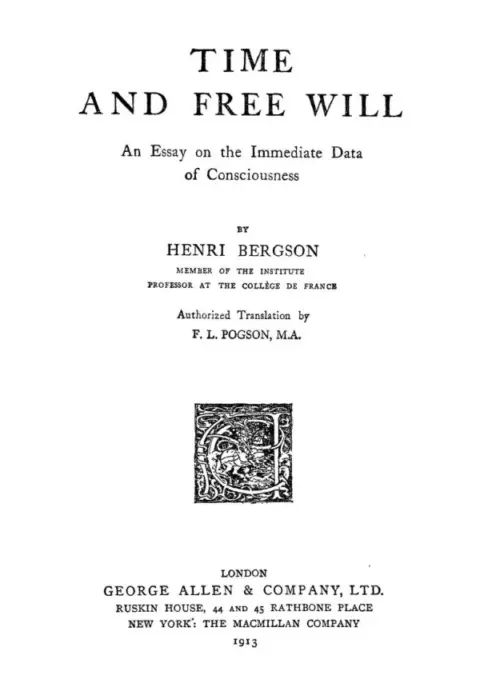
Time and Free Will: An Essay on the Immediate Data of Consciousness
Henri Bergson
THE CLASSIC COLLECTION · 1911
"Creative Evolution" by Henri Bergson is a philosophical work published in 1907. The book challenges Darwin's theory of natural selection, proposing instead that evolution is driven by élan vital—a vital creative impulse within life itself. Bergson explores concepts of subjective time and "duration," suggesting these can only be grasped through intuition rather than rational analysis. His ideas profoundly influenced modernist writers and thinkers, making the book enormously popular in the early twentieth century.
Introduction adapted from the source catalogue; source summaries may be automatically generated.
Free to read · English · 134,128 words · No account needed
MAKE TIME FOR A GOOD BOOK
On by default. Untick to stop anonymous reading totals. Each page counts after 10 seconds in view. How this works.
Anonymous counting is on unless you have switched it off.
Animals, 105-47, 167, 170, 181, 183, 187, 212, 214, 246, 252, 253, 254, 262-5, 267, 271, 293, 301 deduction in, 212 induction in, 214 and man, 139-43, 183, 187, 188, 212, 263, 264, 267 and man in respect to brain, 183, 184-5, 263-5 and man in respect to consciousness, 139-43, 180, 183, 187, 188, 192, 212, 263-8 and man in respect to instruments of action, 139-43, 150-1 and man in respect to intelligence, 137-8, 187, 188, 191-2, 212 and plants, 105-39, 124-6, 143, 145, 146-7, 168-70, 181-2, 253, 254, 293 and plants in respect to activity of consciousness, 109, 111, 113, 119-21, 128-9, 132, 134-6, 142-3, 144, 181-2, 293 and plants in respect to function, 117-8, 121-2, 127 and plants in respect to instinct, 167, 170 and plants in respect to mobility, 109, 110, 113, 129-30, 132-3, 135, 181 and plants in respect to nature of consciousness, 134-5
Antagonistic currents of the vital impetus, 129, 135-6, 181, 184, 250,
258-9
Anthophora, 146-7
Antinomies of Kant, 204, 205
Antipathy. See Sympathy, Feeling, Divination
Antithesis and thesis, 205
Ants, 101, 134, 140, 157
Ape's brain and consciousness contrasted with man's, 263
Aphasia, 181
Apidae, social instinct in the, 171
Apogee of instinct in the hymenoptera and of intelligence in man, 174-5 See Evolutionary superiority
Apogee of sensible object, in philosophy of Ideas, 343-4, 349
Approximateness of the knowledge of matter, 206-7
Approximation, in matter, to the mathematical order, 218.
See Order
Archimedes, 333-4
Aristotle. See Ancient Philosophy, Aristotle
Arrow, Flying, of Zeno, 308-9, 310, 312-3
Art, 6-7, 29 note, 45, 89, 177
Artemia Salina, transformations of, 72, 73
Arthropods in evolution, 130-5, 142
Articulate species, 133
Articulations of matter relative to action, 156, 367
of motion, 310-1
of real time, 332-3
Artificial, how far scientific knowledge is, 197, 218-9
instruments, 138, 139, 140-1
Artist, in illustration of the creativeness of duration, 340-1
Ascending cosmic movement, 11, 208, 275, 369
Ascent toward God, in Aristotle, 323
Association of organisms, 260.
See Individuation
universal oscillation between association and individuation, 259, 260.
See Societies
Astronomy and deduction, 213
and the inert order, 224
modern, in reference to ancient science, 334-6
Atmosphere of spatiality bathing intelligence, 204
Atom, 240, 254, 255
as an intellectual view of matter, 203, 250
and interpenetration, 207
Attack and defence in evolution, 131-2
Attention, 2, 148-9, 154, 184, 209
discontinuity of, 2
in man and in lower animals, 184.
See Tension and instinct, Tension as inverted extension,
Tension of personality, Sympathetic appreciation, etc.,
Relaxation and intellect
Attraction and impulsion in Greek philosophy, 323, 324
Attribute and subject, 148
Automatic activity, 145
as instrument of voluntary, 252
order, 224, 231-4.
See Negative movement, etc., Geometrical order
Automatism, 127, 143-4, 174, 223-4, 261, 264
Background of instinct and intelligence, consciousness as, 186
Backward-looking attitude of the intellect, 47, 48, 237
Baldwin, J.M., 27 note
Ballast of intelligence, 152, 230, 239, 369-70
Bastian, 212 note
Bateson, 63
Becoming, 164, 236, 248-9, 273, 299-304, 307-8, 313-4, 316, 337-8,
342-3, 345, 363
in ancient philosophy, 313-4, 317
in Descartes's philosophy, 346
in Eleatic philosophy, 313-4, 315
in general, or abstract becoming, 304, 306-7
instantaneous and static views of, 272, 304-5
states of, falsely so called, 164, 247-8, 273, 298-301, 307-8
in the successors of Kant, 363.
See Change, New, Duration, Time, Views of reality
Bees, 101, 140, 142, 146, 166, 172
Beethoven, 224
Berthold, 34 note
Bethe, 176 note
Bifurcations of tendency, 54.
See Divergent lines of evolution
Biology, 12, 25, 26, 31-2, 43, 168-9, 174-5, 194-6
evolutionist, 168-9
and philosophy, 43, 194-6
and physico-chemistry, 26
Blaringhem, 85
Your reading position is saved on this browser. Take it to another device with a library code. Reading pages adapt to text, rather than matching a printed edition.
Henri Bergson
Henri Bergson
Henri Bergson
BEHIND THE BOOK
This eBook is for the use of anyone anywhere in the United States and most other parts of the world at no cost and with almost no restrictions whatsoever. You may copy it, give it away or re-use it under the terms of the Project Gutenberg License included with this eBook or online at www.gutenberg.org. If you are not located in the United States, you will have to check the laws of the country where you are located before using this eBook. Read the source licence.
The original source file, including credits and licence, is retained by this library. Request an original-format copy at no charge. Please include the book title and Project Gutenberg identifier #26163.
KEEP YOUR CURIOSITY GOING

David Patterson (Spirit) Hatch
Coulson Kernahan

Ralph Waldo Emerson
Frances Wright

Edwin Abbott Abbott

Joseph Droz