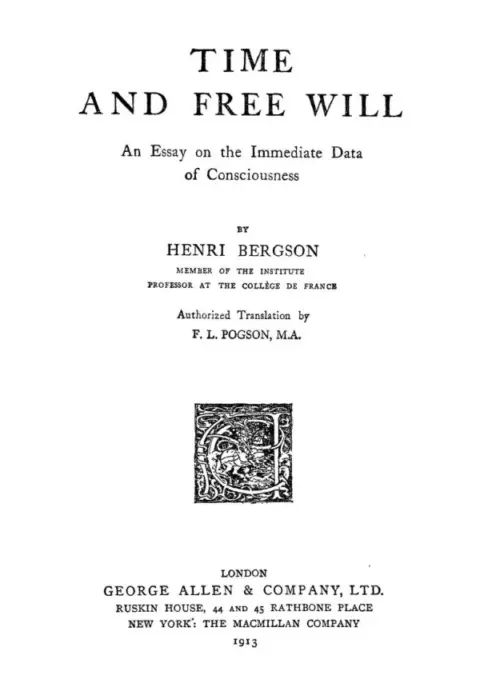
Time and Free Will: An Essay on the Immediate Data of Consciousness
Henri Bergson
THE CLASSIC COLLECTION · 1911
"Creative Evolution" by Henri Bergson is a philosophical work published in 1907. The book challenges Darwin's theory of natural selection, proposing instead that evolution is driven by élan vital—a vital creative impulse within life itself. Bergson explores concepts of subjective time and "duration," suggesting these can only be grasped through intuition rather than rational analysis. His ideas profoundly influenced modernist writers and thinkers, making the book enormously popular in the early twentieth century.
Introduction adapted from the source catalogue; source summaries may be automatically generated.
Free to read · English · 134,128 words · No account needed
MAKE TIME FOR A GOOD BOOK
On by default. Untick to stop anonymous reading totals. Each page counts after 10 seconds in view. How this works.
Anonymous counting is on unless you have switched it off.
This is not saying that the theory of the neo-Darwinians must be altogether rejected, any more than that of the neo-Lamarckians. The first are probably right in holding that evolution takes place from germ to germ rather than from individual to individual; the second are right in saying that at the origin of instinct there is an effort (although it is something quite different, we believe, from an intelligent effort). But the former are probably wrong when they make the evolution of instinct an accidental evolution, and the latter when they regard the effort from which instinct proceeds as an individual effort. The effort by which a species modifies its instinct, and modifies itself as well, must be a much deeper thing, dependent solely neither on circumstances nor on individuals. It is not purely accidental, although accident has a large place in it; and it does not depend solely on the initiative of individuals, although individuals collaborate in it.
Compare the different forms of the same instinct in different species of hymenoptera. The impression derived is not always that of an increasing complexity made of elements that have been added together one after the other. Nor does it suggest the idea of steps up a ladder. Rather do we think, in many cases at least, of the circumference of a circle, from different points of which these different varieties have started, all facing the same centre, all making an effort in that direction, but each approaching it only to the extent of its means, and to the extent also to which this central point has been illumined for it. In other words, instinct is everywhere complete, but it is more or less simplified, and, above all, simplified differently. On the other hand, in cases where we do get the impression of an ascending scale, as if one and the same instinct had gone on complicating itself more and more in one direction and along a straight line, the species which are thus arranged by their instincts into a linear series are by no means always akin. Thus, the comparative study, in recent years, of the social instinct in the different apidae proves that the instinct of the meliponines is intermediary in complexity between the still rudimentary tendency of the humble bees and the consummate science of the true bees; yet there can be no kinship between the bees and the meliponines.[69] Most likely, the degree of complexity of these different societies has nothing to do with any greater or smaller number of added elements. We seem rather to be before a musical theme, which had first been transposed, the theme as a whole, into a certain number of tones and on which, still the whole theme, different variations had been played, some very simple, others very skilful. As to the original theme, it is everywhere and nowhere. It is in vain that we try to express it in terms of any idea: it must have been, originally, felt rather than thought. We get the same impression before the paralyzing instinct of certain wasps. We know that the different species of hymenoptera that have this paralyzing instinct lay their eggs in spiders, beetles or caterpillars, which, having first been subjected by the wasp to a skilful surgical operation, will go on living motionless a certain number of days, and thus provide the larvae with fresh meat. In the sting which they give to the nerve-centres of their victim, in order to destroy its power of moving without killing it, these different species of hymenoptera take into account, so to speak, the different species of prey they respectively attack. The Scolia, which attacks a larva of the rose-beetle, stings it in one point only, but in this point the motor ganglia are concentrated, and those ganglia alone: the stinging of other ganglia might cause death and putrefaction, which it must avoid.[70] The yellow-winged Sphex, which has chosen the cricket for its victim, knows that the cricket has three nerve-centres which serve its three pairs of legs--or at least it acts as if it knew this. It stings the insect first under the neck, then behind the prothorax, and then where the thorax joins the abdomen.[71] The Ammophila Hirsuta gives nine successive strokes of its sting upon nine nerve-centres of its caterpillar, and then seizes the head and squeezes it in its mandibles, enough to cause paralysis without death.[72] The general theme is "the necessity of paralyzing without killing"; the variations are subordinated to the structure of the victim on which they are played. No doubt the operation is not always perfect. It has recently been shown that the Ammophila sometimes kills the caterpillar instead of paralyzing it, that sometimes also it paralyzes it incompletely.[73] But, because instinct is, like intelligence, fallible, because it also shows individual deviations, it does not at all follow that the instinct of the Ammophila has been acquired, as has been claimed, by tentative intelligent experiments. Even supposing that the Ammophila has come in course of time to recognize, one after another, by tentative experiment, the points of its victim which must be stung to render it motionless, and also the special treatment that must be inflicted on the head to bring about paralysis without death, how can we imagine that elements so special of a knowledge so precise have been regularly transmitted, one by one, by heredity? If, in all our present experience, there were a single indisputable example of a transmission of this kind, the inheritance of acquired characters would be questioned by no one. As a matter of fact, the hereditary transmission of a contracted habit is effected in an irregular and far from precise manner, supposing it is ever really effected at all.
Your reading position is saved on this browser. Take it to another device with a library code. Reading pages adapt to text, rather than matching a printed edition.
Henri Bergson
Henri Bergson
Henri Bergson
BEHIND THE BOOK
This eBook is for the use of anyone anywhere in the United States and most other parts of the world at no cost and with almost no restrictions whatsoever. You may copy it, give it away or re-use it under the terms of the Project Gutenberg License included with this eBook or online at www.gutenberg.org. If you are not located in the United States, you will have to check the laws of the country where you are located before using this eBook. Read the source licence.
The original source file, including credits and licence, is retained by this library. Request an original-format copy at no charge. Please include the book title and Project Gutenberg identifier #26163.
KEEP YOUR CURIOSITY GOING

David Patterson (Spirit) Hatch
Coulson Kernahan

Ralph Waldo Emerson
Frances Wright

Edwin Abbott Abbott

Joseph Droz