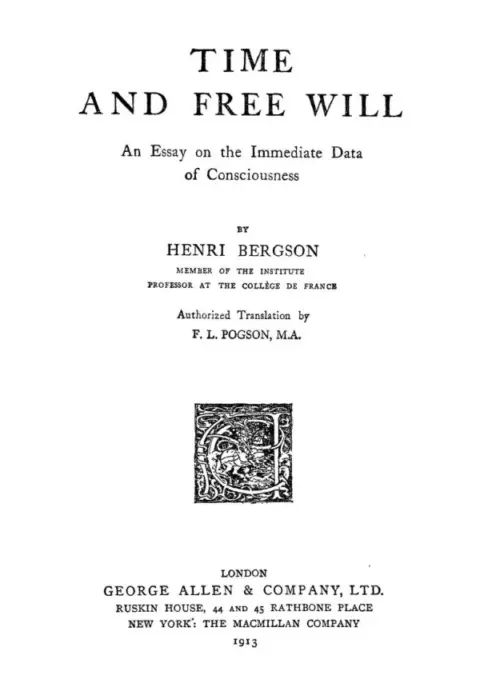
Time and Free Will: An Essay on the Immediate Data of Consciousness
Henri Bergson
THE CLASSIC COLLECTION · 1911
"Creative Evolution" by Henri Bergson is a philosophical work published in 1907. The book challenges Darwin's theory of natural selection, proposing instead that evolution is driven by élan vital—a vital creative impulse within life itself. Bergson explores concepts of subjective time and "duration," suggesting these can only be grasped through intuition rather than rational analysis. His ideas profoundly influenced modernist writers and thinkers, making the book enormously popular in the early twentieth century.
Introduction adapted from the source catalogue; source summaries may be automatically generated.
Free to read · English · 134,128 words · No account needed
MAKE TIME FOR A GOOD BOOK
On by default. Untick to stop anonymous reading totals. Each page counts after 10 seconds in view. How this works.
Anonymous counting is on unless you have switched it off.
No doubt many secondary instincts, and also many varieties of primary instinct, admit of a scientific explanation. Yet it is doubtful whether science, with its present methods of explanation, will ever succeed in analyzing instinct completely. The reason is that instinct and intelligence are two divergent developments of one and the same principle, which in the one case remains within itself, in the other steps out of itself and becomes absorbed in the utilization of inert matter. This gradual divergence testifies to a radical incompatibility, and points to the fact that it is impossible for intelligence to reabsorb instinct. That which is instinctive in instinct cannot be expressed in terms of intelligence, nor, consequently, can it be analyzed.
A man born blind, who had lived among others born blind, could not be made to believe in the possibility of perceiving a distant object without first perceiving all the objects in between. Yet vision performs this miracle. In a certain sense the blind man is right, since vision, having its origin in the stimulation of the retina, by the vibrations of the light, is nothing else, in fact, but a retinal touch. Such is indeed the scientific explanation, for the function of science is just to express all perceptions in terms of touch. But we have shown elsewhere that the philosophical explanation of perception (if it may still be called an explanation) must be of another kind.[67] Now instinct also is a knowledge at a distance. It has the same relation to intelligence that vision has to touch. Science cannot do otherwise than express it in terms of intelligence; but in so doing it constructs an imitation of instinct rather than penetrates within it.
Any one can convince himself of this by studying the ingenious theories of evolutionist biology. They may be reduced to two types, which are often intermingled. One type, following the principles of neo-Darwinism, regards instinct as a sum of accidental differences preserved by selection: such and such a useful behavior, naturally adopted by the individual in virtue of an accidental predisposition of the germ, has been transmitted from germ to germ, waiting for chance to add fresh improvements to it by the same method. The other type regards instinct as lapsed intelligence: the action, found useful by the species or by certain of its representatives, is supposed to have engendered a habit, which, by hereditary transmission, has become an instinct. Of these two types of theory, the first has the advantage of being able to bring in hereditary transmission without raising grave objection; for the accidental modification which it places at the origin of the instinct is not supposed to have been acquired by the individual, but to have been inherent in the germ. But, on the other hand, it is absolutely incapable of explaining instincts as sagacious as those of most insects. These instincts surely could not have attained, all at once, their present degree of complexity; they have probably evolved; but, in a hypothesis like that of the neo-Darwinians, the evolution of instinct could have come to pass only by the progressive addition of new pieces which, in some way, by happy accidents, came to fit into the old. Now it is evident that, in most cases, instinct could not have perfected itself by simple accretion: each new piece really requires, if all is not to be spoiled, a complete recasting of the whole. How could mere chance work a recasting of the kind? I agree that an accidental modification of the germ may be passed on hereditarily, and may somehow wait for fresh accidental modifications to come and complicate it. I agree also that natural selection may eliminate all those of the more complicated forms of instinct that are not fit to survive. Still, in order that the life of the instinct may evolve, complications fit to survive have to be produced. Now they will be produced only if, in certain cases, the addition of a new element brings about the correlative change of all the old elements. No one will maintain that chance could perform such a miracle: in one form or another we shall appeal to intelligence. We shall suppose that it is by an effort, more or less conscious, that the living being develops a higher instinct. But then we shall have to admit that an acquired habit can become hereditary, and that it does so regularly enough to ensure an evolution. The thing is doubtful, to put it mildly. Even if we could refer the instincts of animals to habits intelligently acquired and hereditarily transmitted, it is not clear how this sort of explanation could be extended to the vegetable world, where effort is never intelligent, even supposing it is sometimes conscious. And yet, when we see with what sureness and precision climbing plants use their tendrils, what marvelously combined manoeuvres the orchids perform to procure their fertilization by means of insects,[68] how can we help thinking that these are so many instincts?
Your reading position is saved on this browser. Take it to another device with a library code. Reading pages adapt to text, rather than matching a printed edition.
Henri Bergson
Henri Bergson
Henri Bergson
BEHIND THE BOOK
This eBook is for the use of anyone anywhere in the United States and most other parts of the world at no cost and with almost no restrictions whatsoever. You may copy it, give it away or re-use it under the terms of the Project Gutenberg License included with this eBook or online at www.gutenberg.org. If you are not located in the United States, you will have to check the laws of the country where you are located before using this eBook. Read the source licence.
The original source file, including credits and licence, is retained by this library. Request an original-format copy at no charge. Please include the book title and Project Gutenberg identifier #26163.
KEEP YOUR CURIOSITY GOING

David Patterson (Spirit) Hatch
Coulson Kernahan

Ralph Waldo Emerson
Frances Wright
Edwin Abbott Abbott
Joseph Droz