THE CLASSIC COLLECTION✦Thorns of regretCLASSIC FREE BOOKS
Thorns of regret
Alex. McVeigh, Mrs. Miller
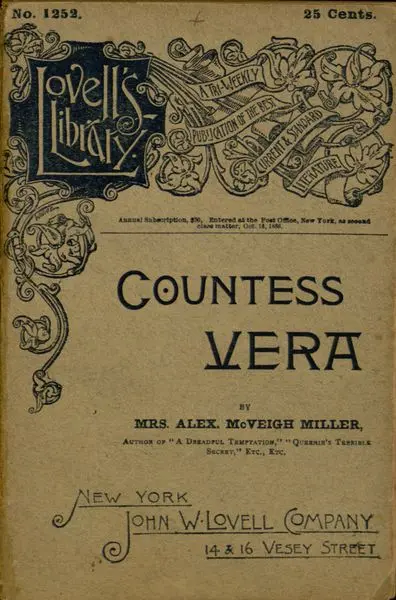
THE CLASSIC COLLECTION · 1883
"Countess Vera; or, The Oath of Vengeance" by Mrs. Alex. McVeigh Miller is a dramatic novel written in the late 19th century. The story revolves around themes of love, loss, revenge, and societal expectations, particularly focusing on the life of Vera Campbell, a young girl struggling against the cruelty of her relatives after the tragic death of her mother. Vera’s journey takes her from sorrow and desperation to a pivotal marriage that brings her both power and conflict. At the start of the novel, the reader is thrust into a poignant scene where Leslie Noble encounters the lifeless body of his bride, Vera's mother, leaving Vera distraught and grieving for the maternal love she lost. The narrative soon shifts to Vera's inner turmoil as she grapples with her circumstances, including the oppressive treatment from her cousin Ivy, who embodies the heartlessness of the privileged class. As events unfold, a dark plot involving Vera's attempted suicide and her father’s long-lost arrival hint at themes of vengeance against those who have wronged her and her mother. This mixture of tragedy and familial betrayal sets the tone for a gripping exploration of resilience against a backdrop of a rigid, unforgiving society.
Introduction adapted from the source catalogue; source summaries may be automatically generated.
Free to read · English · 80,579 words · No account needed
MAKE TIME FOR A GOOD BOOK
On by default. Untick to stop anonymous reading totals. Each page counts after 10 seconds in view. How this works.
Anonymous counting is on unless you have switched it off.
Imagine Lady Clive's delight when she learns that her brother is to marry her favorite, Lady Vera.
"It is what I most wished upon earth," she says, "but I had despaired of ever having my heart's desire. You never acted much like lovers, you two."
"You see I never intended to marry, so I did not encourage lovers,
then," Lady Vera explains.
"And now?" Lady Clive inquires, with a roguish twinkle of her bright,
blue eyes.
"Now I have changed my mind," the countess exclaims, evasively.
"Lovely woman's divine prerogative," laughs her friend. "But do you know that malicious people will say that you have quite thrown yourself away in marrying a plain, untitled American?"
"I am quite indifferent to what they will say," the young countess replies, serenely. "I shall have secured my own happiness, and that is the main point. For the rest, I am not anxious over titles. You know I am part American myself."
"Yes, I know, but this is the first time I have ever heard you allude to it," Lady Clive replies. "I fancied you were ashamed of the Yankee strain in your blood."
The sensitive color rushes warmly into Lady Vera's cheek.
"I was," she admits, "but I had no need to be. My mother was one of the fairest, sweetest, and purest of America's daughters. Yet I had a prejudice against the people of her native land and mine, a girl's prejudice that made me unjust to the many because I hated a few. Some day I will tell you about my life in America, Lady Clive, and you will understand me better, perhaps."
"Shall you go back to the United States with Phil, or shall you prefer a life in England?" Lady Clive inquires.
"We have not settled that yet," the young girl answers, blushing.
Her face has grown very thoughtful as she speaks. A moment later she
asks, in an altered voice:
"Who were those American people whom you met in Switzerland, Lady
Clive?"
Lady Clive seemed to reflect.
"You mean those vulgarly rich people?" she inquires.
"Yes."
"My dear, I have quite forgotten what they were called. I have such a poor memory for names. But no matter. You will see them in London this winter," Lady Clive replies.
And again the vexing question which she has forgotten since yesterday, recurs to Lady Vera's mind:
"What form will my vengeance take?"
But no faintest idea comes to her of the terrible truth. If anyone were to whisper it to her in these first hours of her great new happiness, it would surely strike her dead. The shock of pain would be too great for endurance.
Your reading position is saved on this browser. Take it to another device with a library code. Reading pages adapt to text, rather than matching a printed edition.
Alex. McVeigh, Mrs. Miller
Alex. McVeigh, Mrs. Miller

Alex. McVeigh, Mrs. Miller

Alex. McVeigh, Mrs. Miller
BEHIND THE BOOK
This eBook is for the use of anyone anywhere in the United States and most other parts of the world at no cost and with almost no restrictions whatsoever. You may copy it, give it away or re-use it under the terms of the Project Gutenberg License included with this eBook or online at www.gutenberg.org. If you are not located in the United States, you will have to check the laws of the country where you are located before using this eBook. Read the source licence.
The original source file, including credits and licence, is retained by this library. Request an original-format copy at no charge. Please include the book title and Project Gutenberg identifier #48824.
KEEP YOUR CURIOSITY GOING
Coulson Kernahan

Maurice Baring
Frances Wright
Cécile Tormay

Frederic Jesup Stimson

W. H. P. (William Henry Pope) Jarvis