READ · DISCOVER · ENJOYClassic literature · Always free
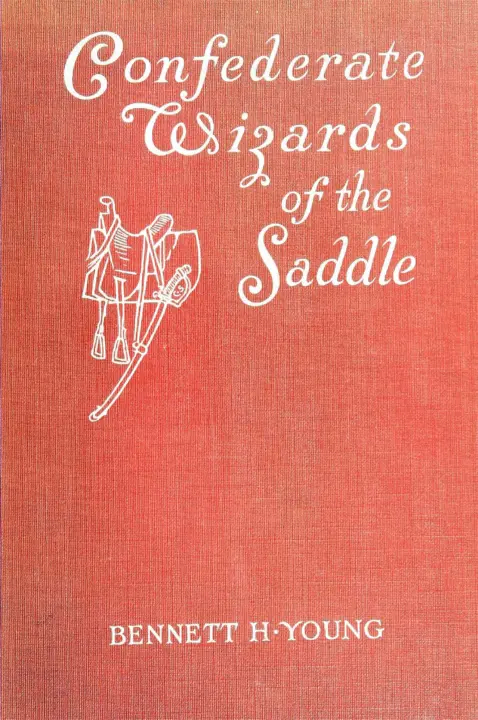
Confederate wizards of the saddle — digital edition cover

THE CLASSIC COLLECTION · 1914

Confederate wizards of the saddle

"Confederate Wizards of the Saddle" by Bennett H. Young is a historical account written in the early 20th century. The book provides a detailed narrative of significant cavalry operations during the American Civil War, particularly focusing on Confederate leaders like Nathan Bedford Forrest, John H. Morgan, and their daring raids and battles. Young, who participated in the conflict, aims to highlight the heroes of the Confederate cavalry and their remarkable endurance, skill, and bravery amidst the challenges they faced. At the start of the work, the author discusses the severe conditions of warfare during the spring and summer of 1864, detailing significant military movements and the valor of Confederate cavalry. Young sets the stage by referencing various battles and leaders, emphasizing the unique role that cavalry played in shaping military strategy during the war. The opening focuses on the Battle of Bryce’s Cross Roads, showcasing Forrest's tactical brilliance against overwhelming odds, particularly his ability to inspire and lead his troops effectively in a critical engagement against Federal forces. Through vivid descriptions and personal anecdotes, Young establishes the book as both a tribute and a historical recounting of the Confederate cavalry's contributions.

Introduction adapted from the source catalogue; source summaries may be automatically generated.

Start reading ↓

Free to read · English · 177,777 words · No account needed

MAKE TIME FOR A GOOD BOOK

Confederate wizards of the saddle

On by default. Untick to stop anonymous reading totals. Each page counts after 10 seconds in view. How this works.

Anonymous counting is on unless you have switched it off.

Confederate wizards of the saddle

General Forrest was too much of a leader not to know that this extraordinary task which he had undertaken could only be accomplished by rapid movement and by concealment of his plans. In the early part of August, in Mississippi, usually copious rains fall. The streams at that season are almost always full. This rendered them far more difficult to bridge and made fording impossible. Forrest could ferry his men and their accoutrements and ammunition and artillery, but the horses must swim. In a pinch he might, by rafting and swimming, get his men over the stream, but water was a deadly foe to powder, and without powder Forrest and his men would ride and swim in vain. This meant delay. Delay meant defeat. But above all, Forrest was a practical man. There was no emergency to which his resourceful mind could not rise. Fortunately for his plans on this occasion, the grapevine life of Mississippi is extremely exuberant. These vines run to the tops of the highest trees, sometimes one hundred and fifty feet. Larger than a man’s arms, they would send out their tendrils to the very top of the highest trees and swinging over some limb would spread out their branches and cover the tree tops. These vines were flexible, almost like ropes, very strong. Forrest undertook, as an engineer, by sending forward his best and most intelligent troopers under brave and energetic commanders, to find those grape vines and use them as cables to span the river. Finding the trees convenient to the banks of the stream, the vines were cut down, twisted around the trees, tied as best they could be, carried across the river, and attached to trees on the other side. A ferry boat was placed in the middle of the stream and anchored. Cypress and other logs were cut into proper lengths, floated into the stream and attached at certain distances to these cables. At Hickahala Creek this novel bridge was first inaugurated. Forrest was kept in close touch with his engineers, who were constructing this strangely fashioned pontoon. Within four or five miles from the stream, all the cabins, houses, barns, stables and gin houses were stripped of the flooring and shedding. Each horseman carried on his shoulder one of these planks. Within an hour the planks were laid, the soldiers dismounted, each man led his horse on the boards and crossed the stream in double file. The cables began to stretch, and by the time all the command had passed over, the planks had become submerged, the water was two feet over the flooring and with difficulty the horses could be led across. Nature seemed at this point to be piling up insuperable obstacles in Forrest’s path. He had truly gone seven miles when another stream, twice as broad and equally as deep stood out with its currents and floods to bid the Southern men stay their march. No long drawn out planning was necessary to figure out some way to outwit the defiance of Cold Water River. If a sixty-foot span could be made of grapevines, why not one of a hundred and twenty feet, and the answer was a sharp command to the pioneers to unsling their axes and build the required structure. One hundred and eighty minutes under the whip and spur of necessity saw the new bridge completed, and the men, houses, cannon and caissons speeding across the apparently unsafe length. The horses were led two abreast, the guns were unlimbered and willing hands and seasoned arms dragged them over to the side where Forrest was pointing the way, it may be to danger, but where glory they believed would crown their army and enterprise with a deserved and splendid success. This circumstance so delayed him that on the night of the 20th he was still at Hernando, Mississippi, twenty-five miles from Memphis. The condition of the roads was almost indescribable. The tramping of the horses made a foot of slush, and the wheels of the ammunition wagons and the cannon caissons cut deep ruts in the roads. The cavalry went at a slow walk, and ten horses were hitched to each piece of artillery. Notwithstanding all of these precautions, half of Forrest’s guns had to be left at Penola. It became apparent that they would not be carried along with sufficient rapidity to justify Forrest in running the risk their movement involved. Still twenty-five miles away from Memphis, Forrest knew he must travel all night. It was a task at which any leader might hesitate, but now hesitation meant disaster, and the lionhearted leader was undertaking amongst the greatest feats he had attempted to perform. Tremendous issues were involved. To save at this period Northern Mississippi Territory and to prevent the junction of General Smith’s forces with those of General Sherman at Vicksburg was vital to the hopes of the Confederate authorities. Rain, storm, mud, floods, deep currents, accelerated by torrents, were the contingencies Forrest must face, but he never had stopped for these things before and through the darkness of the night there was only one command, “Forward,” “Forward,” “Forward.” It was bad enough for those who rode. The beasts who bore the men, weakened by the already grievous burdens laid upon them, were spurred to speedier tramp, but hard as were these pressed with their human loads, the awfullest of the terrors of that terrorful night came to the dumb sufferers who pulled the swaying gun carriages and heavy caissons through the ruts and slush of the ever-lengthening pathway. No cry of mercy could avail for these speechless creations. Slashed with hickory or oak wythes, blood streamed from their mouths from the sawing of their bits to keep them straight in the sunken depths of the muddy way, they passed with indescribable suffering the horrible night. When the limits of physical resistance they reached and no longer left with strength or will to continue the impossible tasks that were being laid upon them, with sullen indifference some of these creatures, ready to die rather than proceed another step, with a determination born of despair, refused to make another effort and bade defiance to their pitiless riders and drivers, who were slashing, jerking and beating in their seemingly mad efforts to urge forward these faithful brutes who had done all they could to help in the effort to save the land of those who, with apparently merciless hearts, called for such terrible strain. Horses have wills as well as men, and defying their owners, some stood still in their tracks and no cruel blows could bring them to move a muscle or pull an ounce. The great crisis was ahead. If the one horse would go down another would be harnessed, and if the led horses had all been used, then a luckless trooper with a strong or powerful mount was bade strip his steed, stow his equipment on a gun carriage or caisson, and take his chances farther on to win from his enemies a something to ride, which the exigencies of the hour had taken away from him. The new team took up the burdens their predecessors had laid down, and the sullen horse was led out into the woods, or now and then, fearing that he might prove of value to the enemy, a shot was fired into his heart to end his sufferings or to destroy that which by some possibility might some day aid those who were fighting the cause for which he had met so violent a death.

Your reading position is saved on this browser. Take it to another device with a library code. Reading pages adapt to text, rather than matching a printed edition.

BEHIND THE WORDS

About Bennett H. (Bennett Henderson) Young

Bennett H. (Bennett Henderson) Young (1843–1919). Explore Confederate wizards of the saddle in this collection. These books span biography & memoir, history.

Explore this author’s books →

THE READERS’ VERDICT

How did this story stay with you?

Not rated yet
Your rating for Confederate wizards of the saddle

Be the first to share your verdict.

One rating per browser, which you can change or remove. A necessary browser identifier remembers your vote. How ratings work

A GOOD STORY DESERVES COMPANY

Pass this book along.

A great read is even better when it’s shared.

SEND A LITTLE INSPIRATION

Share this book

BEHIND THE BOOK

Edition & source details.

Title
Confederate wizards of the saddle
Author
Bennett H. (Bennett Henderson) Young
Publication year
1914
Digital edition publisher
Project Gutenberg
Gutenberg release date
2023-03-04
Language
English
Source edition imprint
$aUnited States :$bChapple Publishing Company, Ltd., $c1914.
Source identifier
Project Gutenberg #70204
Contributors
No additional named contributors in source metadata

Public-domain source & licence

This eBook is for the use of anyone anywhere in the United States and most other parts of the world at no cost and with almost no restrictions whatsoever. You may copy it, give it away or re-use it under the terms of the Project Gutenberg License included with this eBook or online at www.gutenberg.org. If you are not located in the United States, you will have to check the laws of the country where you are located before using this eBook. Read the source licence.

Full source licence and obtaining an original copy

The original source file, including credits and licence, is retained by this library. Request an original-format copy at no charge. Please include the book title and Project Gutenberg identifier #70204.

the full Project Gutenberg License must appear
prominently whenever any copy of a Project Gutenberg work (any work
on which the phrase “Project Gutenberg” appears, or with which the
phrase “Project Gutenberg” is associated) is accessed, displayed,
performed, viewed, copied or distributed:

This eBook is for the use of anyone anywhere in the United States and most
other parts of the world at no cost and with almost no restrictions
whatsoever. You may copy it, give it away or re-use it under the terms
of the Project Gutenberg™ License included with this eBook or online
at www.gutenberg.org. If you
are not located in the United States, you will have to check the laws
of the country where you are located before using this eBook.

1.E.2. If an individual Project Gutenberg electronic work is
derived from texts not protected by U.S. copyright law (does not
contain a notice indicating that it is posted with permission of the
copyright holder), the work can be copied and distributed to anyone in
the United States without paying any fees or charges. If you are
redistributing or providing access to a work with the phrase “Project
Gutenberg” associated with or appearing on the work, you must comply
either with the requirements of paragraphs 1.E.1 through 1.E.7 or
obtain permission for the use of the work and the Project Gutenberg
trademark as set forth in paragraphs 1.E.8 or 1.E.9.

1.E.3. If an individual Project Gutenberg electronic work is posted
with the permission of the copyright holder, your use and distribution
must comply with both paragraphs 1.E.1 through 1.E.7 and any
additional terms imposed by the copyright holder. Additional terms
will be linked to the Project Gutenberg License for all works
posted with the permission of the copyright holder found at the
beginning of this work.

1.E.4. Do not unlink or detach or remove the full Project Gutenberg
License terms from this work, or any files containing a part of this
work or any other work associated with Project Gutenberg.

1.E.5. Do not copy, display, perform, distribute or redistribute this
electronic work, or any part of this electronic work, without
prominently displaying the sentence set forth in paragraph 1.E.1 with
active links or immediate access to the full terms of the Project
Gutenberg License.

1.E.6. You may convert to and distribute this work in any binary,
compressed, marked up, nonproprietary or proprietary form, including
any word processing or hypertext form. However, if you provide access
to or distribute copies of a Project Gutenberg work in a format
other than “Plain Vanilla ASCII” or other format used in the official
version posted on the official Project Gutenberg website
(www.gutenberg.org), you must, at no additional cost, fee or expense
to the user, provide a copy, a means of exporting a copy, or a means
of obtaining a copy upon request, of the work in its original “Plain
Vanilla ASCII” or other form. Any alternate format must include the
full Project Gutenberg License as specified in paragraph 1.E.1.

1.E.7. Do not charge a fee for access to, viewing, displaying,
performing, copying or distributing any Project Gutenberg works
unless you comply with paragraph 1.E.8 or 1.E.9.

1.E.8. You may charge a reasonable fee for copies of or providing
access to or distributing Project Gutenberg electronic works
provided that:

• You pay a royalty fee of 20% of the gross profits you derive from
the use of Project Gutenberg works calculated using the method
you already use to calculate your applicable taxes. The fee is owed
to the owner of the Project Gutenberg trademark, but he has
agreed to donate royalties under this paragraph to the Project
Gutenberg Literary Archive Foundation. Royalty payments must be paid
within 60 days following each date on which you prepare (or are
legally required to prepare) your periodic tax returns. Royalty
payments should be clearly marked as such and sent to the Project
Gutenberg Literary Archive Foundation at the address specified in
Section 4, “Information about donations to the Project Gutenberg
Literary Archive Foundation.”

• You provide a full refund of any money paid by a user who notifies
you in writing (or by e-mail) within 30 days of receipt that s/he
does not agree to the terms of the full Project Gutenberg™
License. You must require such a user to return or destroy all
copies of the works possessed in a physical medium and discontinue
all use of and all access to other copies of Project Gutenberg™
works.

• You provide, in accordance with paragraph 1.F.3, a full refund of
any money paid for a work or a replacement copy, if a defect in the
electronic work is discovered and reported to you within 90 days of
receipt of the work.

• You comply with all other terms of this agreement for free
distribution of Project Gutenberg™ works.


1.E.9. If you wish to charge a fee or distribute a Project
Gutenberg™ electronic work or group of works on different terms than
are set forth in this agreement, you must obtain permission in writing
from the Project Gutenberg Literary Archive Foundation, the manager of
the Project Gutenberg™ trademark. Contact the Foundation as set
forth in Section 3 below.

1.F.

1.F.1. Project Gutenberg volunteers and employees expend considerable
effort to identify, do copyright research on, transcribe and proofread
works not protected by U.S. copyright law in creating the Project
Gutenberg™ collection. Despite these efforts, Project Gutenberg™
electronic works, and the medium on which they may be stored, may
contain “Defects,” such as, but not limited to, incomplete, inaccurate
or corrupt data, transcription errors, a copyright or other
intellectual property infringement, a defective or damaged disk or
other medium, a computer virus, or computer codes that damage or
cannot be read by your equipment.

1.F.2. LIMITED WARRANTY, DISCLAIMER OF DAMAGES - Except for the “Right
of Replacement or Refund” described in paragraph 1.F.3, the Project
Gutenberg Literary Archive Foundation, the owner of the Project
Gutenberg™ trademark, and any other party distributing a Project
Gutenberg™ electronic work under this agreement, disclaim all
liability to you for damages, costs and expenses, including legal
fees. YOU AGREE THAT YOU HAVE NO REMEDIES FOR NEGLIGENCE, STRICT
LIABILITY, BREACH OF WARRANTY OR BREACH OF CONTRACT EXCEPT THOSE
PROVIDED IN PARAGRAPH 1.F.3. YOU AGREE THAT THE FOUNDATION, THE
TRADEMARK OWNER, AND ANY DISTRIBUTOR UNDER THIS AGREEMENT WILL NOT BE
LIABLE TO YOU FOR ACTUAL, DIRECT, INDIRECT, CONSEQUENTIAL, PUNITIVE OR
INCIDENTAL DAMAGES EVEN IF YOU GIVE NOTICE OF THE POSSIBILITY OF SUCH
DAMAGE.

1.F.3. LIMITED RIGHT OF REPLACEMENT OR REFUND - If you discover a
defect in this electronic work within 90 days of receiving it, you can
receive a refund of the money (if any) you paid for it by sending a
written explanation to the person you received the work from. If you
received the work on a physical medium, you must return the medium
with your written explanation. The person or entity that provided you
with the defective work may elect to provide a replacement copy in
lieu of a refund. If you received the work electronically, the person
or entity providing it to you may choose to give you a second
opportunity to receive the work electronically in lieu of a refund. If
the second copy is also defective, you may demand a refund in writing
without further opportunities to fix the problem.

1.F.4. Except for the limited right of replacement or refund set forth
in paragraph 1.F.3, this work is provided to you ‘AS-IS’, WITH NO
OTHER WARRANTIES OF ANY KIND, EXPRESS OR IMPLIED, INCLUDING BUT NOT
LIMITED TO WARRANTIES OF MERCHANTABILITY OR FITNESS FOR ANY PURPOSE.

1.F.5. Some states do not allow disclaimers of certain implied
warranties or the exclusion or limitation of certain types of
damages. If any disclaimer or limitation set forth in this agreement
violates the law of the state applicable to this agreement, the
agreement shall be interpreted to make the maximum disclaimer or
limitation permitted by the applicable state law. The invalidity or
unenforceability of any provision of this agreement shall not void the
remaining provisions.

1.F.6. INDEMNITY - You agree to indemnify and hold the Foundation, the
trademark owner, any agent or employee of the Foundation, anyone
providing copies of Project Gutenberg™ electronic works in
accordance with this agreement, and any volunteers associated with the
production, promotion and distribution of Project Gutenberg™
electronic works, harmless from all liability, costs and expenses,
including legal fees, that arise directly or indirectly from any of
the following which you do or cause to occur: (a) distribution of this
or any Project Gutenberg work, (b) alteration, modification, or
additions or deletions to any Project Gutenberg work, and (c) any
Defect you cause.

Section 2. Information about the Mission of Project Gutenberg

Project Gutenberg is synonymous with the free distribution of
electronic works in formats readable by the widest variety of
computers including obsolete, old, middle-aged and new computers. It
exists because of the efforts of hundreds of volunteers and donations
from people in all walks of life.

Volunteers and financial support to provide volunteers with the
assistance they need are critical to reaching Project Gutenberg’s
goals and ensuring that the Project Gutenberg collection will
remain freely available for generations to come. In 2001, the Project
Gutenberg Literary Archive Foundation was created to provide a secure
and permanent future for Project Gutenberg and future
generations. To learn more about the Project Gutenberg Literary
Archive Foundation and how your efforts and donations can help, see
Sections 3 and 4 and the Foundation information page at www.gutenberg.org.

Section 3. Information about the Project Gutenberg Literary Archive Foundation

The Project Gutenberg Literary Archive Foundation is a non-profit
501(c)(3) educational corporation organized under the laws of the
state of Mississippi and granted tax exempt status by the Internal
Revenue Service. The Foundation’s EIN or federal tax identification
number is 64-6221541. Contributions to the Project Gutenberg Literary
Archive Foundation are tax deductible to the full extent permitted by
U.S. federal laws and your state’s laws.

The Foundation’s business office is located at 41 Watchung Plaza #516,
Montclair NJ 07042, USA, +1 (862) 621-9288. Email contact links and up
to date contact information can be found at the Foundation’s website
and official page at www.gutenberg.org/contact

Section 4. Information about Donations to the Project Gutenberg
Literary Archive Foundation

Project Gutenberg™ depends upon and cannot survive without widespread
public support and donations to carry out its mission of
increasing the number of public domain and licensed works that can be
freely distributed in machine-readable form accessible by the widest
array of equipment including outdated equipment. Many small donations
($1 to $5,000) are particularly important to maintaining tax exempt
status with the IRS.

The Foundation is committed to complying with the laws regulating
charities and charitable donations in all 50 states of the United
States. Compliance requirements are not uniform and it takes a
considerable effort, much paperwork and many fees to meet and keep up
with these requirements. We do not solicit donations in locations
where we have not received written confirmation of compliance. To SEND
DONATIONS or determine the status of compliance for any particular state
visit www.gutenberg.org/donate.

While we cannot and do not solicit contributions from states where we
have not met the solicitation requirements, we know of no prohibition
against accepting unsolicited donations from donors in such states who
approach us with offers to donate.

International donations are gratefully accepted, but we cannot make
any statements concerning tax treatment of donations received from
outside the United States. U.S. laws alone swamp our small staff.

Please check the Project Gutenberg web pages for current donation
methods and addresses. Donations are accepted in a number of other
ways including checks, online payments and credit card donations. To
donate, please visit: www.gutenberg.org/donate.

Section 5. General Information About Project Gutenberg electronic works

Professor Michael S. Hart was the originator of the Project
Gutenberg concept of a library of electronic works that could be
freely shared with anyone. For forty years, he produced and
distributed Project Gutenberg eBooks with only a loose network of
volunteer support.

Project Gutenberg eBooks are often created from several printed
editions, all of which are confirmed as not protected by copyright in
the U.S. unless a copyright notice is included. Thus, we do not
necessarily keep eBooks in compliance with any particular paper
edition.

Most people start at our website which has the main PG search
facility: www.gutenberg.org.

This website includes information about Project Gutenberg,
including how to make donations to the Project Gutenberg Literary
Archive Foundation, how to help produce our new eBooks, and how to
subscribe to our email newsletter to hear about new eBooks.


KEEP YOUR CURIOSITY GOING

Your next chapter awaits.