THE CLASSIC COLLECTION✦An outlaw’s diary: the CommuneCLASSIC FREE BOOKS
An outlaw’s diary: the Commune
Cécile Tormay
THE CLASSIC COLLECTION · 1914
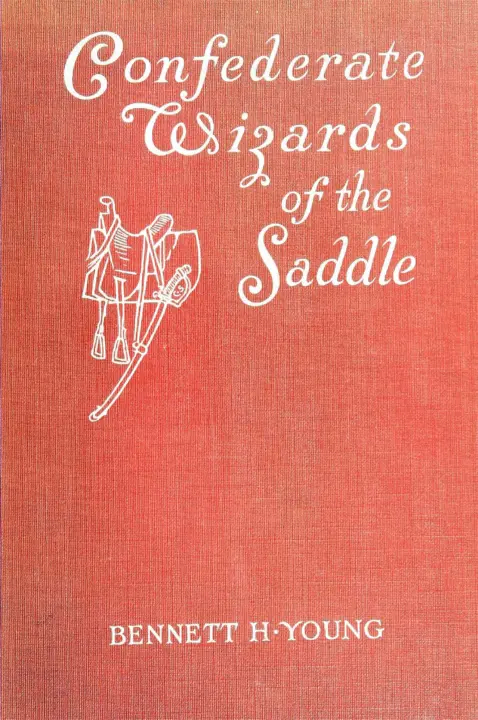
"Confederate Wizards of the Saddle" by Bennett H. Young is a historical account written in the early 20th century. The book provides a detailed narrative of significant cavalry operations during the American Civil War, particularly focusing on Confederate leaders like Nathan Bedford Forrest, John H. Morgan, and their daring raids and battles. Young, who participated in the conflict, aims to highlight the heroes of the Confederate cavalry and their remarkable endurance, skill, and bravery amidst the challenges they faced. At the start of the work, the author discusses the severe conditions of warfare during the spring and summer of 1864, detailing significant military movements and the valor of Confederate cavalry. Young sets the stage by referencing various battles and leaders, emphasizing the unique role that cavalry played in shaping military strategy during the war. The opening focuses on the Battle of Bryce’s Cross Roads, showcasing Forrest's tactical brilliance against overwhelming odds, particularly his ability to inspire and lead his troops effectively in a critical engagement against Federal forces. Through vivid descriptions and personal anecdotes, Young establishes the book as both a tribute and a historical recounting of the Confederate cavalry's contributions.
Introduction adapted from the source catalogue; source summaries may be automatically generated.
Free to read · English · 177,777 words · No account needed
MAKE TIME FOR A GOOD BOOK
On by default. Untick to stop anonymous reading totals. Each page counts after 10 seconds in view. How this works.
Anonymous counting is on unless you have switched it off.
October and November, 1864, covered the most successful and aggressive period of General Forrest’s remarkable exploits. Volumes could be written describing the details of his marvellous marches and his almost indescribable triumphs with the means and men at his command. From August 23rd to October 15th, 1864, his capture of Athens, Alabama, the expedition into middle Tennessee, the destruction of the Tennessee and Alabama railway, the capture of Huntsville, destruction of the Sulphur trestles, the battle at Eastport, had presented an array of experiences and won victories enough to make him and his men heroes for the years to come. Within these fifty-three days the actual and incidental losses inflicted upon the Federals cannot be fully estimated. He had killed and captured thirty-five hundred men and officers of the Federal Army, added nine hundred head of horses to his equipment, captured more than one hundred and twenty head of cattle, one hundred wagons and their supplies, and possessed himself of three thousand stand of small arms and stores for his commissary ordnance and medical supplies, which made glad the hearts of his hungry, ill-clad and debilitated followers.
Six long truss bridges had fallen before his relentless destroyers, one hundred miles of railroad had been completely wrecked, two locomotives, with fifty freight cars, had been demolished, thousands of feet of railway trestles, some of sixty feet in height, had been hewn down and given over to flames, to say naught of hundreds of thousands of other property essential to Federal occupation. He had caught up one thousand men in Middle Tennessee for his own command and enabled six hundred men who had either straggled or been cut off from General Wheeler when he had raided the same territory a short while before to come out to the commands. It had cost Forrest three hundred men and officers, killed or wounded. Some of his bravest and best had died on the expedition. Many of them were men whose places could now never be filled, but according to the economics of war, the price paid was not too great for the results obtained. He had traversed over five hundred miles and left a savagely marked trail of ravage and destruction wherever he had come. Not a day was without some sort of contact with the enemy, and every hour was full of danger and peril, demanding ceaseless vigilance and wariest care. On January 13th, 1864, a new Department styled “Forrest’s Cavalry Department” was organized out of West Tennessee and Northern Mississippi. Hardly had the new year been ushered in when the Federal Government, with ten thousand well-equipped and well-drilled cavalry, undertook to force a way down from Memphis to Meridian, taking in some of the Confederate strongholds like Pontotoc, Okolona, Columbus Junction and Macon, a distance of two hundred and fifty miles, to end at Macon. General Sherman was to move from Vicksburg with an army of twenty thousand troops. Co-operation of the cavalry was deemed of the greatest importance. To lead these horsemen, William Sooy Smith, not only a great engineer, but a successful soldier, was placed in command. Telegraphic communication had been opened between Vicksburg and Memphis, so that it was hoped these forces, thus co-operating, might keep in touch with each other. General Sherman made good his march to Meridian, playing havoc with railroad connections and other property in Mississippi. General Smith however failed to keep his engagement. He had been delayed in starting, until the 11th of February, from his rendezvous, Colliers Station, twenty-five miles southeastward from Memphis. He waited here for Colonel George E. Waring, who had been instructed to come from Columbus, Kentucky, with another brigade, under orders to unite with General Smith. Waring left Columbus with several thousand cavalry, and with the best arms of that period, and what was considered at that time amongst the most thoroughly furnished cavalry forces that had ever gone from the Federal lines. General Smith had informed General Sherman that Forrest would strike him somewhere in Northern Mississippi between Cold and Tallahatchee Rivers. After his invasion of West Tennessee, General Forrest had been enabled to get together four brigades under General Richardson, Colonel McCullough, General Tyree H. Bell and General Forrest’s brother, Jeffrey E. Forrest. The Confederates were not inactive, and they prepared to offer strongest resistance to General Smith. The State Militia, under General Gholson, were brought into line. Smith marched for several days unhindered, and the absence of Confederate forces impressed him that it would not be long before he would come in contact with Forrest. Northwestern Mississippi was a great prairie country, producing the most grain of any section of the Southwest. When the Federals reached West Point, Mississippi, there were unmistakable signs of battle. There General Smith learned that three Forrests were about, General Nathan Bedford, Colonel Jeffrey E., and Captain William, and investigation disclosed that the number of men with Forrest was about two thousand. General Smith had now traveled half way from Memphis to Meridian, and Sherman was waiting and watching for Smith’s coming. General Forrest had studiously circulated reports magnifying the number of men under his command. By the 21st of February, Smith felt that the impending blow was about to fall. He hesitated and was lost. He turned back, and Forrest’s hour of advantage had come. Colonel Waring in his book, “Whip and Spur,” of this moment speaks as follows: “No sooner had we turned tail than Forrest saw his time had come, and he pressed us seriously all day and until nightfall.” The retrograde movement was just commenced when Jeffrey Forrest’s orders were to fall in after Captain Tyler’s battalion and to assail the Federal rear at every chance. Pursuit was vigorous and active, and General Smith’s retreat became almost a stampede. It was in one of these charges that Colonel Jeffrey E. Forrest, commanding a brigade, the younger brother of General Forrest, was killed. For over sixty miles, night and day, a relentless pursuit was kept up. Forrest had four thousand men that were new troops. A majority of them had seen service less than six weeks. They were hardy men but mostly untrained soldiers, but they prided themselves that they were the equals of any veterans.
Your reading position is saved on this browser. Take it to another device with a library code. Reading pages adapt to text, rather than matching a printed edition.
BEHIND THE BOOK
This eBook is for the use of anyone anywhere in the United States and most other parts of the world at no cost and with almost no restrictions whatsoever. You may copy it, give it away or re-use it under the terms of the Project Gutenberg License included with this eBook or online at www.gutenberg.org. If you are not located in the United States, you will have to check the laws of the country where you are located before using this eBook. Read the source licence.
The original source file, including credits and licence, is retained by this library. Request an original-format copy at no charge. Please include the book title and Project Gutenberg identifier #70204.
KEEP YOUR CURIOSITY GOING
Cécile Tormay

Moritz Busch
John L. Ransom
Frances Wright
Cécile Tormay

Mabel Potter Daggett