THE CLASSIC COLLECTION✦Ralph Waldo Emerson, philosopher and seerCLASSIC FREE BOOKS
Ralph Waldo Emerson, philosopher and seer
Amos Bronson Alcott
THE CLASSIC COLLECTION · 1872
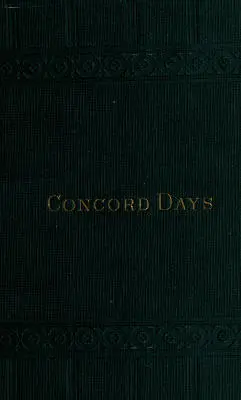
"Concord Days" by A. Bronson Alcott is a reflective literary work written in the late 19th century. This text is primarily a collection of personal essays and observations, drawing from Alcott's experiences and insights as a philosopher, educator, and friend of notable contemporaries such as Henry David Thoreau and Ralph Waldo Emerson. The work seems to explore themes of nature, self-identity, domestic life, and intellectual discourse within the context of Concord, Massachusetts, blending biography, philosophy, and social commentary. At the start of "Concord Days," readers are introduced to Alcott's contemplative world through a series of diary entries documenting his daily life, thoughts on home, and interactions with neighbors and friends. The opening portrays Alcott's appreciation for his surroundings and his home, emphasizing its historical significance and picturesque qualities. He reflects on the nature of his work and the importance of capturing life in writing, while also detailing the beauty of the landscape and the characters who inhabit it. As he expresses his admiration for his contemporaries, particularly Thoreau, Alcott sets the stage for a deeper exploration of philosophical ideas and the human experience in relation to nature.
Introduction adapted from the source catalogue; source summaries may be automatically generated.
Free to read · English · 65,423 words · No account needed
MAKE TIME FOR A GOOD BOOK
On by default. Untick to stop anonymous reading totals. Each page counts after 10 seconds in view. How this works.
Anonymous counting is on unless you have switched it off.
SAMUEL T. (spoke). I was most interested in this verse: "He that drinks of this water shall thirst again, but he that drinks of the water that I shall give him, shall never thirst." He means by this, that those who heard what he taught, and did it, should live always, should never die, their spirits should never die.
MR. ALCOTT. Can spirits die?
SAMUEL T. For a spirit to die is to leave off being good.
EDWARD J. I was interested in the words, "For the water I shall give him will be in him a well of water." I think it means that when people are good and getting better, it is like water springing up always. They have more and more goodness.
SAMUEL R. Water is an emblem of holiness.
MR. ALCOTT. Water means spirit, pure and unsoiled.
EDWARD J. It is holy spirit.
ELLEN. I was most interested in these words: "Ye worship ye know not what." The Samaritans worship idols, and there was no meaning to that.
MR. ALCOTT. What do you mean by their worshipping idols?
ELLEN. They cared about things more than God.
MR. ALCOTT. What kind of false worship do you think Jesus was thinking about when he said: "Woman, the hour is coming and now is, when neither in this mountain--"?
ELLEN. Oh! she thought the place of worship was more important than the
worship itself.
MR. ALCOTT. Well! how did Jesus answer that thought?
ELLEN. He told her what she ought to worship, which was more important
than where.
MR. ALCOTT. Some of you, perhaps, have made this mistake, and thought that we only worshipped God in churches, and on Sundays. How is it,--who has thought so?
(Several held up hands, smiling.)
Who knew that we could worship God anywhere?
(Others held up hands.)
What other worship is there besides that in the church?
EDWARD J. The worship in our hearts.
MR. ALCOTT. How is that carried on?
EDWARD J. By being good.
NATHAN. We worship God by growing better.
AUGUSTINE. We worship God when we repent of doing wrong.
JOSIAH. I was most interested in this verse: "God is a spirit, and they that worship him must worship him in spirit and in truth." It means that to feel our prayers is more important than to say the words.
LEMUEL. And when we pray and pray sincerely.
MR. ALCOTT. What is praying sincerely?
LEMUEL. Praying the truth.
MR. ALCOTT. What is to be done in praying the truth? When you think of prayer, do you think of a position of the body--of words?
LEMUEL (earnestly). I think of something else, but I cannot express
it.
Your reading position is saved on this browser. Take it to another device with a library code. Reading pages adapt to text, rather than matching a printed edition.
BEHIND THE BOOK
This eBook is for the use of anyone anywhere in the United States and most other parts of the world at no cost and with almost no restrictions whatsoever. You may copy it, give it away or re-use it under the terms of the Project Gutenberg License included with this eBook or online at www.gutenberg.org. If you are not located in the United States, you will have to check the laws of the country where you are located before using this eBook. Read the source licence.
The original source file, including credits and licence, is retained by this library. Request an original-format copy at no charge. Please include the book title and Project Gutenberg identifier #46209.
KEEP YOUR CURIOSITY GOING

David Patterson (Spirit) Hatch

David Patterson (Spirit) Hatch

David Patterson (Spirit) Hatch
Coulson Kernahan

Ralph Waldo Emerson

Maurice Baring