THE CLASSIC COLLECTION✦Ralph Waldo Emerson, philosopher and seerCLASSIC FREE BOOKS
Ralph Waldo Emerson, philosopher and seer
Amos Bronson Alcott
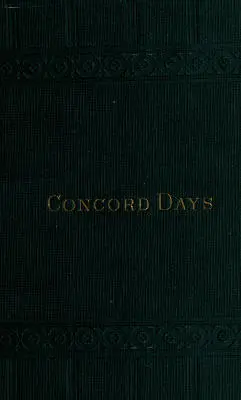
THE CLASSIC COLLECTION · 1872
"Concord Days" by A. Bronson Alcott is a reflective literary work written in the late 19th century. This text is primarily a collection of personal essays and observations, drawing from Alcott's experiences and insights as a philosopher, educator, and friend of notable contemporaries such as Henry David Thoreau and Ralph Waldo Emerson. The work seems to explore themes of nature, self-identity, domestic life, and intellectual discourse within the context of Concord, Massachusetts, blending biography, philosophy, and social commentary. At the start of "Concord Days," readers are introduced to Alcott's contemplative world through a series of diary entries documenting his daily life, thoughts on home, and interactions with neighbors and friends. The opening portrays Alcott's appreciation for his surroundings and his home, emphasizing its historical significance and picturesque qualities. He reflects on the nature of his work and the importance of capturing life in writing, while also detailing the beauty of the landscape and the characters who inhabit it. As he expresses his admiration for his contemporaries, particularly Thoreau, Alcott sets the stage for a deeper exploration of philosophical ideas and the human experience in relation to nature.
Introduction adapted from the source catalogue; source summaries may be automatically generated.
Free to read · English · 65,423 words · No account needed
MAKE TIME FOR A GOOD BOOK
On by default. Untick to stop anonymous reading totals. Each page counts after 10 seconds in view. How this works.
Anonymous counting is on unless you have switched it off.
"I asked the heavens, sun, moon and stars; but they
Said, 'We obey
The God thou seek'st.' I asked what eye or ear
Could see or hear;
What in the world I might descry or know
Above, below?
With an unanimous voice, all these things said,
'We are not God, but we by Him were made.'
"I asked the world's great universal mass
If that God was?
Which with a mighty and strong voice replied
As stupefied,
'I am not He, O man! for know that I
By Him on high
Was fashioned first of nothing, thus inflated,
And swayed by Him by whom I was created.'
"I sought the court, but smooth-tongued flattery there
Deceived each ear:
In the thronged city there was selling, buying,
Swearing and lying,--
In the country, craft in simpleness arrayed;
And then I said,
'Vain is my search, although my pains be great,
Where my God is there can be no deceit.'
"A scrutiny within myself I then
Even thus began:
'O man, what art thou?' What more could I say,
Than dust and clay?
Frail mortal, fading, a mere puff, a blast
That cannot last,--
Enthroned to-day, to-morrow in an urn,
Formed from that earth to which I must return.
"I asked myself, what this great God might be
That fashioned me?
I answered, the all-potent, solely immense,
Surpassing sense,
Unspeakable, inscrutable, eternal,
Lord over all;
The only terrible, strong, just and true,
Who hath no end, and no beginning knew.
"He is the well of life, for He doth give
To all that live
Both breath and being; he is the Creator
Both of the water,
Earth, air and fire; of all things that subsist,
He hath the list;
Of all the heavenly host, or what earth claims,
He keeps the scroll, and calls them by their names.
"And now, my God, by thine illumining grace,
Thy glorious face
(So far forth as it may discovered be)
Methinks I see;
And though invisible and infinite
To human sight,
Thou in thy mercy, justice, truth, appearest,
In which to our weak senses thou com'st nearest.
"O, make us apt to seek and quick to find
Thou God most kind!
Give us love, hope, and faith in thee to trust,
Thou God most just!
Remit all our offences, we entreat,
Most Good, most Great!
Grant that our willing, though unworthy quest,
May through thy grace admit us 'mongst the blest."
By A. BRONSON ALCOTT.
Your reading position is saved on this browser. Take it to another device with a library code. Reading pages adapt to text, rather than matching a printed edition.
BEHIND THE BOOK
This eBook is for the use of anyone anywhere in the United States and most other parts of the world at no cost and with almost no restrictions whatsoever. You may copy it, give it away or re-use it under the terms of the Project Gutenberg License included with this eBook or online at www.gutenberg.org. If you are not located in the United States, you will have to check the laws of the country where you are located before using this eBook. Read the source licence.
The original source file, including credits and licence, is retained by this library. Request an original-format copy at no charge. Please include the book title and Project Gutenberg identifier #46209.
KEEP YOUR CURIOSITY GOING

David Patterson (Spirit) Hatch

David Patterson (Spirit) Hatch

David Patterson (Spirit) Hatch
Coulson Kernahan

Ralph Waldo Emerson

Maurice Baring