
Ten Degrees Backward
Ellen Thorneycroft Fowler
THE CLASSIC COLLECTION · 1898
"Concerning Isabel Carnaby" by Ellen Thorneycroft Fowler is a novel written in the late 19th century. The story is set in a quaint old town called Chayford and primarily revolves around the Seaton family, particularly the lives of siblings Paul and Joanna, as well as their interactions with Alice Martin and Edgar Ford. The narrative explores themes of love, ambition, societal expectations, and the complexities of human relationships through its characters, each navigating their own paths and struggles. The opening of the book introduces us to the Seaton family, particularly with emphasis on their parents, the Reverend Mark Seaton and his wife Ruth, as well as their children, Paul and Joanna. It paints a vivid picture of their upbringing influenced by Methodism and discusses the duality of their lives: Paul, ambitious and set on succeeding at Oxford, versus Joanna, who is more reflective and earnest about her duties and desires. The dynamics of their friendships, especially with Alice Martin—who harbors feelings for Paul—are also established early on, setting the stage for evolving relationships that intertwine ambition, unrequited love, and the expectations placed upon them by their families and society.
Introduction adapted from the source catalogue; source summaries may be automatically generated.
Free to read · English · 103,240 words · No account needed
MAKE TIME FOR A GOOD BOOK
On by default. Untick to stop anonymous reading totals. Each page counts after 10 seconds in view. How this works.
Anonymous counting is on unless you have switched it off.
"I am afraid we must all be content with the second best in this
world," remarked Mrs. Seaton.
"Yes," added Isabel, "like the man who said that as perfection in female beauty did not exist, he was looking out for a wife who could cook a potato properly."
"Certainly half a loaf is better than no bread," suggested Paul.
Edgar shook his head. "As long as people are content with half loaves they will never get whole ones."
"First let them be sure that they want whole ones," suggested Mr.
Madderley.
"Exactly," cried Mrs. Stoneley. "People spend half their lives
crying for things which would make them cry still more if they got
them."
"Whole loaves would be very fattening, in the first place," continued the artist, "nothing would induce me to take one."
"Are you afraid of getting fat?" inquired Isabel, "I never think of
it."
"This dread is the one cloud on my horizon, dear lady, the one discord in my life's harmony. You happy thin people do not know what troubles flesh is heir to, nor what fears."
"Do you think bread so dangerous?" asked Isabel.
"The most fattening thing in the world. I had a friend who said he once inadvertently asked for bread, and he gained a stone in a week."
Isabel laughed. "Then let us be content with only half a loaf; and, if we value our figures, we had better have that toasted."
"Contentment is often only a euphemism for cowardice," said Edgar.
"I am afraid S. Paul did not agree with you," remarked Mr. Seaton.
Edgar smiled; one of the reasons why he was so lovable was that he never lost his temper nor turned rusty in an argument. "S. Paul added godliness to the prescription, however, before he recommended it for general use," he said pleasantly.
Mr. Seaton laughed.
"It seems to me," continued Edgar, "that to bind oneself down to follow any particular party through thick and thin, is to do despite to one's own individuality."
"You know nothing at all about it," exclaimed his father.
The rector looked serious. "Individualism carried to excess soon
becomes rebellion."
"Nevertheless," persisted Edgar, "it is one's duty to do what we think right, regardless of results. We know what was said of them who did evil that good might come; now we are afraid to do good lest evil may come, and I think that our condemnation is as just as theirs."
"I should be sorry to lead a party composed entirely of Edgars," Paul remarked, "there would be a regular Giants' Causeway of rocks ahead."
Mr. Ford nodded. Paul's straightforward common sense always appealed
to him.
Your reading position is saved on this browser. Take it to another device with a library code. Reading pages adapt to text, rather than matching a printed edition.
Ellen Thorneycroft Fowler
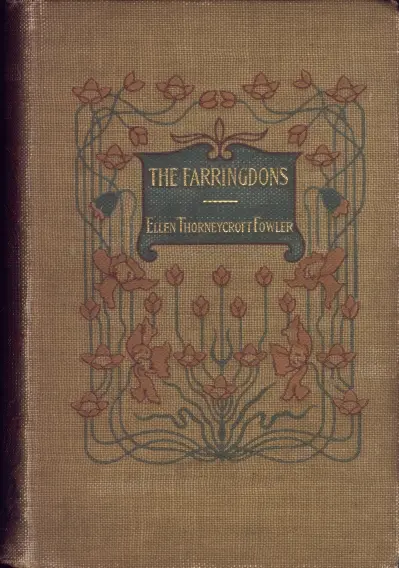
Ellen Thorneycroft Fowler
BEHIND THE BOOK
This eBook is for the use of anyone anywhere in the United States and most other parts of the world at no cost and with almost no restrictions whatsoever. You may copy it, give it away or re-use it under the terms of the Project Gutenberg License included with this eBook or online at www.gutenberg.org. If you are not located in the United States, you will have to check the laws of the country where you are located before using this eBook. Read the source licence.
The original source file, including credits and licence, is retained by this library. Request an original-format copy at no charge. Please include the book title and Project Gutenberg identifier #74380.
KEEP YOUR CURIOSITY GOING
Coulson Kernahan

Maurice Baring
Frances Wright
Cécile Tormay

Frederic Jesup Stimson

W. H. P. (William Henry Pope) Jarvis