
Ten Degrees Backward
Ellen Thorneycroft Fowler
THE CLASSIC COLLECTION · 1898
"Concerning Isabel Carnaby" by Ellen Thorneycroft Fowler is a novel written in the late 19th century. The story is set in a quaint old town called Chayford and primarily revolves around the Seaton family, particularly the lives of siblings Paul and Joanna, as well as their interactions with Alice Martin and Edgar Ford. The narrative explores themes of love, ambition, societal expectations, and the complexities of human relationships through its characters, each navigating their own paths and struggles. The opening of the book introduces us to the Seaton family, particularly with emphasis on their parents, the Reverend Mark Seaton and his wife Ruth, as well as their children, Paul and Joanna. It paints a vivid picture of their upbringing influenced by Methodism and discusses the duality of their lives: Paul, ambitious and set on succeeding at Oxford, versus Joanna, who is more reflective and earnest about her duties and desires. The dynamics of their friendships, especially with Alice Martin—who harbors feelings for Paul—are also established early on, setting the stage for evolving relationships that intertwine ambition, unrequited love, and the expectations placed upon them by their families and society.
Introduction adapted from the source catalogue; source summaries may be automatically generated.
Free to read · English · 103,240 words · No account needed
MAKE TIME FOR A GOOD BOOK
On by default. Untick to stop anonymous reading totals. Each page counts after 10 seconds in view. How this works.
Anonymous counting is on unless you have switched it off.
"Then you will have to quarrel with the rector too, and I will help you," remarked Mrs. Stoneley, "although I have been a devoted wife to him for forty years, he quarrels regularly with me every Academy because I like looking at pictures that he says are without perspective."
"I know the sort," cried Isabel, "dear little scriptural things, like tame and domestic church-windows."
"It is just like men to bother about perspective," added Mrs. Stoneley, "they are so literal, poor dears! that it is not safe to leave anything to their imaginations. Besides you cannot leave anything to something which does not exist."
The rector smiled. "Pardon me, my love, this consideration never hinders me from leaving many things to your discretion."
"Well, Henry, you never heard me fussing about perspective, whatever
else I may have done."
"Certainly not, my love; a desire for perspective presupposes a sense
of proportion."
"Never mind him, Miss Carnaby," said his wife; "you and I will go to the Academy together, and leave him at home to study perspective from the rectory windows."
The rector turned to Edgar. "I think that the idea of duty to one's own conscience is growing to abnormal proportions, and is in great danger of degenerating into a morbid and unhealthy egotism. As far as my experience goes, if a man fulfils his duty towards God and his duty towards his neighbour, he will not have much time left for works of supererogation."
"But are not one's duty towards God and one's duty towards one's own conscience synonymous?" asked Edgar.
Mr. Stoneley thought for a moment. "Not necessarily, I should say. One's duty towards God is clearly defined in our good old Church catechism; but one's duty towards one's own conscience is an elastic term, which may include anything from religious persecution to anti-vaccination."
Mr. Ford chuckled approvingly. "Quite true!"
"As a distinguished politician once said: 'Politics is the science of the second best,'" remarked Paul, "therefore we must recognize the truth that in political strife we can only approximately approach an ideal."
"Precisely," agreed his host, "everything in this world is a matter
of compromise."
"I cannot admit that," cried Edgar with eagerness; "to me, compromise is a detestable word. It is our business to aim at perfection, and to be satisfied with nothing less. The fact that we may fail in our endeavour to attain our ideal, in no way lessens our obligation to follow after it."
"But the danger is," said his mother, "that if we go in for perfection or nothing, we shall in all probability get nothing."
Your reading position is saved on this browser. Take it to another device with a library code. Reading pages adapt to text, rather than matching a printed edition.
Ellen Thorneycroft Fowler
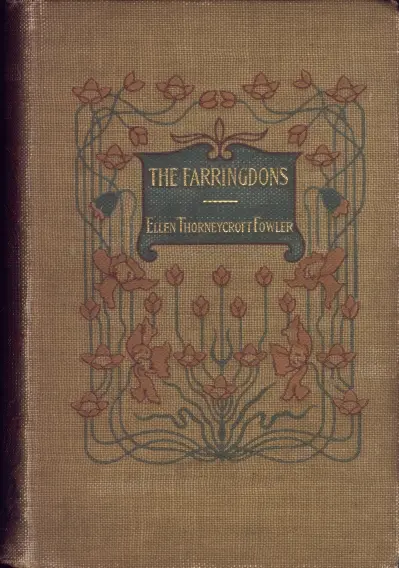
Ellen Thorneycroft Fowler
BEHIND THE BOOK
This eBook is for the use of anyone anywhere in the United States and most other parts of the world at no cost and with almost no restrictions whatsoever. You may copy it, give it away or re-use it under the terms of the Project Gutenberg License included with this eBook or online at www.gutenberg.org. If you are not located in the United States, you will have to check the laws of the country where you are located before using this eBook. Read the source licence.
The original source file, including credits and licence, is retained by this library. Request an original-format copy at no charge. Please include the book title and Project Gutenberg identifier #74380.
KEEP YOUR CURIOSITY GOING
Coulson Kernahan

Maurice Baring
Frances Wright
Cécile Tormay

Frederic Jesup Stimson

W. H. P. (William Henry Pope) Jarvis