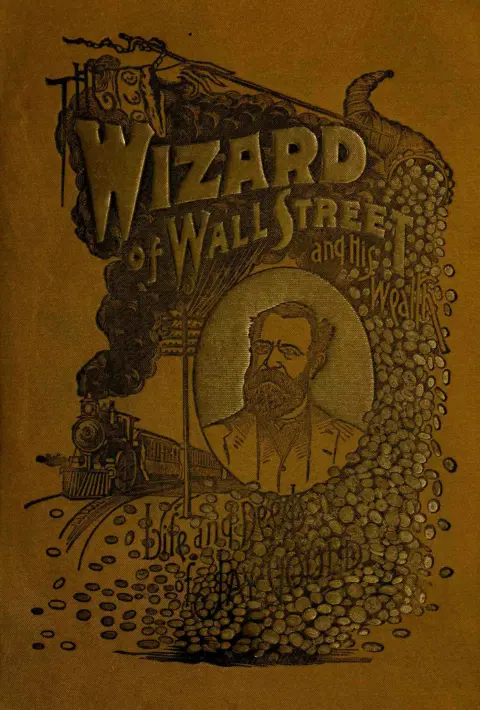
The Wizard of Wall Street and His Wealth; or, The Life and Deeds of Jay Gould
Trumbull White
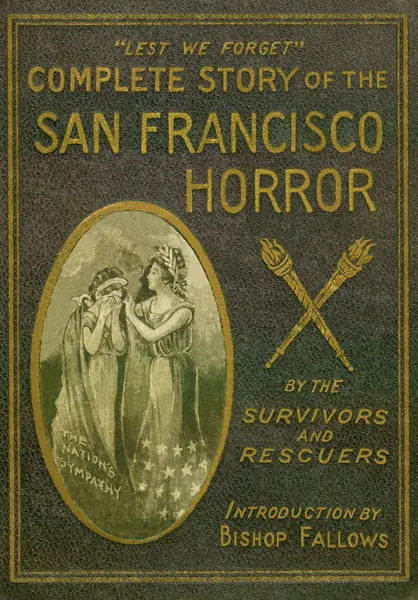
THE CLASSIC COLLECTION · 1906
"Complete Story of the San Francisco Horror" by Linthicum, Fallows, and White is a historical account written in the early 20th century. The book chronicles the devastating events surrounding the San Francisco earthquake of 1906 and the subsequent fire that ravaged the city. It reveals the scale of destruction, the loss of life, and the efforts made by survivors and authorities to deal with the aftermath of this tragic disaster, making it a compelling read for those interested in history or natural calamities. The opening of the work provides a detailed introduction to the catastrophe, describing the earthquake that struck San Francisco in the early hours of April 18, 1906. It paints a vivid picture of panic as buildings collapsed, water mains broke, and fires erupted throughout the city. Survivors faced terrifying scenes amidst the chaos, including the desperate attempts of firefighters who, unable to find water, resorted to using dynamite to control the raging inferno. As the days of destruction unfolded, the narrative evokes the suffering of thousands left homeless and the gallant efforts of rescuers, illustrating both the horrors and the heroism exhibited during one of America’s greatest disasters.
Introduction adapted from the source catalogue; source summaries may be automatically generated.
Free to read · English · 115,284 words · No account needed
MAKE TIME FOR A GOOD BOOK
On by default. Untick to stop anonymous reading totals. Each page counts after 10 seconds in view. How this works.
Anonymous counting is on unless you have switched it off.
=California's Magnificent Educational Institution, the Pride of the State, Wrecked by Quake--Founded by the Late Senator Leland Stanford as a Memorial to His Son and Namesake--Loss $3,000,000.=
One of the most deplorable features of the great California calamity was the destruction of the Leland Stanford, Jr., University, situated at Palo Alto.
The magnificent buildings, including a beautiful memorial hall erected by Mrs. Stanford to the memory of her husband and son, were practically wrecked.
Leland Stanford University was one of the most richly endowed, most architecturally beautiful, and best equipped institutions of learning in the world. Mrs. Jane Stanford, widow of the school's founder, in 1901 gave it outright $30,000,000--$18,000,000 in gilt edged bonds and securities and $12,000,000 in an aggregate of 100,000 acres of land in twenty-six counties in California. This, with what the university had received from Leland Stanford himself, made its endowment the enormous sum of $34,000,000 besides its original capital, and on the death of Mrs. Stanford this was raised to $36,000,000.
In a way the real founder of the university was a young boy, Leland Stanford, Jr. On his death bed he was asked by his parents what he would like them to do with the vast fortune which would have been his had he lived. He replied he would like them to found a great university where young men and women without means could get an education, "for," he added, "that is what I intended all along to do before I knew I was going to die."
The dying wish was carried out.
The foundation stone was laid on the nineteenth anniversary of the boy's birth, and in a few years there sprang into existence at Palo Alto, about thirty-three miles southeast of San Francisco, the "Leland Stanford University for Both Sexes," with the colleges, schools, seminaries of learning, mechanical institutes, museums, galleries of art, and all other things necessary and appropriate to a university of high degree, with the avowed object of "qualifying students for personal success and direct usefulness in life."
The architecture was a modification of the Moorish and Romanesque, with yet a strong blending of the picturesque mission type, which has come down from the early days of Spanish settlement in California. Driving up the avenue of palms from the university entrance to the quadrangle, one was faced by the massive, majestic memorial arch. Augustus St. Gaudens, the great sculptor, embodied his noblest conceptions in the magnificent frieze which adorned the arch.
However beautiful the other buildings, they were easily surpassed by
the marvelous Memorial Church, which was built at a cost of
$1,000,000.
Your reading position is saved on this browser. Take it to another device with a library code. Reading pages adapt to text, rather than matching a printed edition.
Trumbull White
Samuel Fallows
Trumbull White
BEHIND THE BOOK
This eBook is for the use of anyone anywhere in the United States and most other parts of the world at no cost and with almost no restrictions whatsoever. You may copy it, give it away or re-use it under the terms of the Project Gutenberg License included with this eBook or online at www.gutenberg.org. If you are not located in the United States, you will have to check the laws of the country where you are located before using this eBook. Read the source licence.
The original source file, including credits and licence, is retained by this library. Request an original-format copy at no charge. Please include the book title and Project Gutenberg identifier #26380.
KEEP YOUR CURIOSITY GOING
Cécile Tormay

Moritz Busch
John L. Ransom
Frances Wright
Cécile Tormay

Mabel Potter Daggett